


Demolishing temporary and dilapidated houses - a gesture of solidarity and national unity - Photo: VGP/Son Hao
Internal difficulties of the beneficiary household
To promptly provide homes for families facing housing difficulties, local authorities at all levels have proactively addressed land-related issues and allocated land for housing to eliminate temporary and dilapidated houses. Many households have voluntarily donated land to join hands with local authorities in building "three-solid" houses across the country.
However, there are some obstacles that are not easy to overcome during the implementation process, especially regarding matching funds from households eligible for the policy to eliminate temporary and dilapidated houses. This is because, for poor households and those with particularly difficult circumstances, ensuring sufficient income to cover daily living expenses is already challenging, so arranging a large matching fund for house construction is a difficult problem to solve without support from organizations and individuals.
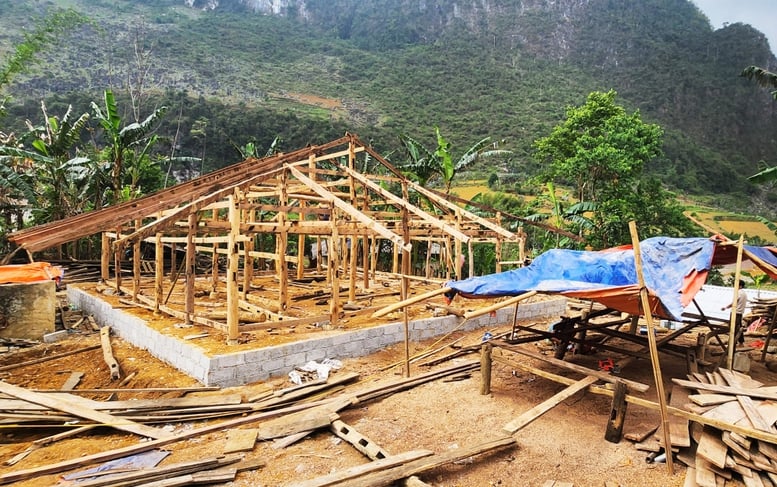
The program to eliminate temporary and dilapidated houses helps poor people in Cao Bang province have sturdy housing and a stable life.
For many years, the entire family of six, including Mr. Nong Van Long, in Na Nhu hamlet, Dan Chu commune (Hoa An district, Cao Bang province), lived in a makeshift tent house. At the beginning of 2025, his family was included in the list of those eligible for support to eliminate temporary and dilapidated houses. However, due to the inability to secure matching funds, the demolition of Mr. Long's house has not yet been implemented.
By early June, the Political Affairs Department of the Cao Bang Provincial Police, in coordination with a charitable organization in Hanoi and the Hanoi Youth Volunteer Association, donated 21 million VND to Mr. Long's family. Along with support from the state budget, construction of a sturdy house was begun, realizing Mr. Long's dream of having a home of his own.
It's not just Mr. Long's family; many other poor households and those with particularly difficult circumstances across the country, despite their urgent need for housing, are unable to secure the necessary matching funds. Although the program to eliminate temporary and dilapidated houses has received support from organizations, individuals, and the entire society, there are still many families who struggle to raise the matching funds to build "solid" houses when they are struggling to make ends meet.
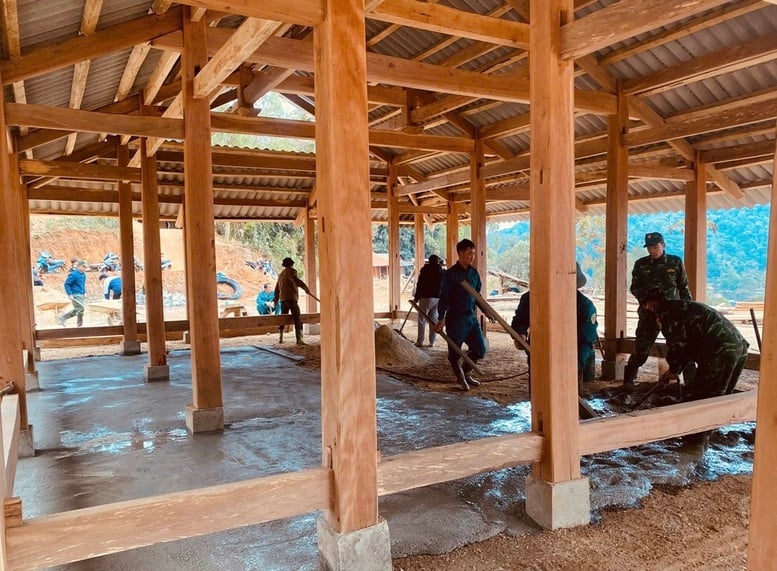
The Border Guard of Son La province is assisting people in border areas to build sturdy houses, contributing to improving their living standards and ensuring security in the region.
For poor households, especially those belonging to ethnic minorities living in remote areas, improving income remains a difficult problem to solve. Unstable income, coupled with a large number of dependents to be considered for "family allowance deductions," makes it very difficult for many households to escape poverty.
The results of the 2024 survey and review of poor and near-poor households (published in Decision No. 217/QD-BLDTBXH dated February 4, 2025, of the former Ministry of Labor, War Invalids and Social Affairs) show that "Employment" and "Dependents in the household" are two indicators that increase pressure on the income of poor households. Accordingly, by the end of 2024, the whole country had 198,275 out of 599,608 poor households due to a shortfall in the "Employment" indicator; and 229,765 out of 599,608 poor households due to a shortfall in the "Dependents in the household" indicator.
Notably, the number of poor households due to deficiencies in the "Employment" and "Number of Dependents in the Household" indicators is mainly concentrated in areas with large ethnic minority populations. In the Northern Midlands and Mountains region alone, by the end of 2024, the entire region had 81,619 poor households due to a lack of "Employment" and 99,136 poor households due to a lack of "Number of Dependents in the Household" indicator, the highest among the six economic regions nationwide.
The difficulty in mobilizing matching funds for eligible households is one of the reasons why the work of eliminating temporary and dilapidated houses in many localities in the "core poverty" areas of the country still faces some challenges. As of June 14, 2025, according to updated data on the housing management software, 25 localities nationwide have completed the elimination of temporary and dilapidated houses, with only Son La province being a poor province that has "reached the finish line," while the localities that have completed the goal all have socio-economic conditions among the most developed in the country.

Mr. Phi Manh Thang, Director of the Legal Department - Ministry of Ethnic Minorities and Religions - Photo: VGP/Son Hao
Despite the challenges ahead, it must be affirmed that, with the determination of the entire political system and the joint efforts of the whole society, the progress in eliminating temporary and dilapidated houses is achieving the set goals. As of June 14, 2025, according to updated data from localities on the management software, the whole country has supported the elimination of 206,832 temporary and dilapidated houses. Of these, 155,501 have been completed and handed over, and 51,331 are under construction or have just started construction.
According to Mr. Phi Manh Thang, Director of the Legal Department of the Ministry of Ethnic Minorities and Religions, the permanent agency of the Central Steering Committee, it is expected that by June 30, 2025, approximately 40 localities will have "reached the finish line" in eliminating temporary and dilapidated houses. Currently, many localities have completed 95-97% of the work; even those with lower completion rates have finished over 80% of the temporary and dilapidated houses that need to be eliminated.
However, it should also be noted that, although the number of temporary and dilapidated houses needing demolition is now very small, these cases are not easy to implement due to many reasons, including resource issues and the matching funds of the policy beneficiaries. Meanwhile, according to Official Dispatch No. 84/CĐ-TTg dated June 8, 2025, the Prime Minister requested the basic completion of the goal of eliminating temporary and dilapidated houses nationwide before August 31, 2025; including housing support for relatives of martyrs and people with meritorious services to the revolution, to be completed before July 27, 2025.
Therefore, to achieve the goal of completely eliminating temporary and dilapidated houses nationwide before August 31, 2025, in Official Dispatch No. 84/CĐ-TTg dated June 8, 2025, the Prime Minister requested the Central Committee of the Vietnam Fatherland Front to direct political and social organizations and professional associations to mobilize youth, women, veterans, trade unions, etc., to contribute their efforts and resources in the spirit of "everyone contributes what they can, those who have labor contribute labor, those who have resources contribute resources, those who have much contribute much, those who have little contribute little".
This is a heartfelt appeal from the Head of Government, and also an administrative mandate for provinces and centrally-administered cities in their efforts to provide homes for their compatriots. In fact, driven by a strong sense of national solidarity and a spirit of "everyone helps in their own way," many localities have made what can be called extraordinary progress in eliminating temporary and dilapidated housing.

Ms. Vo Thi Minh Sinh, Deputy Secretary of the Provincial Party Committee, Chairwoman of the Vietnam Fatherland Front Committee, and Head of the National Assembly Delegation of Nghe An Province - Photo: VGP/Duong Tuan
For example, in Nghe An province, as shared by Ms. Vo Thi Minh Sinh, Deputy Secretary of the Provincial Party Committee, Chairwoman of the Fatherland Front Committee, Head of the National Assembly Delegation, and Deputy Head of the Steering Committee for the Eradication of Temporary and Dilapidated Houses in Nghe An Province, at the seminar "Shelter for the People: Extraordinary Efforts" organized by the Government's Electronic Information Portal on June 3, 2025, in the period from 2019-2022, over three years, Nghe An province mobilized and supported the construction of approximately 4,793 houses. However, in the period from 2022-2025, also within three years, the entire province has built 15,511 houses.
Mr. Phi Manh Thang, Director of the Legal Department of the Ministry of Ethnic Minorities and Religions, believes that the goal of eliminating temporary and dilapidated houses nationwide before August 31, 2025, is entirely feasible. According to Mr. Thang, one of the biggest difficulties faced by localities in the past was the lack of resources, but this has been resolved after the Prime Minister issued Official Dispatch No. 84/CĐ-TTg on June 8, 2025.
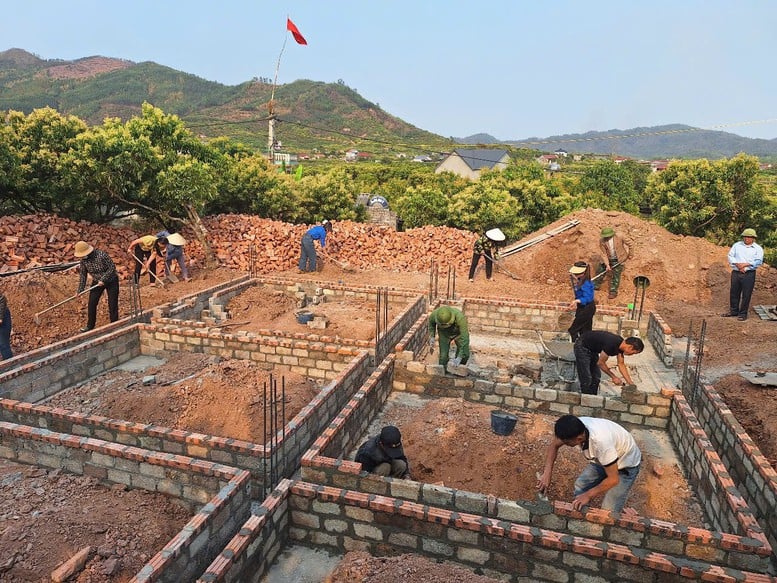
Local forces are helping people build houses as part of a program to eliminate temporary and dilapidated housing in Luc Ngan, Bac Giang.
Specifically, in the past, many localities struggled with mobilizing and balancing resources, especially the difference in funding (to reach the support level of 60 million VND for new construction and 30 million VND for repairs) for housing construction and repair under the two national target programs, as well as housing for war veterans and relatives of martyrs. This "bottleneck" has been resolved in Directive No. 84/CĐ-TTg, where the Prime Minister authorized the use of funds from the emulation movement to eliminate temporary housing, along with resources mobilized from central government-initiated programs.
According to Mr. Thang, for the group of people with meritorious service and relatives of martyrs (requiring the completion of the demolition of temporary and dilapidated houses before July 27, 2025), the Prime Minister has directed that, while waiting for the official support plan to be approved, localities are allowed to advance funds from their local budgets to immediately implement the construction and repair of houses.
"In cases where localities are truly facing difficulties, the Ministry of Finance will compile and submit a support plan before June 25, 2025. Thus, resources for the two main target groups – the poor and those who have rendered meritorious services – have been unlocked. This is a key factor in accelerating progress," Mr. Thang stated.
With decisive leadership from the Prime Minister, the involvement of ministries and agencies, and the strong determination of local authorities, we believe that the whole country will achieve the goal of eliminating temporary and dilapidated houses before August 31, 2025. This is a meaningful and practical milestone to celebrate the 80th anniversary of the successful August Revolution and the National Day of the Socialist Republic of Vietnam.
Lesson 3: After settling down comes establishing a career.
Son Hao
Source: https://baochinhphu.vn/bai-2-than-toc-hon-nua-de-ve-dich-truoc-han-10225061616181059.htm




































































































Comment (0)