


Drawing from the successful models of France and China, it is clear that to effectively develop digital heritage, each country needs to build a long-term vision along with specific strategic policies.
3D historical sites and virtual museums around the world.
Through a combination of art, technology, and preservation, France not only preserves the past but also reconstructs it. From the moment a medieval manuscript appears on a tablet screen to the image of a burned church recreated in virtual reality, the French believe that "cultural memory, once digitized, can be more enduring than stone."
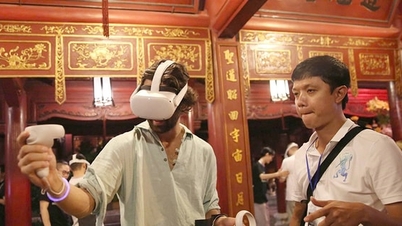
At the Palace of Versailles (France), visitors can wear virtual reality (VR) glasses to explore vanished rooms or destroyed structures. All the splendor and glory of the palace are reborn in the digital space. For France, digitizing heritage is not just a technological showcase but a strategy, in which each dataset and each model acts as a "shield" against loss, whether from fire, conflict, or the ravages of time.
Most museums have integrated interactive digital exhibitions, leveraging virtual reality (VR), augmented reality (AR), and mixed reality (MR) to provide visitors with a multi-dimensional experience. Advanced imaging technologies, 3D photogrammetry, and laser scanning enable accurate recording of artifacts and relics, facilitating virtual preservation for research and display purposes.
For example, the digital reconstruction of Notre Dame Cathedral in Paris after the 2019 fire used AI-powered 3D models to recreate intricate architectural details for conservation purposes. Similarly, the Louvre Museum's VR experience of the Mona Lisa allows viewers to explore the historical context of the artwork, combining storytelling with technology to engage a wide audience and enhance understanding.
In Asia, China has demonstrated a significant transformation in how museums preserve, manage, and present cultural heritage over the past decade. A recent systematic review of 119 institutions from 2014 to 2024 noted extensive advances in the integration of digital technologies , including immersive technologies, data systems, artificial intelligence, and interactive online platforms. The widespread application of virtual reality (VR), augmented reality (AR), and big data has created a significant transformative turning point in China's cultural landscape.
As early as 2003, the Forbidden City launched its first virtual reality experience, allowing visitors to "fly like birds" over the red-painted and golden-tiled roofs of the ancient complex. Currently, any visitor with an internet connection can explore the palace's exquisite chambers and admire impressive cultural artifacts online.
The fusion of technology and culture is breathing new life into China's millennia-old heritage, transforming those cultural values into a shared asset for all of humanity. As Liu Shuguang, Chairman of the China Museum Association, noted, museums can now act as "cultural diplomats," and digital transformation is a powerful tool for sharing China's cultural story with the world.

From archiving to algorithms in digital heritage
France currently boasts over 45,000 protected monuments and approximately 1,200 museums, many of which house works that are difficult to move or even impossible to display regularly. As digitalization enters the picture, France is leading a silent technological revolution: scanning, modeling, and archiving millions of artworks, manuscripts, and artifacts at the Louvre Museum, the French National Library (BnF), and the National Monuments Centre.
The Louvre Museum alone has digitized its entire collection of over 480,000 works in high-resolution online formats. BnF's Gallica platform also offers over 10 million documents, ranging from medieval manuscripts to Belle Époque posters, providing a rich metadata repository that can be searched, annotated, and linked together.
"Digitization is not just about expanding accessibility, but also about resilience. If we lose physical artifacts, we can still retain the knowledge," said Claire Leblanc, a digital archiving expert at the French National Centre for Scientific Research (CNRS).
In China, in collaboration with the technology giant Tencent, the Palace Museum in the Forbidden City (Beijing, China) has digitized approximately 100,000 artifacts using AI and cloud technology.
Interactive mobile applications have enabled users to zoom in on classical paintings up to 40 times their original size, revealing details invisible to the naked eye. These innovations have breathed new life into imperial history through digital technology, sparking renewed interest in traditional culture.
Furthermore, China is also promoting international cooperation programs in the conservation and development of digital heritage. For example, the "Digital Dunhuang" project at the UNESCO World Heritage site of Dunhuang has collaborated with the United States and Europe to refine conservation techniques.
This is a large-scale cultural heritage preservation initiative in China aimed at digitizing all the Mogao Caves, a UNESCO World Heritage site. Such collaborative efforts demonstrate that preserving ancient heritage can be a shared endeavor, transcending all borders.
Great appeal to the global public.
According to France Channel , the digitization of heritage has opened up opportunities for the public to access heritage previously confined to archives and elite institutions. A student in Dakar can now explore the Egyptian collection at the Louvre Museum (Paris, France); a conservationist in Tokyo can study a French Gothic chapel in 3D; an art lover in Paris or a student in Nairobi can take a virtual tour of the Forbidden City or learn about the unique ancient murals in the Mogao Caves as easily as a tourist living in Beijing or Gansu…
In 2021 alone, online exhibitions and training programs launched by Chinese museums attracted approximately 4.1 billion views. This nationwide effort reflects the Chinese government's commitment to innovating the way culture is presented and promoting these creative industries.
At the same time, it also meets the needs of a segment of the public that is increasingly familiar with digital technology and wishes to connect with the past through modern methods. These developments not only enhance the museum experience but have also become a "benchmark" for cultural institutions worldwide that are undergoing similar transformations.
Professor Wang Min of Wuhan University (China) stated that the combination of culture and technology in China not only benefits the country domestically but also spreads internationally. Digital platforms have helped make the nation's heritage more accessible to a global audience.
Drawing from the successful models of France and China, it is clear that to effectively develop digital heritage, each country needs to build a long-term vision along with specific strategic policies.
The future of digital heritage lies in the seamless integration of artificial intelligence (AI) with emerging technologies to create more vibrant, accessible, and sustainable cultural ecosystems. This will ensure the interoperability of national digital data on cultural heritage, while effectively meeting the needs of society and communities for accessing and using services anytime, anywhere.
(To be continued)
Source: https://baovanhoa.vn/van-hoa/bai-4-khi-da-so-hoa-co-the-ben-bi-hon-ca-da-227333.html

![[Image] Close-up view of the interchange connecting the two expressways and Long Thanh Airport.](https://vphoto.vietnam.vn/thumb/1200x675/vietnam/resource/IMAGE/2026/05/25/1779703378210_ndo_br_z7863716673926-224453a31600126cce10622af6290afd-4549-jpg.webp)


![[Image] Hanoi's urban life under the challenge of a "scorching hot" environment](https://vphoto.vietnam.vn/thumb/1200x675/vietnam/resource/IMAGE/2026/05/25/1779706979265_nang-nong-t5-2026-minh-duy-7-4636-jpg.webp)


















































































Comment (0)