

Statistics from the Vietnam Railways Corporation show that the problem of stone-throwing on railway tracks is on the rise. In the first six months of 2024 alone, there were 75 incidents of stones and dirt being thrown at trains, resulting in 79 broken windows on locomotives and carriages.
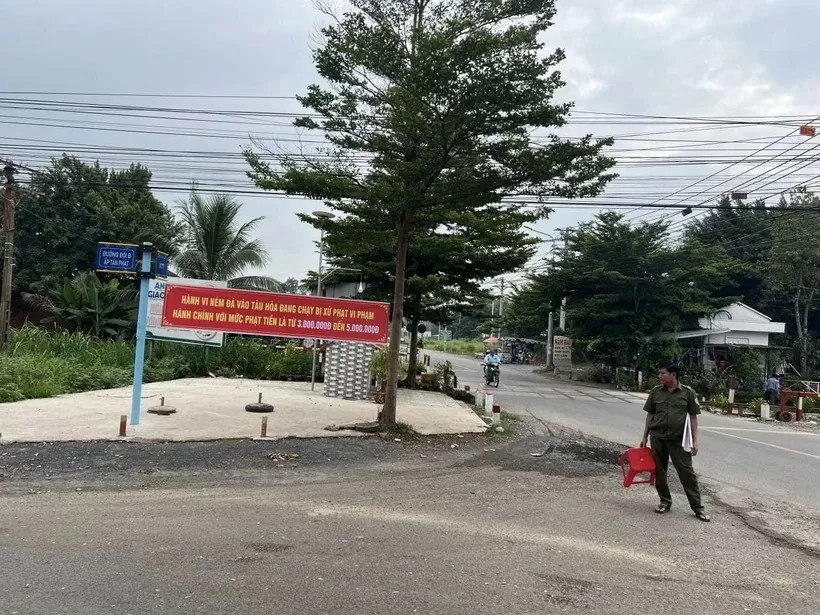 |
| Vietnam Railways Corporation has regularly publicized the harmful effects of throwing stones at trains. (Source: VNA) |
According to Vietnam Railways Corporation ( VNR ), at 11:55 PM on July 10, 2024, train H2705, traveling on the Hanoi – Lao Cai route, was passing through Mau Dong commune, Van Yen district, Yen Bai province when the co-driver, Nguyen Van Quan (53 years old), was suddenly hit in the head by stones thrown by local people, causing him to bleed profusely.
The main driver attempted to bring the train back to Mau Dong station at 10:04 AM on July 11th to take the victim to Mau A Hospital for emergency treatment. The train stopped at Mau Dong station for nearly two hours waiting for another assistant driver to replace him. The suspect was subsequently arrested by the police.
The public surely hasn't forgotten the sacrifice of Mr. Le Minh Phu, train driver of Team 1 (Operations Workshop, Da Nang Locomotive Factory). He was posthumously awarded the Medal of Courage by the President of Vietnam for performing his duty, saving lives and protecting state and people's property.
According to co-driver Ho Ngoc Hai, on the evening of March 10, 2015, the train was traveling at approximately 75 km/hour in the Quang Tri – Dien Sanh section. As it approached the level crossing at kilometer 639 + 750 (equipped with automatic warning lights), a large dump truck traveling in the same direction suddenly switched on its turn signal. The train driver repeatedly sounded the warning horn, but the truck did not stop and abruptly crossed the tracks.
At that moment, train driver Le Minh Phu shouted to the co-driver to find a safe place to escape, while he pulled the lever and applied the emergency brakes, but could not avoid a head-on collision with the dump truck. After the collision, three carriages adjacent to the locomotive were thrown off the tracks. Fortunately, all 583 passengers and 29 crew members on board were safe. However, train driver Phu was trapped in the locomotive cabin and died. The railway industry suffered losses of approximately 23 billion VND for repairing the locomotive, carriages, infrastructure, and transferring passengers.
Statistics from VNR show that the problem of stone-throwing at railway tracks is on the rise. In the first six months of 2024 alone, 75 incidents of stones and rocks being thrown at trains occurred on the lines, resulting in 79 broken windows on locomotives and carriages. Localities with the most incidents include Khanh Hoa (18 incidents); Dong Nai (15 incidents); Binh Dinh (8 incidents); Quang Nam (8 incidents); Binh Thuan and Thua Thien Hue (5 incidents each); and Quang Tri, Quang Ngai, and Ninh Thuan (4 incidents each).
Concerned about traffic safety and the lives of passengers and staff, the railway industry recently had to "appeal" to Quang Ngai province for assistance in preventing stone-throwing incidents that shatter train windows. Without timely intervention, these stone-throwing incidents, which mostly occur at night in deserted areas, will become more frequent.
In 1881, construction began on the first railway line in Vietnam and Indochina, a 71 km line connecting Saigon with My Tho. It was later expanded to a total length of 2,600 km, spanning all three regions of the country. Currently, the national railway network has a total length of 3,143 km and 277 stations, including 2,703 km of main lines and 612 km of station and branch lines, comprising 7 main lines.
According to Article 35, Chapter IV of the Railway Law (Law No. 06/2017/QH14 dated June 16, 2017), train drivers and assistant train drivers are railway personnel directly involved in train operations, aged between 23 and 55 for men, and between 23 and 50 for women; and possess a health certificate.
With complex traffic conditions and outdated infrastructure, train driving is considered a dangerous profession due to the constant risk of accidents. Even more worrying, in recent years, the Railway College has faced significant difficulties in recruiting students. For the past three years, the college-level program has been unable to open classes because it has received fewer than 10 applications. This is because, unlike car driving, train driving only teaches you how to drive trains; after graduation, you must pass multiple exams and spend many years before becoming a certified driver. Meanwhile, current income is low while the pressure and risks are high.
Students admitted to the school must meet two conditions: they must be in good health according to the regulations for railway train driving regarding height, weight, eyesight, hearing, etc., as stipulated by the Ministry of Health; and they must have graduated from high school and be selected for admission by the school's admissions committee.
After completing the course, trainees must pass tests and assessments to become a first-class assistant driver. If successful, they must meet the following conditions: at least 24 consecutive months of safe train driving with 30,000 safe kilometers, ensuring average fuel consumption as prescribed by the enterprise, no disciplinary actions, and no violations of regulations resulting in written reprimands or higher, before being eligible to take the exam for the second-class assistant driver position.
To be promoted from co-driver to chief train driver, one must have at least 36 consecutive months of safe driving experience, along with other similar conditions. If all goes smoothly, officially becoming a knight "at the helm" conquering heavy steel vessels weighing over 100 tons requires an additional 5-6 years.
No matter how capable, courageous, or dedicated to their profession, any railway worker will need a long time to recover from any collision, accident, or incident (other vehicles colliding with trains, natural disasters like storms and floods endangering railway infrastructure, foreign objects directly threatening the safety of the train crew, etc.). At best, recovery time is needed; at worst, it costs them their lives, all for the sake of ensuring trains reach their destinations safely.
Throwing stones, dirt, or other debris is a violation of the law and can result in administrative or criminal penalties, depending on the nature of the act and the extent of the damage. Specifically, according to Decree 144/2021/ND-CP on violations of public order regulations, throwing stones at a moving train is punishable by an administrative fine of 3,000,000 to 5,000,000 VND. If injuries are caused, the perpetrator must cover all medical examination and treatment costs.
Based on Clause 1, Article 134 of the 2015 Penal Code, as amended by Clause 22, Article 1 of the 2017 Law amending the Penal Code, whoever intentionally inflicts injury or causes harm to the health of another person resulting in a bodily injury rate of 11% to 30% or less than 11% but in certain specific cases shall be punished with non-custodial correctional measures for up to 3 years or imprisonment from 6 months to 3 years.
Based on the current situation, in addition to urging units to implement comprehensive solutions to prevent throwing rocks and soil at trains, VNR needs to continue coordinating with local authorities and police to go to each household living along both sides of the railway to raise awareness and encourage them to sign commitments not to throw rocks and soil at trains.
Local police along the route must monitor, verify, investigate, and handle cases, and deter those who throw stones at trains, while the railway industry should inform students about these stone-throwing incidents so they understand that this action is extremely dangerous.
Besides the challenge of balancing the need to restore the workforce's productivity and improve income to retain drivers, the most important factor remains public awareness, because the railway is a vital and priority route.
We need to work together to ensure that every moment spent on the train is a happy, comfortable, and safe experience for the train driver.
Source: https://baoquocte.vn/bao-dong-do-an-toan-chay-tau-chuyen-chua-hoi-ket-278649.html

![[Photo] General Secretary and President To Lam presides over a meeting on preparations for the review of one year of operation of the three-tiered government system.](https://vphoto.vietnam.vn/thumb/1200x675/vietnam/resource/IMAGE/2026/06/02/1780391821195_a1-bnd-4595-9717-jpg.webp)




























































































Comment (0)