

 |
| Entrance to the rubber tree conservation area. Photo: Ngoc Thao |
Located within a 2-hectare area, planned and constructed in 2015, the plantation is not only a place to preserve valuable genetic resources but also a proud cultural and historical highlight for rubber industry workers.
A symbol of rubber industry culture.
The first impression upon arriving at the rubber plantation conservation area is the grand entrance gate and the system of buildings, which are harmonious, green, and clean. Every small detail within the grounds is meticulously cared for, reflecting the dedication of Phu Rieng Rubber Company in preserving and cherishing traditional values. The spacious and airy environment, with walking paths through the plantation, and architectural features characteristic of the rubber industry, all create an overall atmosphere that is both solemn and welcoming.
Over time, the plantation has become a destination for learning about the history of the rubber industry, and a venue for organizing extracurricular activities and traditional education for the younger generation in the locality.
 |
| A stone plaque within the premises clearly displays information about the preserved rubber plantation. |
Few people know that this rubber plantation is one of the first areas planted by Phu Rieng Rubber Company in 1981 - a time when the company was newly established and facing numerous difficulties.
Back then, the production area was vast, bombs, mines, and chemical toxins from the war remained, living conditions were harsh, malignant malaria was rampant, and infrastructure and equipment were virtually nonexistent. Yet, overcoming all obstacles, thanks to their solidarity and creative labor, the company's first rubber workers persevered, planting trees, expanding the area, and gradually stabilizing production. The GT1 plantation was established in that difficult context, and therefore holds special significance – a testament to the will and determination of Phu Rieng Rubber Company.
According to records at the plantation, the GT1 rubber variety is a clonal line that was widely planted worldwide from the 1960s to the 1980s and began to be introduced into Vietnam for large-scale cultivation in 1981. This is also the rubber variety chosen by Phu Rieng Rubber Company in its early days of establishment.
GT1 was chosen due to its many advantages, such as: stable yield of 1-1.4 tons/ha/year in the Southeast region and 1.1-1.2 tons/ha/year in the Central Highlands; good resistance to diseases such as tapping panel canker, pink mold, and leaf fall during the rainy season; good response to latex stimulants; ability to withstand high tapping intensity; less susceptibility to latex drying, wind resistance, and reduced breakage.
Thanks to these outstanding characteristics, GT1 has made a significant contribution to establishing a stable production foundation, helping Phu Rieng Rubber Company to develop steadily in its early years.
A "witness" to 47 years of history, formation, and development.
The preserved rubber plantation not only has scientific and production value but also historical significance. It is an important part of the 47-year journey of building and developing Phu Rieng Rubber Company since its establishment (September 6, 1978). The plantation also marks the implementation of the agreement between the Vietnamese and Soviet governments on "Cooperation in the production and processing of natural rubber on a scale of 50,000 hectares during the 1980-1984 period".
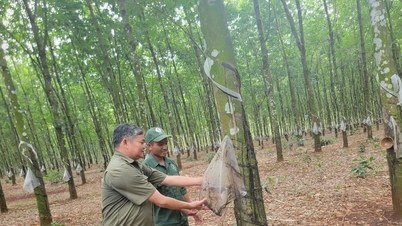
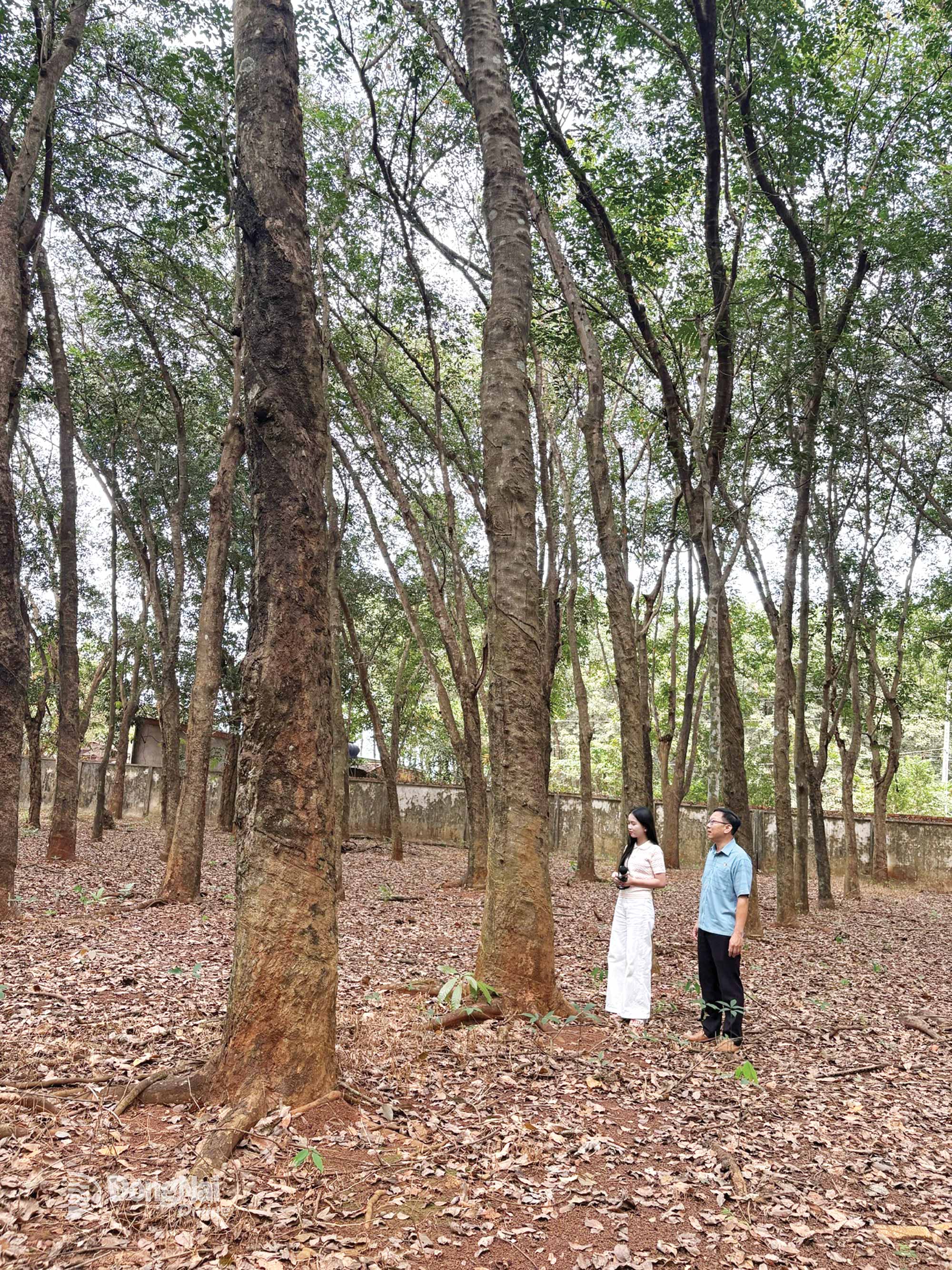 |
| Mr. Nguyen Mau Huy, Deputy Team Leader of Long Tan Team, introduces the rubber plantation to reporters. Photo: Ngoc Thao. |
Throughout its journey, the company has experienced periods of ups and downs, facing many seemingly insurmountable challenges. But thanks to the spirit of unity, innovation, and creativity of generations of leaders, staff, and workers, Phu Rieng Rubber Company has continuously developed. In particular, since entering the period of reform, the company has consistently achieved stable growth, becoming one of the leading units within the Vietnam Rubber Industry Group (VRG).
Not only does Phu Rieng Rubber Company contribute to the socio-economic development of the locality, but it also maintains security and order in the rural areas where the enterprise is located, contributing to building a civilized and modern Dong Nai province. During the 2020-2025 period, the company's total revenue increased by 1.13% compared to the previous term. Specifically, pre-tax profit increased by nearly 15%; after- tax profit increased by over 43.8%; average labor productivity reached 9.1 tons/person/year; and average income reached 138.8 million VND/person/year, an increase of 13.37%.
The preserved rubber plantation is not only a beautiful green space, but more importantly, it is a place that preserves the professional memories, silent sacrifices, and indomitable spirit of generations of workers at Phu Rieng Rubber Company. This is also the foundation for the company's continued strong development, making positive contributions to the Vietnamese rubber industry and to the prosperity of Dong Nai province.
Mr. NGUYEN MAU HUY , Deputy Team Leader of Long Tan Team, Phu Rieng Rubber Company Limited.
The establishment and maintenance of the conservation rubber plantation reflects the sustainable development strategy of Phu Rieng Rubber Company. Not only does it preserve the valuable GT1 genetic resource – a rubber variety that has been associated with the company since its early, challenging days – but the plantation also serves as a place to recall traditions, educate the younger generation, and foster professional pride.
Mr. Le Ngoc Hung, Assistant Head of Technical Management, Long Tan Team, said: "This rubber tree conservation garden is very meaningful to the workers of Phu Rieng Rubber Company. It's not just a garden, but also a part of our professional memories, a place to meet and rest after hard working hours. Especially, it's a space for the company to organize events to foster camaraderie and strengthen the bonds between workers."
Mr. Hung shared: “The age of this plantation is the same as my age (47 years old), and I am very proud that two generations of my family have been involved in the rubber industry. This place reminds workers like my parents of the difficult and challenging days of clearing land to plant rubber trees.”
Mr. Nguyen Mau Huy, Deputy Team Leader of Long Tan Team, shared: "The unit has 6 production teams, including one specializing in seedling production. Currently, the team manages a total area of nearly 1,700 hectares of rubber trees, with an average yield of 2.3 tons/ha in 2025; the total rubber latex production is estimated at 2,423 tons, exceeding the company's plan by about 100 tons. Thanks to this impressive production result, salaries and bonuses will be significantly improved, with the average income of workers expected to reach over 14 million VND/person/month this year."
“Located right in front of the unit’s headquarters, the rubber plantation is always well protected. This is a key location in the conservation of genetic resources, and a place for traditional education for the locality and the rubber industry,” Mr. Nguyen Mau Huy emphasized.
Thanh Thao
Source: https://baodongnai.com.vn/van-hoa/202512/bao-ton-de-phat-trien-ben-vung-0a81a29/
![[Photo] The courage of new recruits of Brigade 144 on the training ground.](https://vphoto.vietnam.vn/thumb/1200x675/vietnam/resource/IMAGE/2026/05/27/1779881651341_anh-man-hinh-2026-05-27-luc-18-32-52.png)
![[Photo] The heat at the fireworks display site on the opening night of the Da Nang International Fireworks Festival 2026](https://vphoto.vietnam.vn/thumb/1200x675/vietnam/resource/IMAGE/2026/05/27/1779889741485_ndo_br_z7872039145157-fecaba5112f39e8352544099d7ef4738-5140-jpg.webp)































![[Photo] The courage of new recruits of Brigade 144 on the training ground.](https://vphoto.vietnam.vn/thumb/402x226/vietnam/resource/IMAGE/2026/05/27/1779881651341_anh-man-hinh-2026-05-27-luc-18-32-52.png)
















Comment (0)