

First, let's talk about the title "village." Actually, historically, our country has never had an administrative unit called a village. The basic administrative units during the feudal era included communes, hamlets, wards, and towns, while the administrative units from the August Revolution onwards were hamlets and villages.
So where is the village located? Well, it's in the common people. What does "preserving the soul of the village," as author Bui Hoai Son mentions, mean? Not the "soul of the hamlet," but rather, if viewed in terms of the administrative designations of the feudal state, the village is essentially a commune, hamlet, village, camp, ward, or office—these are the basic residential units.
For example, in my hometown during the feudal era, the official title was An Ba commune, but the people always called it An Ba village, and the communal house was called An Ba village communal house (not An Ba commune communal house). Next to my hometown was Chu Tuong Ty village, which was a village of people who worked in the casting trade. People also called it Chu Tuong village, and the villagers were called Chu Tuong villagers. That is, "village" was not an official title, but a folk name replacing the official titles: commune, village, camp, hamlet, and office. Sometimes people also combined the names to call it village village or village commune.
Professor Phan Dai Doan, in his book "Vietnamese Villages and Communes - Some Economic, Cultural, and Social Issues" (National Political Publishing House, 2000), wrote: "A village is a civil settlement unit, a commune is a basic administrative unit." It can be understood that official designations (village, commune, hamlet, etc.) are heavily administrative, while folk designations (village) are more focused on cultural depth and life. Since the August Revolution, basic administrative designations have also been called communes and hamlets, without the official village designation. Yet, villages still implicitly exist. This refers to the concept of a village.
The specific names of villages are incredibly profound and rich. Professor Phan Dai Doan, in the aforementioned book, listed ancient and very ancient village names in the Northern Delta region, written in both Nôm and Vietnamese. Many other village names belong to the Sino-Vietnamese word class. In some cases, a village or commune has both a Sino-Vietnamese (official) name and a Nôm (folk) name coexisting, such as in my hometown, the village of Quat Lam (Sino-Vietnamese), commonly known as Cay Sung village.
In some cases, a village or commune may have only one name. But whatever the name, generally speaking, village names have existed since ancient times. Studying toponymy, I've found that the names of communes established after the August Revolution are often newly created, while the names of villages and communes from the feudal era were inherited from hamlets, having existed for hundreds, even thousands of years.
Thus, considering the depth of time, the village name is truly traditional. Considering human emotions, the attachment to the village must be stronger than to the district (formerly) or province. This is because a smaller space requires a more intimate connection than a larger one. And this is also because of the "village culture" characteristic, a prominent feature of Vietnamese culture that some researchers often discuss.
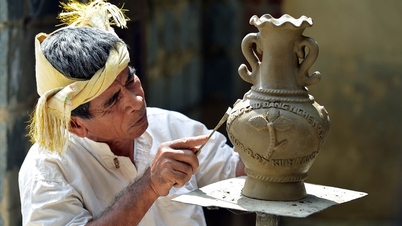
Therefore, I understand that author Bui Hoai Son's intention in preserving the "soul of the village" is to find ways to preserve the names of villages that have existed since ancient times, especially those with outstanding cultural traditions (such as Ho Village with its folk paintings or Bat Trang Village with its pottery), while we reorganize villages and residential areas according to the general policy.
If one doesn't understand that "village" is the very soul and sacred culture of the units that were formerly officially called communes, hamlets, camps, or what are now called villages and residential areas, then it's easy to wonder or criticize: If there is no unit in the administrative system called a "village," then what is the so-called "village soul" that needs to be preserved? The name is just a name, but it will surely transmit the precious traditional spirit from the past, and nothing can replace it.
Source: https://baovanhoa.vn/van-hoa/bao-ton-ten-lang-co-229722.html
![[Image] "Journey of Hope" promotes the organ and tissue donation movement in Vietnam.](https://vphoto.vietnam.vn/thumb/1200x675/vietnam/resource/IMAGE/2026/05/20/1779294400833_1-8910-jpg.webp)
![[Photo] General Secretary and President To Lam works with the Party Committee of the Ministry of Health on the work of Vietnamese traditional medicine.](https://vphoto.vietnam.vn/thumb/1200x675/vietnam/resource/IMAGE/2026/05/20/1779294323718_a1-bnd-2978-3319-jpg.webp)
![[Photo] National Assembly Chairman Tran Thanh Man working with the Standing Committee of the National Assembly's Delegation Affairs Committee.](https://vphoto.vietnam.vn/thumb/1200x675/vietnam/resource/IMAGE/2026/05/20/1779294340023_ndo_br_1-1691-jpg.webp)







































































Comment (0)