

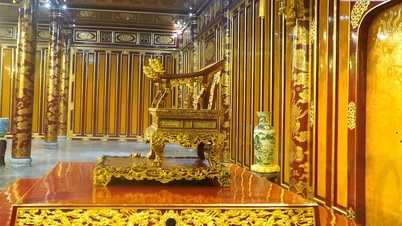
According to the description, if someone approaches the area near the throne, the alarm system will activate and immediately sound an alert.
In addition, a glass "fence" is planned to be erected around it. This move is initially seen as a proactive and positive step by the Center in urgently researching and developing a special protection plan for the national treasure.
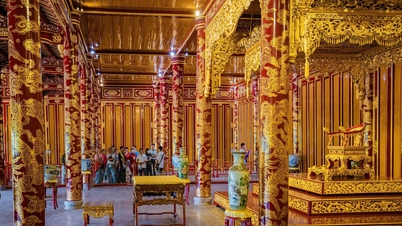
However, this pilot project also revealed some instabilities, if not outright unacceptable ones, because the alarm system, including a rather large camera and numerous smaller cameras, along with warning lights, were all installed in one location on the ceiling of the Thai Hoa Palace.
Any visitor could easily see this alarm system and surveillance cameras because it was so "obvious." Furthermore, its placement somewhat affected the original integrity of the palace ceiling, significantly impacting the aesthetics of the heritage site, and was not authorized by the relevant authorities. Currently, the experimental alarm system at Thai Hoa Palace has been dismantled, and further research is underway to find a more suitable solution.
The above illustrates that researching, applying, and implementing plans and measures to ensure the absolute safety of national treasures is not an easy or simple matter. The reality is that many heritage and museum management units are quite confused by the requirement to "develop and implement special protection plans for national treasures," or "national treasures must be subject to special protection," because they believe they still do not fully understand what constitutes special protection or absolute safety protection.
In reality, many localities have not yet invested sufficient funds in researching and developing special protection plans to ensure the absolute safety of national treasures. Furthermore, the number of people with in-depth expertise in the preservation and protection of national treasures is still quite small, making them insufficient to play a consultative and critical role in implementing special protection and preservation plans.
A museum official in the North Central region frankly stated, "Up until now, we still lack a full understanding, both theoretically and practically, of the special preservation and protection regime for national treasures. Therefore, our unit has only applied some measures beyond the norm, such as ensuring adequate lighting, using dehumidifiers, and maintaining stable temperatures..."
Recently, the People's Committee of Hue City submitted a report to the Ministry of Culture, Sports and Tourism on the review and assessment of the current state of exhibition, preservation, protection, and security measures for national treasures. The report included proposals for the Ministry to open specialized training courses and professional training for museum staff, and to direct the Department of Cultural Heritage and leading museums to guide the development of plans to ensure the absolute safety of national treasures.
This is a matter of great concern, therefore specific guidance from competent authorities is urgently needed, along with contributions from leading experts and researchers in the preservation and protection of artifacts and treasures, paying particular attention to large-scale treasures and treasures made of different materials. With this guidance, localities will be able to develop their own plans to ensure the absolute safety of national treasures.
Source: https://baovanhoa.vn/van-hoa/bao-ve-tuyet-doi-an-toan-cho-bao-vat-141366.html


![[Photo] General Secretary and President To Lam presides over the meeting to approve the draft report on the results of the second inspection by the Politburo of the Standing Committee of the Hanoi City Party Committee.](https://vphoto.vietnam.vn/thumb/1200x675/vietnam/resource/IMAGE/2026/05/26/1779789811432_a2-bnd-4430-9620-jpg.webp)







































































Comment (0)