

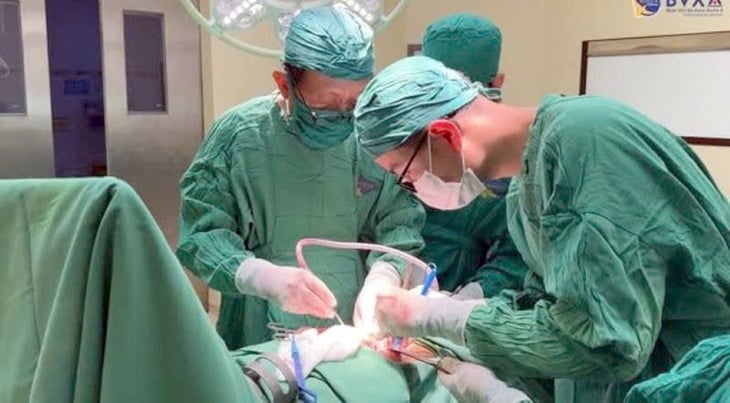
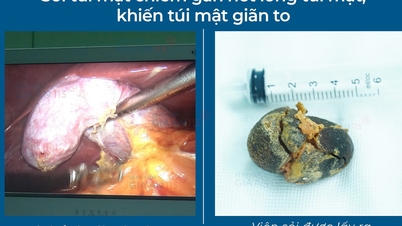
The patient underwent surgery to remove gallstones and lobectomy - Photo courtesy of the hospital.
Many people suddenly have to undergo liver surgery or develop bile duct cancer simply because they underestimate benign gallstones and don't get them checked. Small gallstones that many people often ignore can sometimes be the root cause of another disease.
This is not only a dangerous disease but also a major challenge in medicine due to the difficulty in early diagnosis and the complexity of treatment.
Unforeseen dangers
A 69-year-old male patient, with a history of cholecystectomy five years prior, presented to Bach Mai Hospital ( Hanoi ) with symptoms of dull epigastric pain, jaundice, and a 3kg weight loss in one month. Examination results showed biliary obstruction due to gallstones, suspected bile duct cancer, and a left hepatic abscess...
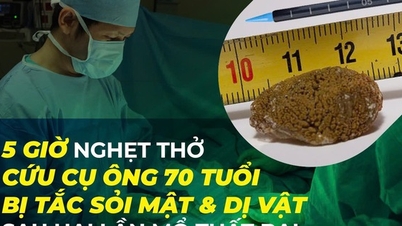
Surgical findings revealed an invasive tumor and a approximately 1cm gallstone located in the lower part of the common bile duct (CBD), obstructing bile flow and causing significant bile leakage. Multiple lymph nodes were present in the hepatic hilum and pancreatic head regions.
Postoperative pathology revealed the lesion to be adenocarcinoma of the bile ducts – an uncommon, insidious, but extremely malignant type of cancer.
Similarly, Ms. HTKH (47 years old, from the former Soc Trang province) experienced recurring abdominal pain. Upon examination at Xuyen A General Hospital in Vinh Long, it was discovered that gallstones were filling the common bile duct and left lobe of the liver, causing left hepatic fibrosis. Surgery removed numerous small stones clustered together, measuring 14 x 8 mm, and also involved resection of the left lobe of the liver and placement of a drainage tube in the bile duct... effectively preventing further complications.
Dr. Le Quoc Toan, from the General Surgery Department of Xuyen A General Hospital in Vinh Long, stated that in patient H.'s case, if the part of the liver containing the stones is not surgically removed, the risk of recurrence of bile duct stones after treatment is very high. The patient is prone to recurrent acute cholangitis, and this atrophied liver tissue has a very high risk of developing intrahepatic cholangiocarcinoma.
Therefore, liver resection is the best solution in this case.
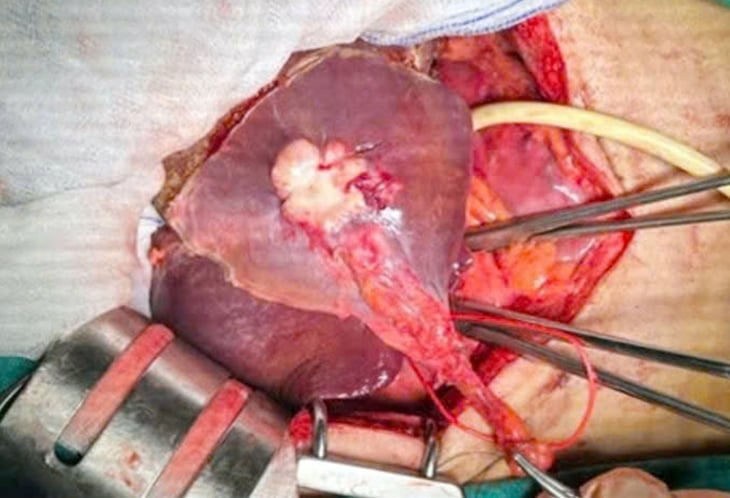
Intraoperative and postoperative images of HPT IV liver tumor - Photo: Provided by the hospital.
Difficult to diagnose early.
Dr. Nguyen Thanh Khiem, from the Digestive Surgery Center at Bach Mai Hospital, warns about the small gallstones that many people often overlook. However, gallstones are not simply a benign condition; they are "inflammators" and can even become "cancer-causing agents" in the bile ducts.
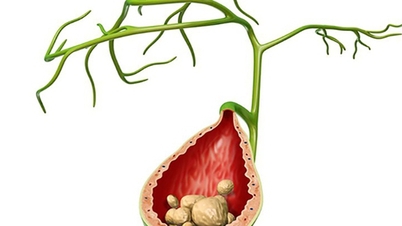
The development of cancer on a background of gallstones can be explained by several mechanisms: gallstones are the deposition of substances in bile fluid, forming stones.
Initially, gallstones may only cause abdominal cramps, fever, and jaundice due to obstruction or inflammation. However, if gallstones persist for a long time, causing chronic inflammation, the risk of developing bile duct cancer increases significantly.
Bile duct cancer presents a major challenge in medicine due to its difficulty in early diagnosis and complex treatment. Individuals with a history of gallstones should have regular checkups and pay particular attention to signs of jaundice (yellowing of the skin and eyes). These are symptoms that indicate a tumor is obstructing the bile ducts.
Jaundice usually develops gradually, unlike gallstone jaundice which is often accompanied by abdominal pain and fever. Generalized itching is due to the accumulation of bilirubin in the blood. Pale stools and dark urine are consequences of bile duct obstruction.
Pain in the right lower quadrant or epigastric region, which may be dull or intense and continuous. Unexplained weight loss accompanied by fatigue and loss of appetite. Persistent mild fever due to infection or cancer.
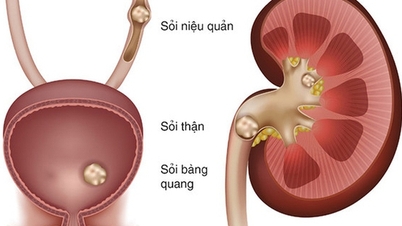
Don't wait until kidney stones cause complications before seeking treatment.
Dr. Dang Quoc Ai, deputy head of the general surgery department at E Hospital, said that gallstones are a common disease in Vietnam, affecting anyone, but less so in young people. Those at high risk include: obese individuals because gallstones are related to excess cholesterol in the blood; and women using birth control pills containing estrogen...
Gallstones can cause other complications such as peritonitis, acute pancreatitis, septic shock from biliary tract infection, etc.
These are all life-threatening surgical emergencies. Furthermore, gallstones can lead to chronic inflammation, which over time can cause gallbladder atrophy, cholecystitis with obstruction, and is the initial cause of dysplasia and cancer of the gallbladder and bile ducts.
Dr. Truong Thanh Tung, deputy head of the Urology Department at Thanh Hoa General Hospital, said that small, mobile gallstones in the common bile duct usually do not have clinical symptoms and can only be detected incidentally during a systematic examination, or sometimes manifested by a mild, transient pain in the right lower rib area.
When gallstones in the common bile duct cause typical bile duct obstruction and biliary tract infection, the general condition changes very rapidly, with symptoms such as fever, fatigue, loss of appetite, jaundice of the skin and mucous membranes, progressive weight gain, and rapid weight loss... Severe biliary tract inflammation can cause life-threatening syndromes such as hepatorenal syndrome (liver failure, cirrhosis with ascites, cholestasis, subcutaneous hemorrhage), renal failure...
Ways to prevent the disease
People should have annual health checkups, especially if gallstones are detected, they should have follow-up examinations every six months, and early, proactive intervention should be considered. Currently, there are many methods for diagnosing and early detection of common bile duct stones such as ultrasound, abdominal CT scan, endoscopic retrograde cholangiopancreatography (ERCP), magnetic resonance cholangiopancreatography (MRCP)...
Early detection through regular health checkups will lead to more effective and safer treatment.
How is kidney stone removal surgery performed?
Dr. Thanh Tung advises that gallstones, if detected early, are relatively easy to treat with surgery to remove the stones or drain the bile ducts. However, if stones remain for a long time and gradually progress, they can lead to cirrhosis with ascites and cholestasis. Therefore, if symptoms such as severe abdominal pain, jaundice, or yellowing of the eyes appear, patients should immediately go to a medical facility for timely treatment.
Dr. Dang Quoc Ai warned that in the past, when medicine was not as developed, gallbladder removal surgery was a last resort because the surgery was extremely invasive, so many people still believe that gallstones should only be treated when complications arise. But today, that view is no longer appropriate.
We are living in an era of disease prevention, early detection, treatment, and early intervention to address the root causes of illness, preventing the disease from progressing to a severe stage that makes treatment difficult, affects health, and endangers lives.
Source: https://tuoitre.vn/bat-ngo-xo-teo-gan-do-soi-mat-20250808080645261.htm
































































































Comment (0)