

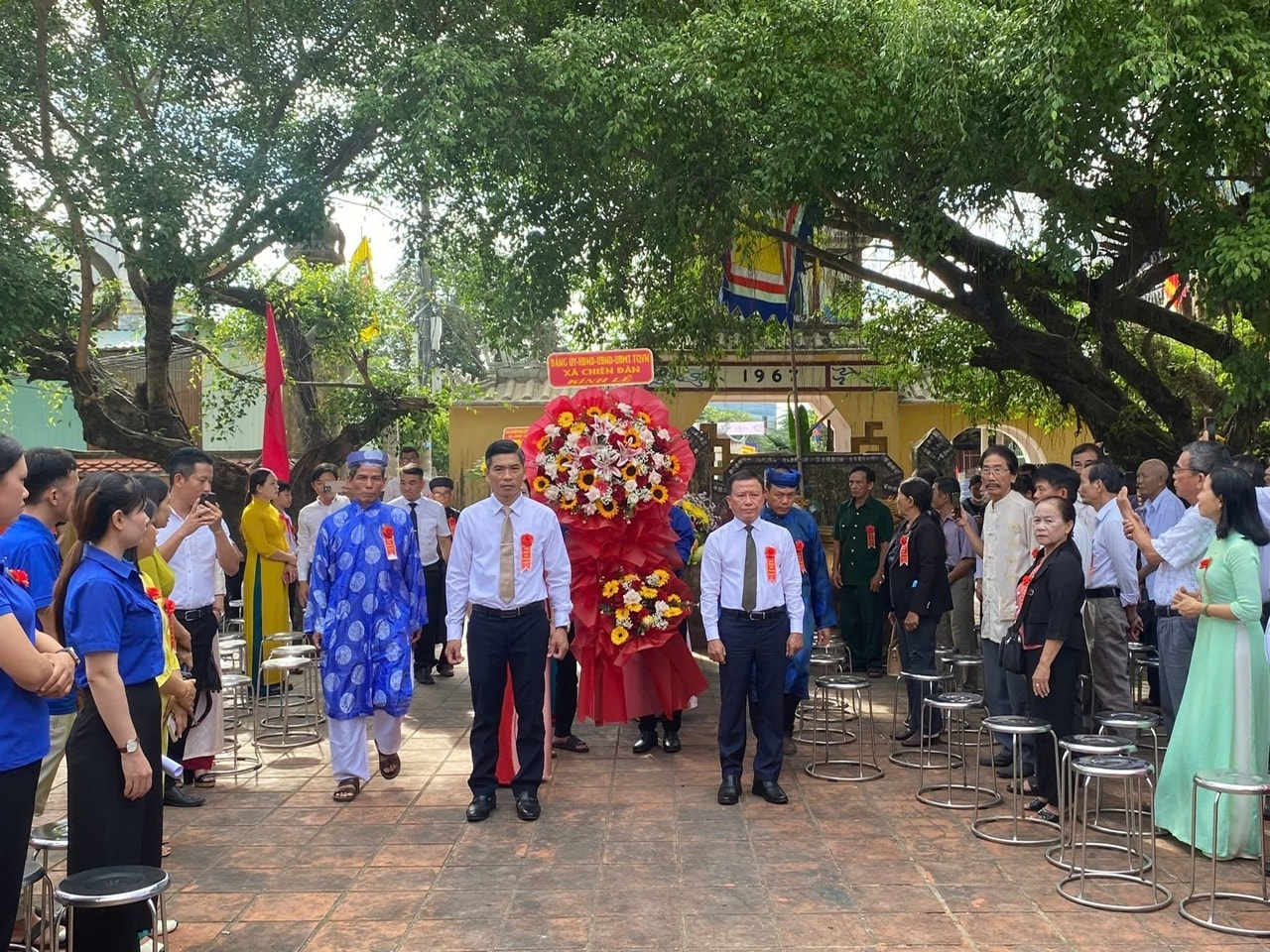
The locals still pass down the old saying: "First La Qua, second Thanh My, third Chien Dan," referring to the scale of the oldest communal houses in Quang Nam province. Through the vicissitudes of time, only Chien Dan communal house remains intact, a source of pride for the local people. It is also the oldest communal house in Quang Nam province that is still in its original state.
A hundred years under the village communal house roof
The 14th day of the 7th lunar month each year is a special time for the people of the old Ha Dong region. Considered the cultural cradle of the old Tam Ky region, the ancient Chien Dan communal house and its annual traditional festival not only embody the concept of traditional rituals and activities, but also reveal the voice of the community and the story of preserving the traditional identity of Vietnamese villages.
The scent of incense wafts with the sound of the wooden gong. Quietly behind the main hall, as if reflecting on the entire 500-year journey of the village temple, Mr. Nguyen Dinh Khoi - a member of the Management Board of Chien Dan village temple - said that from the incense offering ceremony, the worship of the village's ancestors, and the commemoration of the pioneers, all are to remind descendants of their village's origins, keeping in the heart of every Vietnamese person the flame of their roots.
History has placed Chiên Đàn communal house at the center of the historical memory axis that shaped Quảng Nam province. Documents from the Chiên Đàn communal house management board record that Chiên Đàn was formerly part of Hà Đông district, Thăng Hoa prefecture, with a rich history closely linked to the development of the Chiên Đàn region. In 1471, King Lê Thánh Tông established the Quảng Nam province, and Hà Đông district was created. To commemorate the contributions of the ancestors who pioneered the land and established the village, between 1471 and 1473, the people collectively built a communal house named Chiên Đàn.
Every year, the people of Chien Dan village hold a communal house worship ceremony on the first day of spring and organize a grand festival on the 15th day of the 7th lunar month. These activities aim to both report achievements and express gratitude for the blessings of favorable weather, prosperous businesses, good health, peace, and to educate their children about their ancestral roots.
Throughout history, the Chiên Đàn village communal house, associated with Chiên Đàn commune, has been deeply marked by the footsteps of heroes, Confucian scholars, patriots, and famous figures from Quảng province.
The names of figures who once shone brightly in this land in many fields, such as Kieu Phung, Dong Cong Truong, Nguyen Duc, Tran Van Du, Huynh Thuc Khang, Duong Thuong, Duong Thac… with their glorious achievements are recorded alongside Chien Dan communal house. From being a gathering place for villagers, marking uprisings, speeches, and tax payments, Chien Dan communal house also served as the location for the establishment of the Resistance Administrative Committee after the August Revolution...
The thread that connects the community
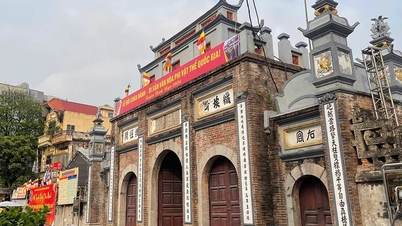
In 2002, the temple was classified as a national-level architectural and artistic heritage site – a belated recognition, but still timely to honor a sacred space that remains intact. The dark, polished jackfruit wood columns, the yin-yang tiled roof, and the intricately carved rafters of the Van Ha craftsmen… still proudly withstand storms and winds. From its construction to the present day, the temple has undergone several renovations, but the original elements of the temple have been preserved, maintaining the integrity of an ancient architectural work.
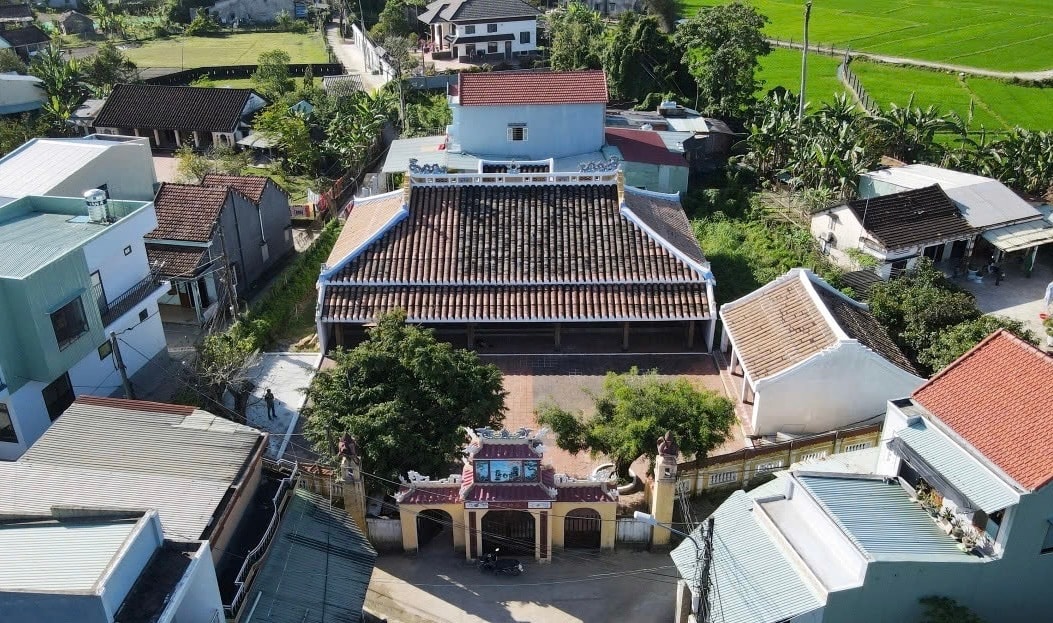
The intricately carved wooden rafters from the renowned Van Ha guild are still there. The carving heritage of the traditional Van Ha craft is evident in every architectural detail of Chien Dan communal house, which is over half a century old.
Therefore, what remains of the ancient Chien Dan communal house is also a memory from several hundred years ago for the carpenters of Van Ha village. The story of the founder of the carpentry trade in Van Ha village, originally from the Thanh-Nghe-Tinh region, who first planted his stake and struck the hammer, plane, and chisel on this land, is recounted in the remnants of the Chien Dan communal house, with each carving detail on the gable and eaves seemingly retold.
Mr. Thai Binh, Secretary of the Party Committee of Chien Dan commune, said that as time passes, the architectural and artistic values, historical beauty, and traditional culture of the Chien Dan village communal house festival are still preserved and promoted by generations. This is an honor and a source of pride not only for the people of Chien Dan but also for every citizen of Quang Nam province. Now, the Chien Dan communal house is a special institution of the locality.
Mr. Thai Binh added that, after the administrative unit reorganization, the communes of Tam Thai, Tam Dan, and the town of Phu Thinh were merged into one, and the new name given was Chien Dan commune - a place name associated with history. According to him, the choice of the name "Chien Dan" aims to honor the glorious tradition, connect local cultural identity, and contribute to fostering national pride.
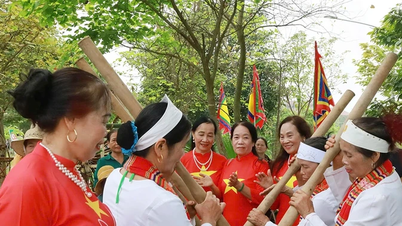
During the recent festival, crowds still lingered in the courtyard of the ancient village temple, following the rhythm of the drums and chants of the Bài Chòi folk game, even as the sun shone through the leaves onto their faces. The main ceremony was over, but the village festival was far from over.
According to researchers, in Chien Dan, the ritual traditions are passed down in their original form by the village elders. The festival traditions, however, remain deeply rooted in folk life, encompassing community games intertwined with the lives of the people of Quang Nam, such as Bài Chòi (a traditional folk game) or various forms of traditional martial arts performances.
The villagers of Chien Dan affectionately call their village festival a "festival of reunion." Each year, the village festival brings gifts and scholarships, extending the path to education for local children. It serves as a tangible measure of community values... beginning with the persistent preservation of the village festival.
According to documents from the Culture and Social Affairs Department of Chien Dan commune, when King Le Thanh Tong led his army into battle to pacify the south, the king used Chien Dan communal house as a resting place and made appropriate decisions to achieve victory.
The village temple was then situated in a high, dry location, overlooking a vast area of land.
A few kilometers from Chien Dan is the Tam Ky River, which provides shelter. The village of Chien Dan is surrounded by many small tributaries, and above all, it is protected by numerous high hills, making it ideal for deploying forces for both attack and defense.
Source: https://baodanang.vn/ben-bi-giu-le-hoi-dinh-lang-3302797.html


![[Photo] General Secretary and President To Lam presides over a meeting with the Central Organizing Committee.](https://vphoto.vietnam.vn/thumb/1200x675/vietnam/resource/IMAGE/2026/06/03/1780482764658_a1-bnd-4741-3342-jpg.webp)


![[Photo] Secretary of the National Assembly Party Committee, Chairman of the National Assembly presides over the meeting of the Standing Committee and Executive Committee of the National Assembly Party Committee.](https://vphoto.vietnam.vn/thumb/1200x675/vietnam/resource/IMAGE/2026/06/03/1780480353201_ndo_br_bnd-2585-jpg.webp)















![[Photo] First session of the 14th Congress of the Vietnam Trade Union](https://vphoto.vietnam.vn/thumb/1200x675/vietnam/resource/IMAGE/2026/06/03/1780465947883_ndo_br_img-3852-jpg.webp)

























![[Video] Sunset at Lap An Lagoon – Where the sun sets over the fishing nets](https://vphoto.vietnam.vn/thumb/1200x675/vietnam/resource/IMAGE/2026/05/31/1780192137701_beach-landscape-sea-water-nature-grass-745871-pxhere-com.jpeg)



























Comment (0)