

(NLĐO) - The northern hemisphere of a planet within our solar system appears to have been stripped of a layer of rock and soil 5-6 km thick compared to the rest of the hemisphere.
A study recently published in the scientific journal Geophysical Research Letters has solved a long-standing mystery about Earth's neighboring planet: the "Mars Splitting" puzzle.
The concept of "Martian splitting" has been discussed since the 1970s and has puzzled the scientific community for half a century.
But now, by "unearthing" data from NASA's InSight spacecraft, which completed its mission a few years ago, a team of authors from the Chinese Academy of Sciences and the Australian National University have found the answer.
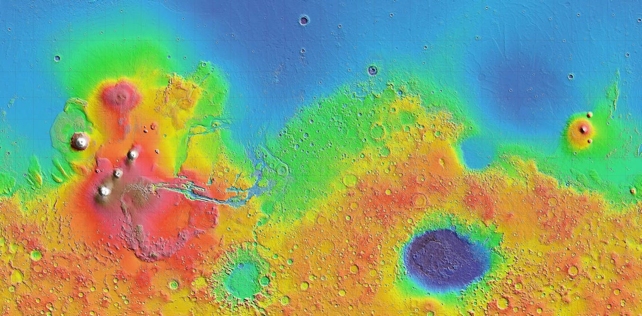
Topographic maps show the divergence of Mars: the southern highlands are colored yellow and orange, while the northern lowlands are colored blue and green - Image: NASA/JPL/USGS
"The split of Mars" refers to the fact that the northern and southern hemispheres of the red planet are strangely different.
The first Mars observation missions discovered that the planet's northern hemisphere is 5-6 km lower than its southern hemisphere. No other world in the solar system has two hemispheres that are so contrasting.
In addition, the surfaces of the two hemispheres are also very different.
The southern highlands are characterized by numerous impact craters and frozen volcanic lava flows. In contrast, the surface of the northern lowlands is smooth and flat, with virtually no geological scars or other notable features.
From geophysical and astronomical measurements, we also know that Mars' crust is significantly thicker beneath the southern highlands. Furthermore, the rocks in the south are magnetized, while those in the north are not.
Two main hypotheses have emerged.
The first is the endogenous hypothesis, which suggests that differences in heat transfer through the rising of warmer material and the sinking of colder material within the Martian mantle led to the apparent dichotomy on its surface.
The second hypothesis is the exogenous hypothesis, which suggests that this splitting came from space, for example, a collision of an object the size of the Moon or slightly smaller, reshaping the planet's surface.
A Chinese-Australian research team analyzed data from the InSight spacecraft and found credible evidence of a Martian earthquake cluster in the Terra Cimmeria region of the southern highlands.
They performed similar calculations for previously observed earthquakes in the Cerberus Fossae region of the Northern Lowlands.
Comparisons between the two regions indicate that seismic waves lose energy more rapidly in the southern highlands. The most plausible explanation is that the rocks beneath the southern highlands are hotter than those in the north.
The temperature difference between the two halves of the planet supports the idea that this division is caused by internal forces within Mars, rather than external influences.
This scenario also suggests that the planet's ancient plate tectonics were the primary cause of everything.
This also helps to shape the bodies of water on the Martian surface, with water flowing up beneath the southern highlands and down beneath the northern lowlands.
But that's a story from billions of years ago, when life was thought to have existed alongside water.
However, the research results have offered hope and helped guide future searches for life, as they provide evidence that Mars once had plate tectonics.
Currently, Earth is the only planet in the Solar System with plate tectonics. This process has contributed to stabilizing the planet's environment, climate, and chemical composition, helping to nurture life and possibly triggering reactions that gave rise to early life forms.
Source: https://nld.com.vn/bi-an-hanh-tinh-bi-phan-doi-giua-he-mat-troi-196250121112355789.htm































































































Comment (0)