

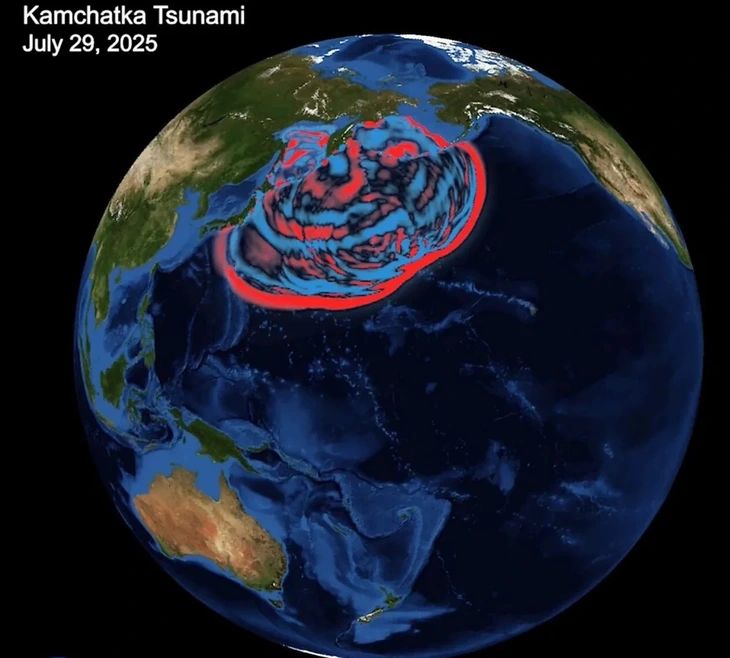
Satellites like SWOT could help improve existing forecasts of how tsunamis spread across the ocean - Photo: NOAA
Launched in 2022 by NASA and the French National Centre for Space Studies (CNES), the SWOT satellite is designed to track the movements of large and small currents around the globe. After several years of collecting data on ocean currents, SWOT accidentally "captured" a rare event: a tsunami in the Pacific Ocean.
On July 29, an 8.8 magnitude earthquake occurred in the Kuril-Kamchatka subduction zone off the southeastern coast of Russia, creating a tsunami that spread rapidly across an area in the Pacific Ocean just as SWOT flew over the area.
Combining SWOT satellite data and three buoys from the Deep-sea Tsunami Assessment and Reporting (DART) project, researchers captured the tsunami's propagation and dispersion pattern with unprecedented detail, according to ScienceAlert on December 3.
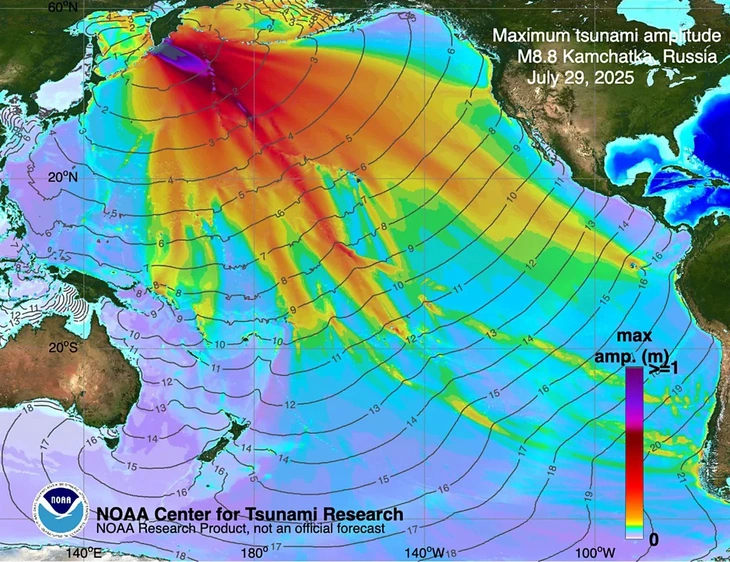
Data from SWOT and DART buoys help predict the direction of tsunami movement - Photo: NOAA
The results show that the actual tsunami model is more complex than long assumed. According to traditional models, large tsunamis are considered to be "non-dispersive", that is, they maintain their structure as a single wave as they move.
However, SWOT data shows the opposite: the July 29 tsunami was split into a relatively large leading wave, followed by smaller waves.
"I think of the SWOT data as a new pair of glasses. Previously, DART buoys only showed us tsunamis at a few points in the middle of the ocean. Other satellites could see them, but only a small part of the tsunami.
SWOT allows recording a wide swath of ocean surface up to 120km with unprecedented high resolution," said Angel Ruiz-Angulo, lead author of the study and working at the University of Iceland.
This new discovery not only sheds light on how tsunamis propagate, but also promises to improve forecasting models and early warning systems.
SWOT and other satellites could help with real-time tsunami monitoring in the future, the team says, which is especially important for coastal communities that need more time to evacuate before a disaster strikes.
The study was published in the journal The Seismic Record .
Source: https://tuoitre.vn/ve-tinh-bat-duoc-song-than-khong-lo-tren-thai-binh-duong-phat-hien-dieu-bat-ngo-20251203120031447.htm

























![[Photo] Worshiping the Tuyet Son statue - a nearly 400-year-old treasure at Keo Pagoda](/_next/image?url=https%3A%2F%2Fvphoto.vietnam.vn%2Fthumb%2F1200x675%2Fvietnam%2Fresource%2FIMAGE%2F2025%2F12%2F02%2F1764679323086_ndo_br_tempimageomw0hi-4884-jpg.webp&w=3840&q=75)
![[Photo] Parade to celebrate the 50th anniversary of Laos' National Day](/_next/image?url=https%3A%2F%2Fvphoto.vietnam.vn%2Fthumb%2F1200x675%2Fvietnam%2Fresource%2FIMAGE%2F2025%2F12%2F02%2F1764691918289_ndo_br_0-jpg.webp&w=3840&q=75)































































Comment (0)