

Scientists have just discovered new evidence of Libyan desert glass – a strange yellow glass scattered across Egypt and Libya, formed from an extreme cosmic event about 29 million years ago.
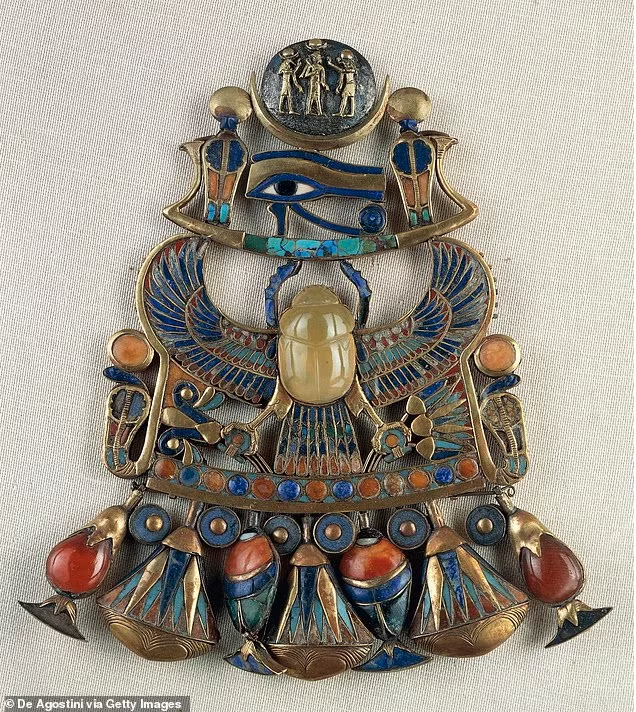
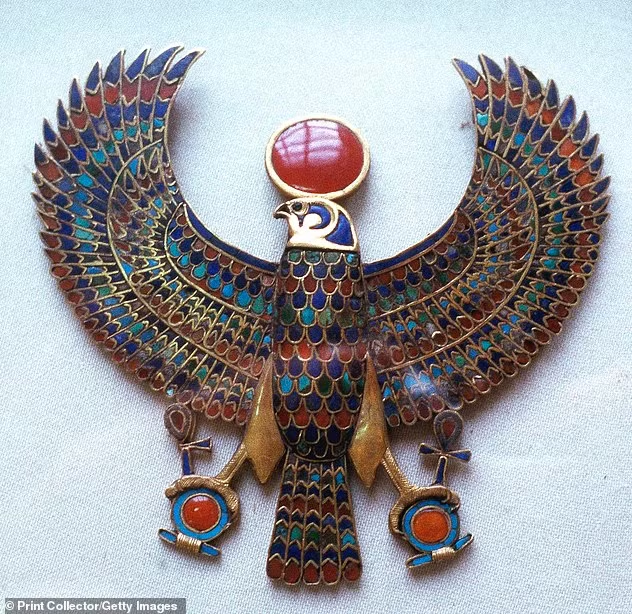
This type of glass was once highly valued by the ancient Egyptians and was placed in the tomb of King Tutankhamun.
A research team from the University of Milano-Bicocca (Italy) discovered a rare zircon grain hidden within glass, which has a branching, tree-like structure called dendritic texture.
The zircon particles are extremely small, only about 20 micrometers, indicating that they were once heated intensely, completely melted, and then quickly recrystallized.
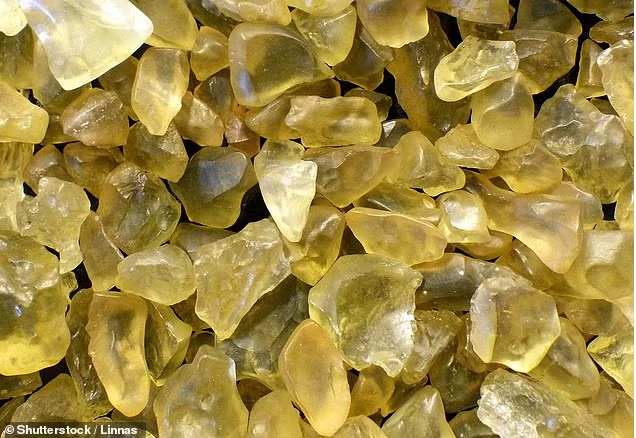
This proves that the glass once withstood temperatures exceeding 2,250 degrees Celsius, much higher than volcanic lava, which typically only reaches 700 to 1,200 degrees Celsius.
Analysis revealed that the glass trapped between the zircon branches had a different chemical composition, containing more aluminum and zirconium, suggesting it originated from a separate lava droplet that cooled and solidified independently.
There was no trace of the intermediate minerals that typically appear when zircon melts; it was all zircon. This suggests that the heating and cooling process occurred extremely rapidly, "freezing" the evidence in place.
Scientists believe zircon is a microscopic record of an extremely violent event, where extreme temperatures melted both the zircon and the surrounding silica-rich material, forming droplets of rapidly cooling solution.
However, the debate remains unresolved: Some argue for a direct meteorite impact, while others believe the meteorite exploded in the atmosphere with enough force to melt the desert below.
The discovery of zircon did not resolve the controversy but provided strong evidence that the event involved unusual temperatures and occurred under turbulent conditions.
This is why the Libyan desert glass continues to be one of the longest-standing mysteries of planetary science, and also a testament to the reverence the ancient Egyptians held for it when they placed it in the tomb of King Tutankhamun.
Source: https://giaoducthoidai.vn/bi-an-thuy-tinh-ngoai-trai-dat-trong-mo-vua-tutankhamun-post780153.html


![[Photo] General Secretary and President To Lam presides over a meeting on preparations for the review of one year of operation of the three-tiered government system.](https://vphoto.vietnam.vn/thumb/1200x675/vietnam/resource/IMAGE/2026/06/02/1780391821195_a1-bnd-4595-9717-jpg.webp)
























































































Comment (0)