

Sitting in a cafe for 8-10 hours is normal.
Nguyen Thi Tuyet Ngung, a student at the Ho Chi Minh City University of Fine Arts, often "sets up shop" at the cafe, saying it's her familiar place for studying and working. According to Ngung, the cafe has a spacious environment, Wi-Fi, and air conditioning, making it suitable for online learning, group work, or freelance work.
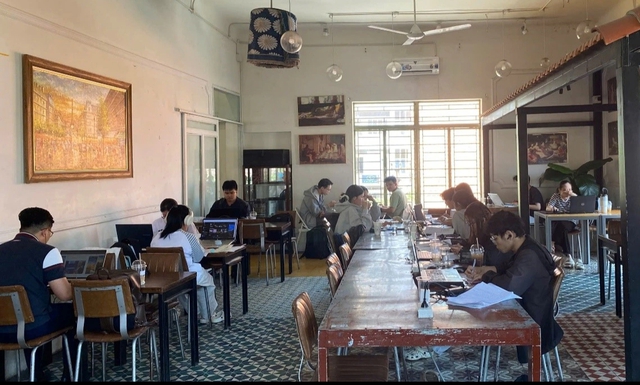
Many young people choose coffee shops as a place to work or study for hours on end.
PHOTO: MAI CAT
"I chose this cafe because of its comfortable atmosphere, where I can freely be creative, study in groups, or do online assignments. The open environment is quite suitable for Gen Z," Ngưng shared.
Huynh Thien An (28 years old), residing in Thanh My Tay Ward, Ho Chi Minh City, said he often "pays his dues" at a coffee shop on Xo Viet Nghe Tinh Street (Thanh My Tay Ward). His job as a real estate agent for rental rooms and serviced apartments doesn't require him to go to the office, so Thien An and his colleagues treat the coffee shop as their office. "I sit there from morning until evening for more than 8 hours, drink two cups of coffee, and meet clients and friends at the shop," Thien An said. Because he sits there for so long, he's become more familiar with the place and proactively orders more food or invites friends and clients to support the shop.
For Nguyen Thi Duyen (23 years old), who works at a company on Duong Dinh Nghe Street, Yen Hoa Ward, Hanoi , she goes to a coffee shop to work about 3-4 days a week, spending 8 to 10 hours there each time. "Usually, a drink at the shop costs between 45,000 and 60,000 VND. I often choose a quiet shop with air conditioning to sit and work," Duyen said.

Many young people tend to "camp out" at cafes to meet deadlines, study online, or work in groups.
PHOTO: MAI CAT
Duyen said that when she needs to meet clients or do work requiring creativity, she chooses a coffee shop. Although she frequently works in coffee shops, Duyen also acknowledges the inconveniences: "In crowded coffee shops, the music and noise easily reduce concentration, leading to lower work efficiency. And when you get used to working in a coffee shop and return to an office environment, it's difficult to adapt. Not to mention, if you work in a coffee shop every day, the monthly beverage expenses are quite significant."
Not just Thien An and Duyen, in recent years, the sight of young people carrying backpacks, laptops, chargers, headphones, etc., to cafes to work has become commonplace.
We visited a cafe on Ngo Tat To Street, Thanh My Tay Ward (Ho Chi Minh City), and noticed that both floors were always packed with customers from noon until 9 PM. Most of the customers were young people, some studying, some working, some chatting with friends… At lunchtime, they would leave their laptops and backpacks there, or have someone watch over them; then they would return to work after about 15 or 30 minutes. Many young people sat in the cafe from noon until night; even after we left at 9 PM, they were still engrossed in their work.
When the coffee shop is... abused
This trend exploded after the Covid-19 pandemic, as remote work, freelancing, and content creation became more common. The fact that many people view coffee shops as "mobile offices" causes considerable inconvenience for both the owners and other customers. In reality, the phenomenon of customers lingering in coffee shops is nothing new; this topic has been debated numerous times on online forums.

Some customers were lying down on the chairs in the cafe.
ILLUSTRATIVE PHOTO: THANH DA
Last year, social media was abuzz with news about a coffee chain allegedly covering up electrical outlets to subtly deter customers from lingering. Although the chain later issued an official statement explaining that the minor adjustments at some stores were intended to refresh the space and provide a more complete and enjoyable experience for customers, public opinion remained divided.
On fan pages like "Association of Cafe Owners with Few Customers," "Cafe Owners," "Cafe Owners' Association," etc., discussions often revolve around this topic. Many cafe owners report difficulties when customers order only one drink but sit for hours, occupying tables, chairs, and space in the cafe, not to mention increased electricity and water costs. This situation directly impacts revenue, especially in smaller cafes.
Recently, the incident of a group of customers sitting at a cafe in Nhieu Loc Ward (Ho Chi Minh City) for about 10 hours but only ordering one drink is a case in point. Specifically, during this time, the group of young people left the cafe to have lunch but kept their seats, then returned to continue sitting, even sleeping on the chairs, and brought food and drinks from outside. The cafe announced an extra charge, and the customers gave the cafe a 1-star rating because the extra charge was not announced beforehand.
This incident sparked much debate. Dinh Thi Hoai (26 years old, Thanh My Tay Ward, Ho Chi Minh City) commented: "It's normal for restaurants to charge extra for sitting too long, but I think they should have clearly announced it from the beginning. If customers can accept it, then they should come in. As for the customers, they shouldn't let their personal feelings affect other people's businesses," Hoai said.
Nguyen Kim Duyen (32 years old, residing in Phu Loi Ward, Ho Chi Minh City) believes that young people should choose cafes with designated areas for studying or working to avoid disturbing other customers. According to Duyen, if customers sit for too long, they should order more food instead of just using one drink for hours.
From a business perspective, Mr. PHK, the owner of a coffee shop in Binh Quoi Ward, Ho Chi Minh City, observes: "The shop's survival depends on customers. When we opened the shop, we determined from the beginning that customers who stay for a long time and those who leave quickly would balance each other out. However, there are also cases where customers sit from morning till night ordering only one iced coffee, equivalent to just 18,000 VND; while the shop incurs many associated costs: electricity, water, staff, taxes... With a 18,000 VND coffee for a whole day, the shop doesn't make a profit, or even loses money. I hope customers understand and sympathize with the shop owners."
Risk mitigation strategies
Dr. Pham Thi Thuy, a sociologist and lecturer at the Regional Political Academy 2, believes that coffee shops are businesses that incur many operating costs. Therefore, it is perfectly normal for young people to pay a small surcharge for sitting for a long time. If customers give a one-star rating because of this, it is an unkind and heartless act. However, according to her, to avoid disputes and conflicts, coffee shops should provide clear information from the outset. "Coffee shops should behave appropriately and have clear regulations and inform customers in advance about their policies," Dr. Thuy said.
Financial expert Lam Minh Chanh, founder of WikiMoney financial AI (residing in Saigon Ward, Ho Chi Minh City), argues that the "culture of sitting around" for 6-10 hours in a coffee shop with a small order puts significant pressure on revenue, drives up electricity, water, and personnel costs, and blocks opportunities to attract new customers.
Mr. Chánh suggested that cafes should place small notices at tables reminding customers of the maximum reservation time as stipulated by the cafe. "Developing a 'Coworking Cafe' model – a separate area for workers with hourly or combo package fees, distinct from the space for walk-in customers – is also a way to avoid unnecessary risks and conflicts. This model respects the needs of both groups of customers while ensuring sustainability for businesses," Mr. Chánh said.
According to this financial expert, coffee shops offer flexible learning and working spaces for young people, but without proper usage, they can easily become "free offices," impacting the overall experience and business operations. The key is not to restrict this trend, but rather for each young person to adjust their behavior to use the space in a civilized and appropriate manner.
Source: https://thanhnien.vn/bien-quan-ca-phe-thanh-van-phong-di-dong-dung-qua-lam-dung-185260525185830568.htm




![[Image] Hanoi's urban life under the challenge of a "scorching hot" environment](https://vphoto.vietnam.vn/thumb/1200x675/vietnam/resource/IMAGE/2026/05/25/1779706979265_nang-nong-t5-2026-minh-duy-7-4636-jpg.webp)






























































































Comment (0)