

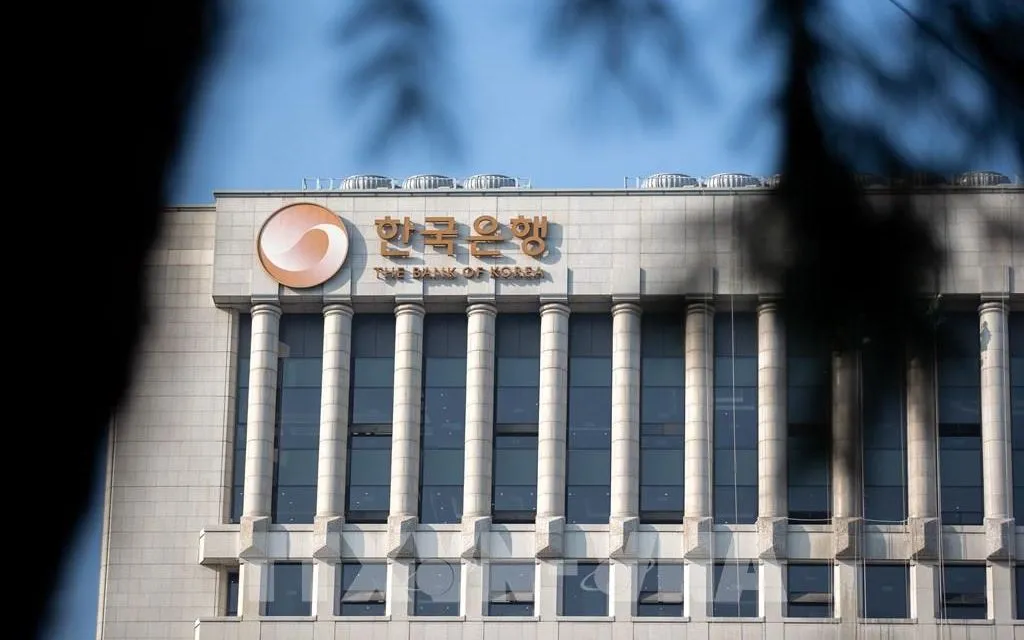
The headquarters of the Bank of Korea in Seoul. Photo: THX/VNA
Thus, the Bank of Korea has maintained this interest rate for six consecutive periods since July 2025.
Information indicates that Bank of Korea Governor Rhee Chang-yong chaired the meeting. Analysts suggest that the decision to continue freezing interest rates appears to be influenced by the volatile trend of the won-USD exchange rate. The won-USD exchange rate fell to 1,420 won/USD at the end of January 2026, then surged to 1,470 won/USD in early February and is currently on a downward trend.
Experts believe that if the Bank of Korea (BoK) cuts interest rates, the interest rate differential between South Korea and the United States could widen further. The US benchmark interest rate is currently between 3.5% and 3.75% per year. A larger interest rate differential could cause foreign funds to shift to the US in search of higher returns, potentially exacerbating the weakening of the won.
Rising housing prices are also considered a reason for keeping interest rates unchanged. According to the Korea Real Estate Regulatory Board (REB), apartment prices in Seoul in January 2026 increased by 1.07% compared to the previous month, the highest increase since October 2025. In this context, lowering interest rates could lead to injecting more liquidity into the real estate market.
Amid strong export growth in South Korea, fueled by the semiconductor industry's boom, concerns about an economic slowdown, often cited as a reason for interest rate cuts, have eased.
The consumer sentiment index in South Korea rose 1.3 points in February 2026 from the previous month to 112.1 points, marking the second consecutive month of increase. The business sentiment index also recovered, reaching 94.2 points in February, up 0.2 points.
Researcher Jo Yong-gu at Shinyoung Securities said that with the economy showing signs of recovery thanks to strong exports from the semiconductor industry and stable consumer spending, the need for lower interest rates has weakened. According to this expert, the overheated real estate market and the weak won will continue, therefore the period of maintaining interest rates is likely to last for a considerable time.
In addition, in its revised economic outlook report released on February 26, the Bank of Korea (BoK) raised its forecast for South Korea's real Gross Domestic Product (GDP) growth this year from 1.8% to 2.0%. This figure is 0.2 percentage points higher than the 1.8% forecast released in November 2025. This is believed to reflect the increase in exports, particularly in semiconductors, and the recovery of the South Korean economy.
Source: https://vtv.vn/bok-giu-nguyen-lai-suat-lan-thu-sau-lien-tiep-100260226163941965.htm


![[Image] Nearly 125,000 Hanoi students completed the Literature exam for the 10th grade entrance exam.](https://vphoto.vietnam.vn/thumb/1200x675/vietnam/resource/IMAGE/2026/05/30/1780117233041_ndo_br_thiet-ke-chua-co-ten-2-png.webp)
























































































Comment (0)