

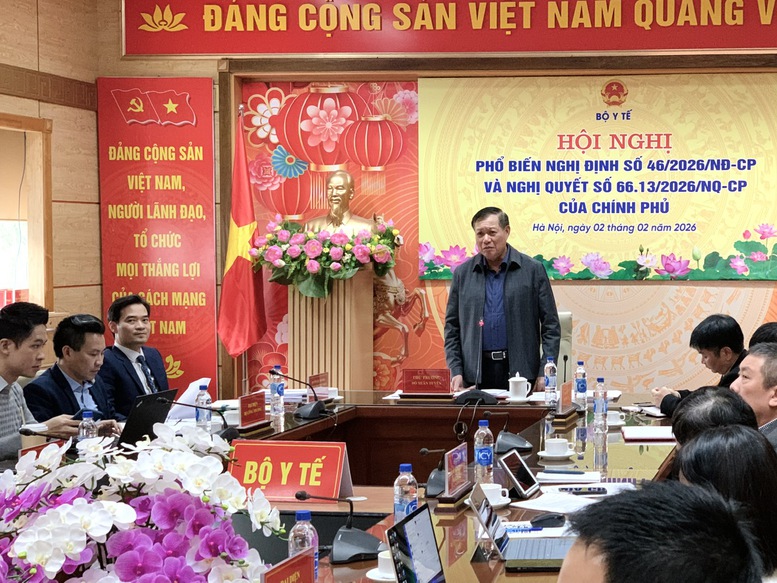
Deputy Minister of Health Do Xuan Tuyen chaired the meeting - Photo: VGP/HM
At the meeting, from the perspective of the lead agency, Deputy Minister of Health Do Xuan Tuyen stated that during the implementation of the recent new regulations (Government Decree 46/2026/ND-CP detailing the implementation of some articles and measures to organize and guide the implementation of the Law on Food Safety), the Ministry received feedback from several units regarding imported food, mainly agricultural products, seafood, fresh food, and some confectionery products that were difficult to clear through customs.
Immediately after receiving the feedback, the Ministry of Health, along with relevant ministries and agencies, held a meeting to review the necessary actions and requested units to focus on resolving issues for citizens and businesses.
"When implementing new regulations, initial confusion and difficulties are inevitable. Therefore, we need to focus on and urgently resolve difficulties and obstacles during the implementation process," Deputy Minister Do Xuan Tuyen emphasized.
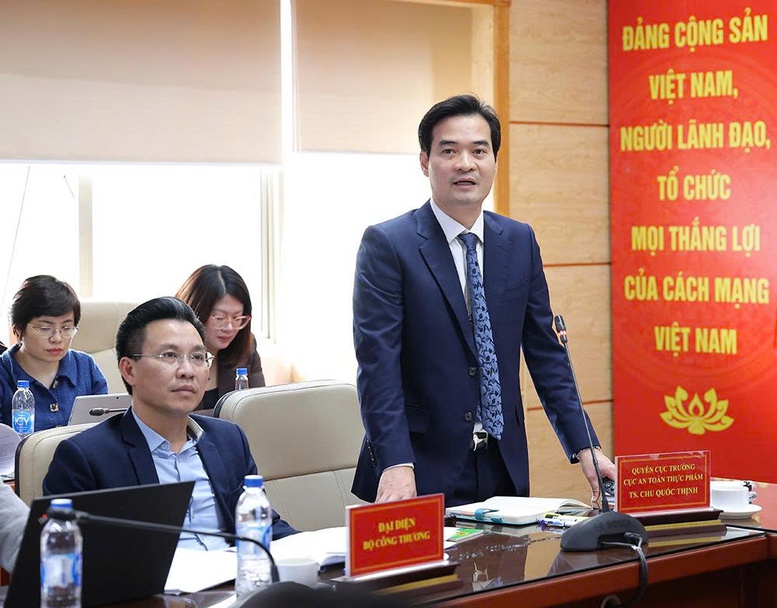
Dr. Chu Quoc Thinh, Acting Director of the Food Safety Department, Ministry of Health - Photo: VGP/TM
The unit did not accept samples for testing.
Representing Tay Ninh province, Ms. Dinh Thi Phuong Khanh, Deputy Director of the Department of Agriculture and Environment, stated that the situation regarding fresh agricultural products has been resolved and is basically stable. However, a problem has arisen: after businesses complete the procedures to bring goods to storage and await the results of testing by designated state testing agencies, many testing units are now refusing to accept samples, even though regulations stipulate that these units are valid until March 31, 2026.
Therefore, businesses lack sufficient documentation to submit to Customs for clearance procedures. Ms. Khanh requested that ministries and agencies direct the urgent resolution of this issue to alleviate the burden on businesses. Currently, some businesses are incurring storage fees of up to approximately $6,000 per day.
According to Ms. Dinh Thi Phuong Khanh, the product currently facing this issue is olive oil.
Regarding the regulatory authorities, Dr. Chu Quoc Thinh, Acting Director of the Food Safety Department, Ministry of Health, stated that the Department had received information that the Quality Measurement and Standardization Technical Center 3 (Quatest 3) – designated to receive food samples for testing in Tay Ninh province – was not accepting samples. However, this unit refused to accept samples because it did not meet the testing requirements and was therefore not permitted to accept samples. Businesses can then transfer samples to the Ho Chi Minh City Institute of Public Health.
A representative from the Ministry of Industry and Trade also stated that the Ho Chi Minh City Institute of Public Health, designated by the Ministry of Industry and Trade, is fully capable of receiving samples and requested Tay Ninh province to guide businesses to contact them for registration.
Regarding this issue, from the perspective of the lead agency, Deputy Minister of Health Do Xuan Tuyen emphasized that, according to the regulations in Decree 46, the Ministries of Health, Industry and Trade, and Agriculture and Environment must provide and publicly disclose the list of units designated to manage and inspect state food safety on their respective websites. This must be implemented urgently so that localities can proactively access the websites to update the list and guide businesses in implementation, or localities have the right to designate units to collect samples for testing, without being dependent on any single agency or unit.
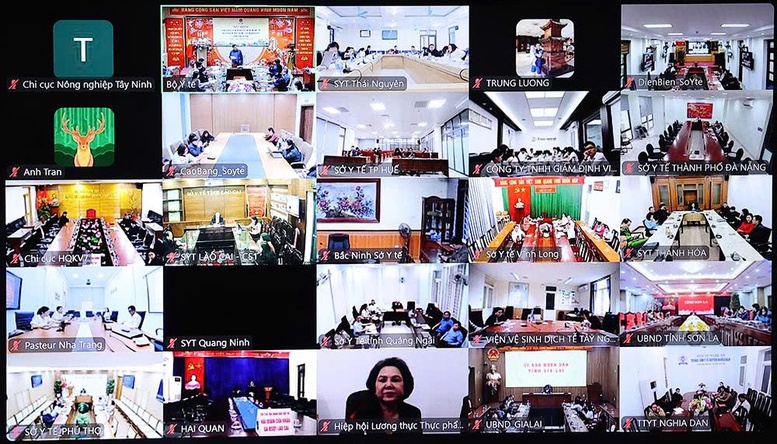
Online meeting locations - Photo: VGP/TM
Removing obstacles related to imported food.
According to Ms. Nguyen Thi Thanh Binh, Deputy Team Leader of the Lao Cai International Border Gate Customs Team, following the implementation of new regulations from January 26th, approximately 25 vehicles carrying confectionery shipments subject to food safety inspections, which fall under the responsibility of the Ministry of Industry and Trade, are currently stranded at Kim Thanh International Road Border Gate No. 2.
Currently, according to feedback from businesses, there are no official guidelines or instructions regarding the processing of registration requests and the issuance of food safety inspection results for these shipments. Therefore, businesses have not yet submitted the necessary documents to the Customs authorities for customs clearance.
The fundamental obstacle in implementing the new regulations related to imported goods is the declaration of conformity and state inspection. These confectionery shipments are imported goods – one of the four groups of goods that require a declaration of conformity.
According to the new regulations, the transitional period for conformity registration and the time for processing the application are 10 days, making it impossible for businesses to complete the process before Tet (Lunar New Year). Therefore, Lao Cai province hopes to resolve this difficulty by postponing the effective date of the new regulations by 20-30 days so that businesses can complete the conformity declaration in time, allowing goods to be cleared through customs.
Regarding this matter, Mr. Chu Quoc Thinh, Acting Director of the Food Safety Department, Ministry of Health, stated that concerning the registration documents for state inspection to serve as a basis for comparison with regular inspections, we are currently undergoing a transition. Previously, inspections were based on documents, but now they involve sampling for certain indicators, which are selected by the businesses/state inspection agencies.
Article 24 of Decree 46 of 2026 stipulates the documentation requirements for strict inspection, reduced inspection, and routine inspection. Accordingly, quality criteria are implemented in three cases: registration for conformity declaration, registration for applicable standards, and product registration.
In the absence of the three aforementioned sets of documents, Point b, Clause 2 and Point b, Clause 1 of Article 24 of Decree 46 stipulate that the sampling criteria shall be selected based on the product standards provided by the business owners. This Decree is very flexible, meaning that in addition to these documents, product criteria and product standards can also be used to select samples.
Article 54, Clause 1, Transitional Provisions of Decree 46 also stipulates that, for products that have been self-declared before the effective date of this Decree, organizations and individuals may continue to produce, trade, and import those products until the registration of conformity is completed.
During this period, organizations and individuals are responsible for completing the conformity assessment in accordance with this Decree within 12 months from the effective date. This means that all products that were declared before this effective date have another 12 months for businesses to complete the process.
Regarding confectionery products, Mr. Thinh stated that currently there are no technical standards in place, so there is no need to register for conformity declaration. If there is a previously submitted self-declaration, that document can be used. If there is no such self-declaration, a registration for the applicable standard can be made according to this new Decree.
"Therefore, the requirement for conformity declaration registration will not apply; conformity declaration registration will only be required when there are technical standards for safety and quality indicators," Mr. Chu Quoc Thinh emphasized.
At the meeting, representatives from the Ministry of Agriculture and Environment shared that Decree 46 demonstrates a strict management approach to food safety at every stage, including for imported goods, to ensure that the supply for export meets market requirements.
However, initial implementation will inevitably lead to confusion among relevant agencies, businesses, and localities. The most important thing is to gather information promptly and have solutions to guide and resolve these issues.
Representatives from the Ministry of Agriculture and Environment also stated that the implementation of the new regulations on routine inspections differs from Decree 15 of 2018. This regulation requires guidance for nationwide implementation. The Ministry of Agriculture and Environment will closely coordinate with the Ministry of Health in developing this guidance document to provide general instructions for all products under the new regulations compared to Decree 15 of 2018.
Mr. Chu Quoc Thinh said that the Ministry is expected to issue these guidelines tomorrow (February 3rd), after receiving feedback from the Ministry of Industry and Trade and the Ministry of Agriculture and Environment.
Hien Minh
Source: https://baochinhphu.vn/cac-bo-hop-thao-go-vuong-mac-ve-thong-quan-thuc-pham-102260202192618785.htm



















![[Video] Sunset at Lap An Lagoon – Where the sun sets over the fishing nets](https://vphoto.vietnam.vn/thumb/340x192/vietnam/resource/IMAGE/2026/05/31/1780192137701_beach-landscape-sea-water-nature-grass-745871-pxhere-com.jpeg)





![[Photo] The General Secretary, President and his wife lay flowers at the Ho Chi Minh Monument in Manila.](https://vphoto.vietnam.vn/thumb/1200x675/vietnam/resource/IMAGE/2026/05/31/1780219759477_anh-man-hinh-2026-05-31-luc-16-29-07.png)






































































Comment (0)