

Most Asia- Pacific countries don't expect tips, while in the US, tipping is a cultural norm.
Tom Marchant, co-founder of the UK-based luxury travel company Black Tomato, said, "Each country has its own way of handling tips, but it's a sensitive issue."
CNN interviewed etiquette experts and frequent travelers about proper tipping practices in different parts of the world . Below are some tipping guidelines for each continent.
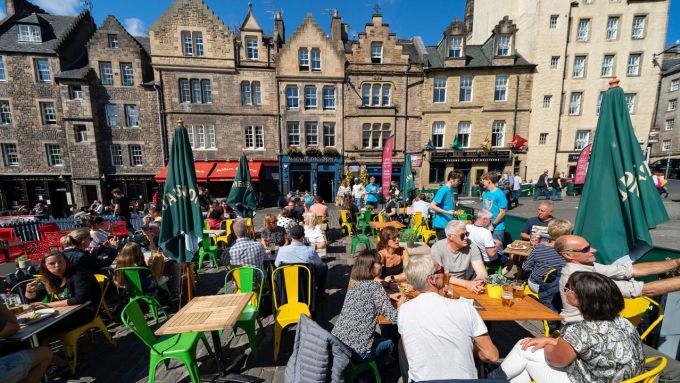
Tourists dine outdoors in Edinburgh, Scotland. Photo: Alamy
Asia-Pacific
"In Asia, you first need to know whether tipping is appropriate in your destination," CNN wrote. In Japan and South Korea, visitors should "refrain from leaving change anywhere," according to etiquette expert Maryanne Parker. "Tipping isn't part of their culture. It's considered rude," Parker said.
Nick Leighton, another expert, confirms this. He recently traveled to Japan and found the country "very consistent in its tipping culture." However, tipping is considered customary in ryokan (traditional inns), where service is highly valued.
In Thailand, tipping is not a long-standing cultural practice, and people rarely do it. However, tipping is gradually becoming more common.
In mainland China, the bill is usually given to diners at the beginning of the meal, just before the dishes are served; there is no tipping culture. Taiwan is similar.
According to Parker, tipping is not common in Australia. In New Zealand, it's "optional," although tipping 10% of the bill for excellent service has become customary in restaurants.
"Don't assume that every country in the Asia-Pacific region bans tipping. India is another example. Tipping is a custom here," Parker said.
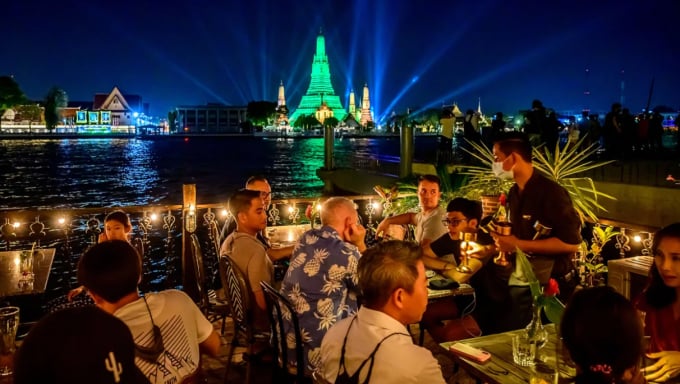
Tourists dine outdoors at a restaurant on the banks of the Chao Phraya River, admiring Wat Arun temple (lit with blue lights) in Bangkok, Thailand. Photo: AFP
Europe
According to Marchand, tipping is not common in Spain, and few locals practice it. Marchand advises guests to tip 2-3 euros at casual restaurants and bars, and 5-10% of the total bill at more upscale establishments.
John Robinson, from North Carolina, USA, recently visited Sicily, Italy, with 11 friends. He never saw a service charge (tip) printed on restaurant bills or private tours. The islanders don't expect tips. "If they do, they'd be very grateful," Robinson said. The tourist added that even without expecting tips, those working in the tourism and service industry do a good job. "They really do a great job," Robinson said.
The Frommers travel guide (USA), with over 75 million travel books published, states that service charges are often added to hotel and restaurant bills in Italy. If you want to tip for a service that truly satisfies you, round up the bill.
In the UK, tipping is typically 10-15% of the bill if you're satisfied with the service, according to local tour company Scottish Tours. Restaurants now often add a 12.5% service charge, so check your bill before tipping. Tipping is also common when food is served at your table. Tipping isn't necessary for takeout or drinks at the bar. Adding a tip to the driver isn't essential but is always appreciated.
In France, tipping isn't mandatory, but it's "a pleasant surprise if we leave some money," Parker said. Eastern European countries also don't expect tipping.
North America
"Visitors to America can be shocked. Tipping is cultural," Leighton said. The British newspaper Independent suggests that when visiting America, you should tip 15% of the fare to the driver, $1 for a luggage bag at the hotel (for the porter) or a drink at the bar, and 18% at restaurants.
However, according to CNN , in many parts of the US, tips have reached 20% of the total bill, especially after the pandemic severely damaged the service industry.
The Toronto Star says tipping in Quebec "is expected to be higher" than in the rest of Canada. In Mexico, tipping isn't mandatory but "everyone expects it," according to Parker. If customers are satisfied, they can leave a tip of 15% of the bill.
In Caribbean countries, tipping is expected. "From a personal perspective, leaving a generous tip is a way to help the locals. Many islands in this region are struggling because they suffer from numerous natural disasters," Parker said.
Other places in the world
In Africa, tipping is optional. For guided safari experiences, tips can range from $20-25 USD per day.
When visiting Central and South America, tourists should tip in local currency. Giving foreign currency requires locals to exchange it, which is inconvenient. In Peru, Chile, and Panama, a tip of 10% of the bill is recommended.
Brett Anitra Gilbert, an associate professor at the Kogod School of Business at American University in Washington, D.C., says tipping depends on the culture and customs of the place visited. However, Gilbert often makes an exception and increases the tip for locals, which makes them very happy.
Leighton advises that to know exactly how much to tip and when to tip, tourists should ask locals, hotel staff, or tour service providers.
Writer Lisa Wyatt Roe from Texas, USA, says she often joins Facebook groups and communities in the places she visits. The question "should I tip?" is usually answered with the most enthusiastic and accurate advice from locals.
(By Anh Minh , according to CNN )
Source link

![[Photo] Prime Minister Pham Minh Chinh attends the Conference on the Implementation of Tasks for 2026 of the Industry and Trade Sector](/_next/image?url=https%3A%2F%2Fvphoto.vietnam.vn%2Fthumb%2F1200x675%2Fvietnam%2Fresource%2FIMAGE%2F2025%2F12%2F19%2F1766159500458_ndo_br_shared31-jpg.webp&w=3840&q=75)





























































































Comment (0)