

During use, do you notice that the water jets from your showerhead are becoming weaker, spraying in erratic directions, and that cloudy white deposits are appearing on the surface of the nozzle? This phenomenon stems from hard water, which contains a large amount of dissolved mineral ions, mainly calcium and magnesium.
As water evaporates after each shower, these minerals are left behind, precipitating and forming a layer of calcium carbonate (CaCO3) that adheres tightly to the metal surfaces and rubber nozzles of the showerhead. Over time, this limescale buildup thickens, clogging the micro-spray nozzles. If left untreated, this not only overloads the booster pump or water supply system, but the damp environment mixed with mineral deposits also becomes an ideal breeding ground for bacteria, directly affecting the skin and respiratory health of users.
Ways to clean shower heads that have white limescale buildup.
Instead of having to disassemble the device with complex mechanical tools or use toxic industrial cleaning chemicals, you can completely clean white limescale buildup on your showerhead using familiar materials found in your kitchen.
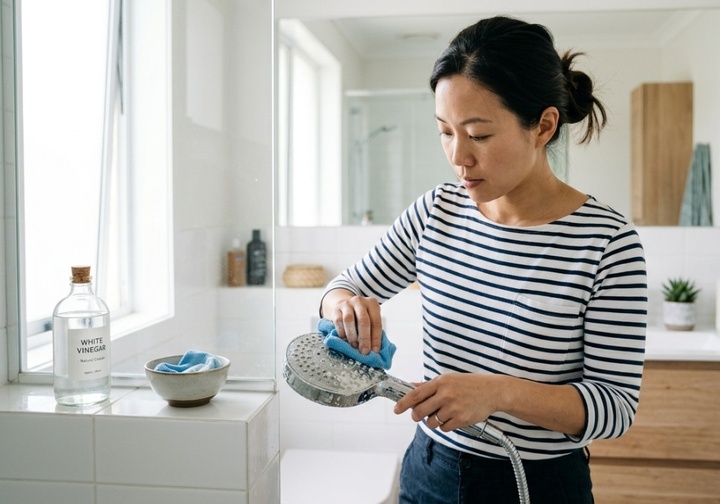
Cleaning showerheads with white vinegar can help remove plaque without scratching the surface of the fixture. Photo: CH
Method 1: Seal tightly with white vinegar.
This is a classic, safe, and highly effective method that doesn't require any plumbing expertise. White vinegar contains approximately 5-7% acetic acid. When this acidic solution comes into contact with calcium carbonate, the main component of limescale, a chemical reaction occurs, transforming the hard limescale into water-soluble calcium acetate salt and releasing CO2 gas. This process completely removes the buildup without scratching the chrome surface of the shower head.
Perform:
- Prepare a thick plastic bag, large enough to completely cover the shower head, along with a few rubber bands and about 300ml of white vinegar.
- Pour vinegar into a plastic bag. Pull the bag over the showerhead so that the side with the spray holes is completely submerged in the vinegar solution.
- Use a rubber band to tightly tie the opening of the plastic bag to the shower head to secure it in place.
- Leave it soaking for about 2 to 4 hours. If the sediment is too thick, you can let it soak overnight.
- Finally, remove the vinegar bag. Turn on the tap at maximum pressure for about 2 minutes to allow the water pressure to push out all the softened and loosened residue. Wipe the tap surface with a soft cloth.
Method 2: Combining baking soda and vinegar
In cases where showerheads haven't been cleaned for years, limescale deposits can harden into rock-like clumps. A combination of baking soda and white vinegar will create a deeper cleaning effect. The reaction between the alkaline compound (baking soda) and the acid (vinegar) produces a powerful effervescence of CO2 gas. Millions of these tiny bubbles act like a micro-drill, penetrating the crevices of the limescale, breaking down its physical structure, and making the cleaning process faster and more thorough.
Perform:
- Mix about 3 tablespoons of baking soda with a little water to form a paste.
- Using an old, soft-bristled toothbrush, apply this mixture evenly to the surface of the showerhead's spray nozzles, paying particular attention to areas with thick limescale buildup. Let the mixture sit for about 15 minutes.
- Continue wrapping the showerhead with a plastic bag containing white vinegar as in Method 1. As soon as the vinegar meets the baking soda, a bubbling reaction will occur.
- Let it sit for another 1-2 hours, then remove it. Use the same soft brush to gently scrub along the spray nozzles to remove any remaining residue, then rinse thoroughly with water.

Fresh lemons are also a cheap and readily available ingredient for cleaning showerheads. Photo: HT
Method 3: Using fresh lemons
If you don't like the strong, sour smell of white vinegar, fresh lemon is a perfect alternative. This method is suitable for monthly maintenance when the limescale isn't too thick. The abundant citric acid in fresh lemons is an excellent biological solvent that helps loosen mineral bonds. In particular, the essential oils from the lemon peel will leave a very pleasant and refreshing scent in the bathroom.
Perform:
- Squeeze the juice from 3 to 4 fresh lemons, straining out the seeds. You can add a little warm water to increase the volume of the solution.
- Remove the shower head. If your shower head is designed to be easily opened by hand, soak it directly in a bowl of lemon juice. If it's not convenient to remove it, use the method of wrapping it in a plastic bag as described above.
- Allow the solution to work for about 1 to 2 hours. Citric acid will gradually break down the cloudy white plaque.
- Rinse thoroughly with water, flush the valve to clear the small grooves, and dry with a microfiber towel.
Notes on cleaning showerheads with white limescale buildup.
Safe mechanical unclogging: For some showerheads with rubber or silicone nozzles, after soaking them in vinegar/lemon juice, you can gently massage the nozzles with your fingers to loosen the buildup. If the hard plastic or metal nozzles are deeply clogged, use a toothpick or safety pin to gently poke into each hole. Absolutely do not use excessive force that could tear the rubber nozzle.
Avoid abrasive materials: Do not use aluminum scouring pads, steel wool, or strong hydrochloric acid (HCl) toilet cleaners to scrub your showerhead. These will immediately strip away the delicate chrome/nickel plating, causing the showerhead to tarnish and rust permanently.
Note the soaking time for plated materials: If your shower head is made of bare brass, gold-plated, or dark nickel-plated, the contact time with acid, even natural acids like vinegar, should not exceed 30 minutes to avoid discoloration of the metal surface.
Understanding the nature of mineral deposits and flexibly applying scientific principles to cleaning not only helps restore the functionality of appliances and save costs, but also makes household chores easier, more refined, and safer for every family.
Source: https://vtcnews.vn/cach-ve-sinh-voi-sen-bi-dong-can-trang-ar1020452.html

























![[Photo] Reception to welcome General Secretary and President To Lam and his wife on their State visit to the Philippines](https://vphoto.vietnam.vn/thumb/1200x675/vietnam/resource/IMAGE/2026/06/01/1780295488620_vna-potal-chieu-dai-chao-mung-tong-bi-thu-chu-tich-nuoc-to-lam-va-phu-nhan-tham-cap-nha-nuoc-toi-philippines-8798060-7855-jpg.webp)







































































Comment (0)