

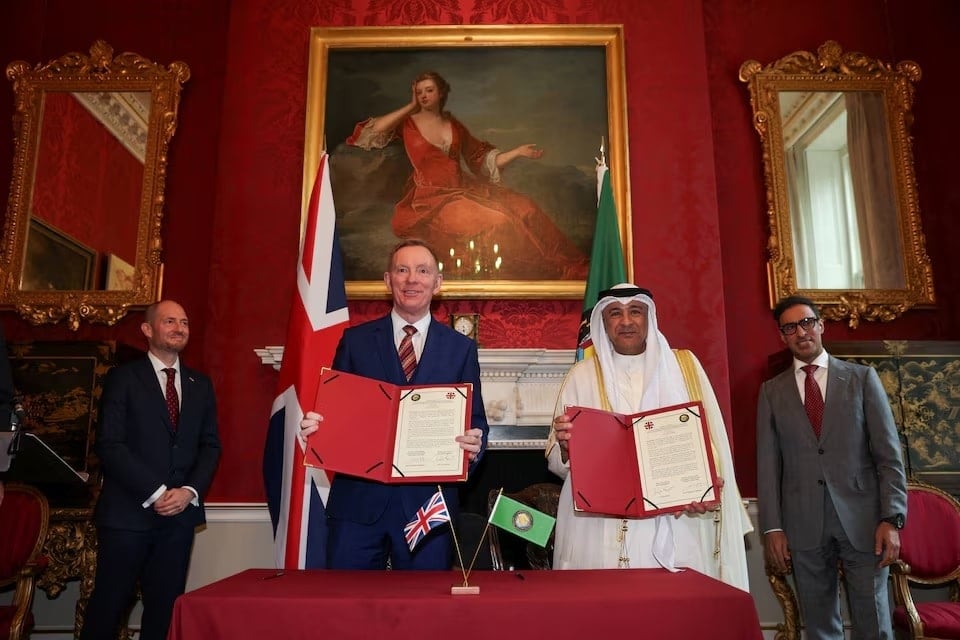
The agreement was signed on May 20th between the UK and six GCC countries: Bahrain, Kuwait, Oman, Qatar, Saudi Arabia, and the United Arab Emirates (UAE). This is the first free trade agreement between the GCC and a G7 country.
Seeking dual benefits
The agreement is comprehensive and inclusive, with a core commitment to deep tariff reductions. According to Reuters , around 93% of GCC import tariffs on British goods will be eliminated under the agreement, equivalent to approximately £580 million in taxes per year when fully implemented.
In return, the UK reduced some tariffs on goods from the GCC, although key exports from the region such as oil and gas were already tariff-free in the UK market. This indicates the agreement's focus is on expanding cooperation in non-energy sectors, services, and investment.
Sectors expected to benefit significantly include automotive, aviation, electronics, food and beverages, and especially services – a sector that currently accounts for more than half of the UK's exports to the GCC. This presents a considerable opportunity for British businesses, given the rapidly growing demand for luxury goods in the GCC, driven by some of the world's highest per capita incomes.
Reuters quoted GCC Secretary-General Jasem Mohamed Albudaiwi as praising the agreement for establishing a mechanism for cooperation and delivering “tangible and measurable” economic benefits to investors and citizens of the signatory parties. Currently, total trade between the UK and the GCC stands at around £53 billion per year and could increase by nearly 20% once the agreement is fully implemented, indicating significant potential for further cooperation between the parties.
Strategic repositioning move
The timing of this "win-win" agreement is no coincidence, reflecting the convergence of various economic and geopolitical pressures that are forcing countries to restructure their trade relations.
According to the BBC , for the UK, the agreement has two distinct layers of significance. Firstly, there are direct economic benefits, with the British government estimating the agreement could contribute around £3.7 billion annually to the economy in the long term. More importantly, it is a strategic step in the process of economic repositioning after Brexit.
Upon leaving the European Union, the UK no longer directly benefits from the continent's largest single market. This forces the country to proactively expand its network of partners to faster-growing regions with greater investment potential and greater strategic importance in terms of energy and capital flows.
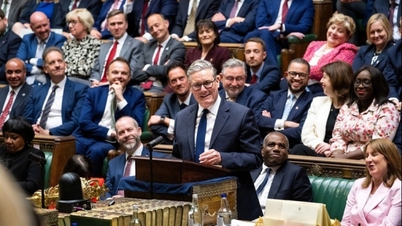
Therefore, the agreement with the GCC extends the series of agreements that the UK has been promoting with India, the US, the EU, and South Korea, aiming to build a more diverse and flexible space for trade cooperation and reduce dependence on the traditional European market. British Prime Minister Keir Starmer emphasized: “This agreement is a major victory for British businesses and workers, who are expected to benefit in the coming years through higher wages and more job opportunities.”
Meanwhile, for the GCC, the agreement comes at a time when the region wants to expand its economic influence beyond its traditional role as an energy supplier.
Saudi Arabia, the UAE, and Qatar are all investing heavily in finance, logistics, high technology, tourism, and clean energy as part of their post-oil development strategies. In this context, deeper access to the UK's financial, legal, educational, and technological ecosystems – particularly London, one of the world's largest financial centers – is strategically significant.
Observers believe that the potential of this complementary agreement lies not only in expanding trade in goods, but also in its ability to create a strategically important space for economic and investment cooperation between the UK and the Gulf region for decades to come.
The Greater Central Economic Zone (GCC) is currently the world's energy hub and is transforming into a new growth pole for global finance, logistics, technology, and investment. With a GDP of approximately £1.9 trillion and abundant international investment capital, the GCC possesses the necessary market access, capital flows, and geostrategic location, making it attractive to global partners.
More broadly, the historic UK-GCC handshake represents a vibrant slice of a new trade order characterized by less reliance on traditional trade blocs, greater flexibility in partnerships, and, importantly, a closer focus on energy security, technology, and investment. It also represents how nations are repositioning their roles in a fragmented yet interdependent world.
Source: https://baodanang.vn/cai-bat-tay-chien-luoc-giua-anh-va-vung-vinh-3337565.html

![[Photo] Standing Committee member of the Party Central Committee Tran Cam Tu working with the Central Inspection Committee](https://vphoto.vietnam.vn/thumb/1200x675/vietnam/resource/IMAGE/2026/05/28/1779969579668_ndo_br_bnd-2495-jpg.webp)
















































































Comment (0)