

To live in Saigon is to be a Saigonese. That's a concise, straightforward, and rather generous definition of a person living in Vietnam's largest city. However, when it comes to " Hanoiese ," that definition becomes complicated: How many years have you lived here? How many generations? Do you live in the Old Quarter or the suburbs? Are both your parents from Hanoi?
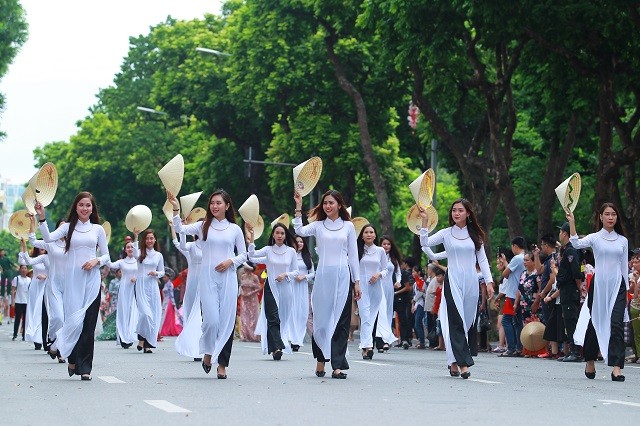 |
| A fashion show featuring traditional Ao Dai (Vietnamese long dress) will be held on the pedestrian street around Hoan Kiem Lake. |
After the liberation of Hanoi on October 10, 1954, there were approximately 200,000 people with registered residency in Hanoi. I'm not sure how many there are now. All I know is that, according to a news article from August 2023, after several expansions, Hanoi now has 8.5 million inhabitants.
Perhaps because land has expanded but the population remains large, a segment of the capital's residents has adopted such a strict definition. This is likely due to a desire to protect the refined and elegant image often associated with the "original" people of Thang An (Hanoi). Indeed, vegetable vendors in Lang village pass down this folk verse: " Brother, help me with a pair of sturdy, inexpensive carrying poles / Borrow a polite person to carry them to the capital ."
Preserving the unique humanistic values of a region is the right thing to do. However, we sometimes forget the historical flow of this land. The refined culture of Thang Long - Hanoi is a confluence of many regions. The central government was located here, attracting talented and distinguished individuals. Nguyen Trai was from Nhi Khe (formerly Ha Tay), Le Quy Don from Thai Binh, Ho Xuan Huong originally from Nghe An. Then there was the Ly Dynasty from Bac Ninh , the Tran Dynasty from Nam Dinh, the Later Le Dynasty from Thanh Hoa… (Since our country regained independence after more than 1000 years of Chinese rule, no king has been from Thang Long). All of them are the finest examples of the capital city, contributing to the diverse cultural achievements of Thang Long - Hanoi.
And it's not just kings and famous people; many renowned crafts in the capital were brought here by people of other origins. Hanoi pho (allegedly) originated from Nam Dinh. The famous pork sausage comes from Uoc Le village, Ha Tay province. Sticky rice cakes are from Hai Duong province. Although not born in the capital, these famous crafts and renowned delicacies that make up the 36 streets of Hanoi had to go through the evaluation and acceptance of the people of Hanoi before they could become famous and spread throughout the country.
Let's not forget Hanoi's colloquial name, "marketplace land"—a term coined by people from other places who came here to trade. This illustrates that the vitality of this land is created by people from all corners of the country.
Simply put, the people of Hanoi are from all over the country, and the remarkable thing about this place is that there is absolutely no regionalism. People from everywhere come to the capital, bringing with them the essence of their hometowns' professions to earn a living. They treat each other with politeness and refinement... to coexist harmoniously and thrive here. The elegance and sophistication that we often look back on the past with admiration comes from these people from all over the country.
So what exactly is a Hanoian? That concept, it turns out, has remained constant throughout history. Everyone, whether born and raised in this land or who came here to build a life, if they are connected to Hanoi, is already a Hanoian. Conversely, Hanoi's culture is always changing and adapting. It is always tolerant and open to receiving and refining the finest labor and positive values that people bring here.
Source
![[Photo] General Secretary and President To Lam presides over a working session with the Central Policy and Strategy Committee on the development of the materials industry.](https://vphoto.vietnam.vn/thumb/1200x675/vietnam/resource/IMAGE/2026/05/21/1779359935432_a3-bnd-3129-1412-jpg.webp)

![[Photo] National Assembly Chairman Tran Thanh Man working with the Standing Committee of the Law and Justice Committee](https://vphoto.vietnam.vn/thumb/1200x675/vietnam/resource/IMAGE/2026/05/21/1779378929214_ndo_br_1-4610-jpg.webp)













































































Comment (0)