

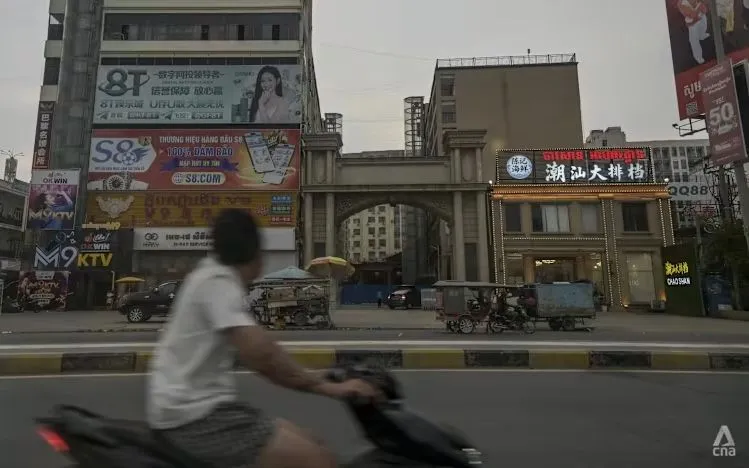
A man walks past a billboard advertising illegal online gambling in Bavet, Cambodia, May 2026. (Photo: CNA)
Cambodia has recently launched more aggressive crackdowns on online scam centers, targeting around 300 establishments, including many casinos. However, according to CNA, this campaign is leaving behind a humanitarian crisis as many foreigners who were lured into these scams now lack the money, documents, or visas to return home.
One of them is Abdul, a Ugandan who was promised a job teaching English in Bangkok, Thailand. After that plan fell through, he accepted a data entry job in Cambodia from online recruiters, but was then taken through several stages in Thailand, Laos, and then Cambodia. Upon arrival, Abdul said he was forced to participate in an online scam.
According to Abdul, he was not paid and was only freed after police raided the facility where he was being held. Even so, he is still unable to return home and is living in unsafe conditions in Phnom Penh.
CNA reported that in May, dozens of Indonesians camped outside their embassy in Cambodia, waiting for their repatriation papers to be processed after leaving the online gambling and fraud industry. Many said they were tricked into working there and subjected to abuse.

People ride motorbikes through an area where police are cracking down on fraud in Phnom Penh, Cambodia, May 2026. (Photo: CNA)
Experts believe Cambodia has become one of the hotspots for online scams in Southeast Asia. These scams often involve romance, fraudulent investments, cryptocurrency, or online gambling. Some participants are willing, but many are trafficked through fake job offers, have their passports confiscated, are held captive, beaten, or forced to meet sales quotas.
The Cambodian government asserts it is aggressively cracking down on this criminal industry. In April, Cambodia passed its first anti-fraud law, criminalizing technology-based fraud, recruitment, and support for fraud centers, with the highest penalty being life imprisonment.
However, experts warn that criminal groups are shifting to smaller-scale operations, hiding in apartments, townhouses, or residential areas in Phnom Penh. This makes detection and dismantling more difficult and increases the risk of those trapped being re-recruited into new scams.
Source: https://vtv.vn/campuchia-tiep-tuc-truy-quet-trung-tam-lua-dao-100260601133449921.htm





![[Photo] General Secretary and President To Lam presides over a meeting on preparations for the review of one year of operation of the three-tiered government system.](https://vphoto.vietnam.vn/thumb/1200x675/vietnam/resource/IMAGE/2026/06/02/1780391821195_a1-bnd-4595-9717-jpg.webp)















































































Comment (0)