


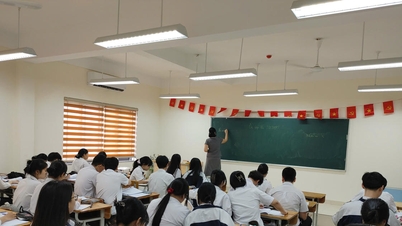
According to the Hanoi University's 2024-2025 academic year admissions plan, tuition fees for the next academic year will be approximately 720,000 - 1,740,000 VND per credit. Compared to last year's fees of approximately 650,000 - 1,390,000 VND per credit, tuition fees have increased by about 10-25%.
At other training institutions, tuition fee increases have also been announced. For example, at Hanoi Medical University, Associate Professor Dr. Le Dinh Tung - Head of the Training Management Department - stated that for the 2024-2025 academic year, the university will continue to collect tuition fees according to the Government's regulations for financially autonomous public educational institutions in group 2 (Decree 81/2021/ND-CP and Decree 97/2023/ND).
According to the aforementioned regulations, for non-autonomous universities, the lowest tuition fee in the Medical and Pharmaceutical fields has increased by approximately 3.1 million VND to 27.6 million VND/year; For level 1 autonomous public universities, tuition fees are determined at a maximum of twice the tuition fee ceiling of non-autonomous universities corresponding to each field of study and each academic year. For level 2 autonomous public universities, tuition fees are determined at a maximum of 2.5 times the tuition fee ceiling of non-autonomous universities corresponding to each field of study and each academic year. In 2023, the Medical and Traditional Medicine majors at Hanoi Medical University had the highest tuition fee at 55.2 million VND/year. Ophthalmic Refraction, Medical Laboratory Technology, Rehabilitation Technology, and Advanced Nursing programs had tuition fees of 41.8 million VND/year…
At the Ho Chi Minh City University of Medicine and Pharmacy, Associate Professor Dr. Nguyen Ngoc Khoi - Head of the Training Department, stated that in 2024, tuition fees for various majors will range from 46 to 84.7 million VND per academic year (10 months), a 10% increase compared to the current rates. The two majors, Medicine and Dentistry, will have tuition fees exceeding 80 million VND per year, an increase of over 7 million VND.
According to the admissions plan announced by Ho Chi Minh City University of Technology, in 2024 the university will offer 8 training programs with tuition fees ranging from a minimum of 30 million VND to a maximum of 807 million VND per year. Specifically, standard programs taught in Vietnamese; the Talent Program; and the High-Quality Vietnamese-French Engineering Program (PFIEV) have tuition fees of approximately 15 million VND per semester. Tuition fees for programs taught in English and advanced programs taught entirely in English are approximately 40 million VND per semester (excluding the Pre-English semester). For international transfer programs, tuition fees are approximately 40 million VND per semester for the first 2-2.5 years. For the final 2-2.5 years, transferring to a partner university, tuition fees range from approximately 566 to 807 million VND per year.
Earlier this April, Ho Chi Minh City University of Law also announced new tuition fees for the 2023-2024 academic year. These fees are significantly higher than the previous year. Students will pay tuition for the second semester at the new rate and cover the remaining amount from the first semester. The university also announced tuition fees for the 2024-2025 academic year, with increases ranging from over 2 million VND to approximately 16 million VND per year depending on the program.
Regarding concerns from students and their families about the tuition fee increase for the upcoming academic year, Dr. Nguyen Thi Cuc Phuong, Vice Rector of Hanoi University, shared that to pursue their desired major, students can consider several factors, such as choosing a university with tuition fees that are within their family's financial means. Some universities that are not yet fully autonomous in terms of recurrent and investment expenses may have lower tuition fees than those that are completely self-sufficient. In particular, according to Dr. Phuong, students should strive to excel academically to be eligible for scholarships. Students with above-average academic performance have a chance to receive scholarships. Scholarship amounts can range from 100% to 120% of tuition fees. For students from disadvantaged economic backgrounds, multiple cost-saving measures should be implemented simultaneously. In addition, students can also work part-time starting from their second year to cover part of their tuition or living expenses.
Source

![[Photo] Prime Minister Pham Minh Chinh presides over a meeting on private sector economic development.](/_next/image?url=https%3A%2F%2Fvphoto.vietnam.vn%2Fthumb%2F1200x675%2Fvietnam%2Fresource%2FIMAGE%2F2025%2F12%2F20%2F1766237501876_thiet-ke-chua-co-ten-40-png.webp&w=3840&q=75)



























































































Comment (0)