

Convenience comes with food safety risks.
Street food stalls in front of schools have long been an indispensable part of school life. However, behind this convenience lie food safety hazards that parents, students, and schools need to be aware of.
Data from the Food Safety Department of the Ministry of Health shows that 70-80% of street food, including snacks sold near school gates, is found to be contaminated with bacteria such as E. coli – a bacterium that causes diarrhea and intestinal diseases – and cholera. In particular, residual chemicals, pesticides, and growth hormones in these foods will gradually be absorbed into the body, accumulating and potentially causing cancer.
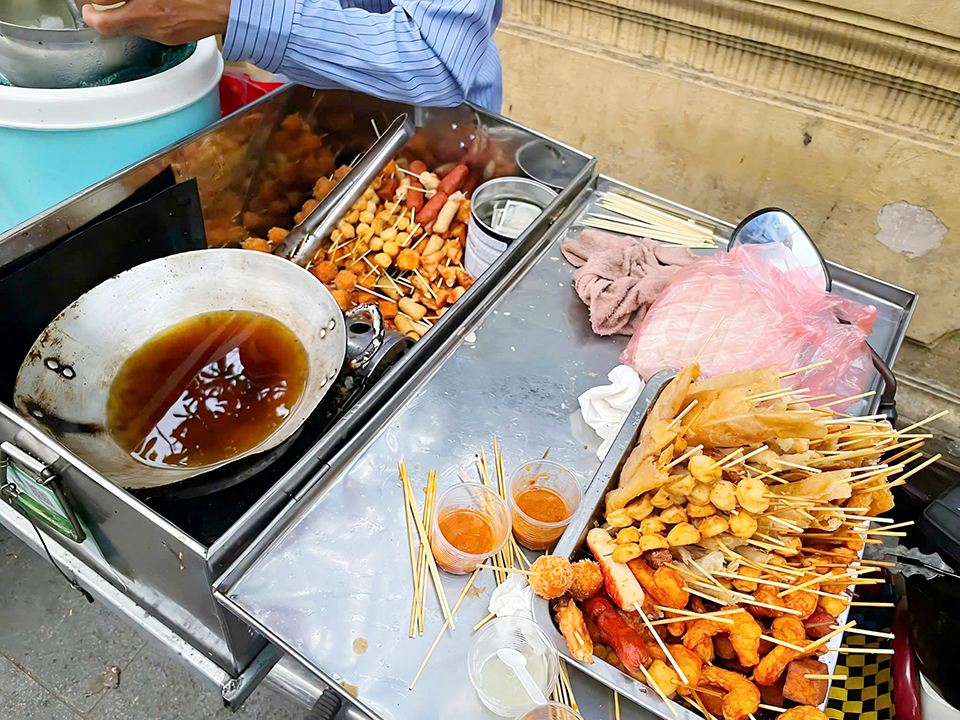
According to observations by reporters from Kinh tế & Đô thị (Economy & Urban Affairs), sidewalk stalls, mobile food carts, and street vendors are rampant in front of many schools in Hanoi, operating in a way that is difficult to control. These stalls sell a variety of snacks such as sausages, fried fermented pork rolls, cheese sticks, grilled meat skewers, mixed rice paper salad, and candies, always attracting large numbers of students due to their appealing flavors, eye-catching colors, and affordable prices.
Posing as students buying popular snacks, we were "overwhelmed" by the preparation methods and prices of these street food items near a school gate in Hanoi . Observations revealed that the price of various "dirty skewers" ranged from only 2,000 to 8,000 VND per skewer; many colorful and flavored soft drinks cost only 5,000 to 15,000 VND per cup;...
Alarmingly, these food items are often poorly processed with many ingredients of unknown origin and without brand labels. The frying oil is often reused multiple times and turns pitch black, posing a risk of producing harmful substances.
The processing procedures at these establishments are also noteworthy, as processing equipment is frequently used interchangeably between raw and cooked food without thorough cleaning. Vendors handle food directly with bare hands; inadequate storage methods, without proper covering, allow dirt and insects to easily penetrate;…
Even at a stall selling "dirty skewers" at the intersection of Lo Duc and Pham Dinh Ho streets (Hai Ba Trung district), near Le Ngoc Han Primary School, reporters witnessed vendors using rags to clean the spring roll rolling table – a place that comes into direct contact with food – to wipe their hands and processing tools such as knives and scissors, or to absorb excess oil in the trays holding cooked food.
Unable to find suitable locations, many street vendors disregard hygiene and sell their wares near unsanitary areas such as trash cans and sewers. Furthermore, vendors often pick up discarded skewers after customers discard them and reuse them. While it's unclear whether these skewers are properly cleaned and processed according to food safety standards, this irresponsible behavior demonstrates a disregard for food safety regulations and business ethics for the sake of profit.
The whole community is working together.
In recent times, ensuring food safety in schools has always been a priority for Hanoi City. Since August 2024, the city has begun implementing a specialized plan titled "Strengthening Food Safety Control in and Around School Gates in Hanoi" for all educational institutions throughout the city.
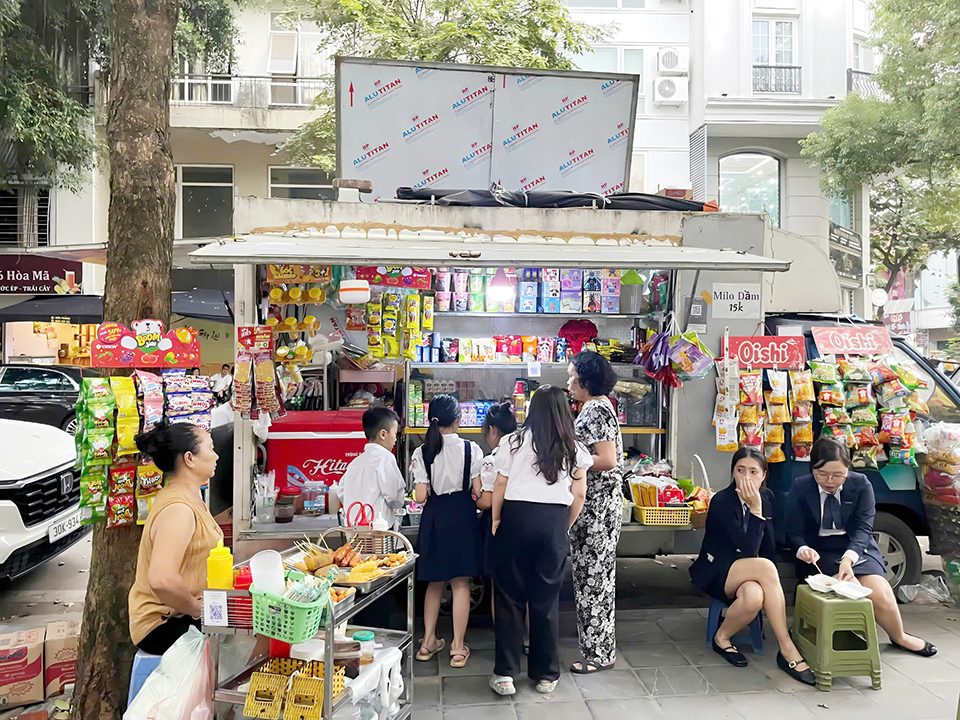
According to Dang Thanh Phong, head of the Hanoi Food Safety and Hygiene Department, from August 2024 to the end of August 2025, the entire city will focus intensely on ensuring food safety both inside and outside schools. Hanoi will review educational institutions, collective kitchens, and school canteens under its management.
At the same time, authorities will investigate, review, and continuously update information on food service establishments, street food vendors, and grocery stores selling pre-packaged and ready-to-eat processed foods around school gates, categorized by product type and category. However, government control will not be effective without cooperation from families and schools.
To minimize risks and protect children from food poisoning before school gates, Dr. Nguyen Trong An, former Deputy Director of the Department of Child Protection and Care, Ministry of Labor, Invalids and Social Affairs, believes that the role of family education is paramount.
Dr. Nguyen Trong An noted that parents should equip their children with basic knowledge about distinguishing between unsafe and safe food, identifying reputable establishments, and avoiding places that sell food that does not meet food safety standards.
In parallel, schools also need to take stronger action. Beyond simply advising students and parents against consuming street food of unknown origin, schools should strengthen supervision and proactively coordinate with relevant authorities to strictly penalize businesses that violate food safety standards.
Source: https://kinhtedothi.vn/canh-bao-an-toan-thuc-pham-truoc-cong-truong-hoc.html


















![[Photo] Reception to welcome General Secretary and President To Lam and his wife on their State visit to the Philippines](https://vphoto.vietnam.vn/thumb/1200x675/vietnam/resource/IMAGE/2026/06/01/1780295488620_vna-potal-chieu-dai-chao-mung-tong-bi-thu-chu-tich-nuoc-to-lam-va-phu-nhan-tham-cap-nha-nuoc-toi-philippines-8798060-7855-jpg.webp)























































Comment (0)