

An 11-year-old child with an abnormally large neck was diagnosed with a thyroid disorder during a medical examination, posing a risk of growth retardation and delayed puberty if left untreated.
An 11-year-old girl visited Medlatec General Hospital with an abnormally enlarged neck and was diagnosed with Hashimoto's thyroiditis in the hypothyroid phase.
 |
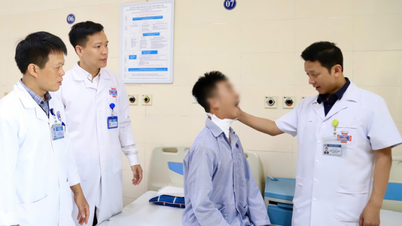
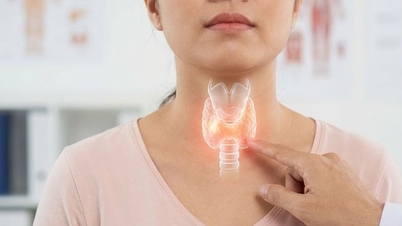
| Illustrative image. |
This is a common autoimmune disease affecting children and adolescents. If left undetected and untreated, it can impact a child's physical, mental, and motor development. In older children, it can cause delayed or absent puberty.
For about 3-4 years now, the family of 11-year-old PNBL from Hanoi noticed that her neck was unusually large, larger than that of her peers, and continuously increasing in size, accompanied by dry skin and constipation. Worried, the family took her to Medlatec General Hospital for examination.
At the hospital, the doctor conducted a clinical examination and performed tests and imaging studies to aid in diagnosis. Thyroid ultrasound images showed abnormally large left and right lobes, but no cystic or solid structures were detected.
Thyroid function tests showed elevated TSH levels, indicating hypothyroidism. Elevated anti-TPO and anti-TG levels indicated the presence of anti-thyroid antibodies in the blood.
The doctor diagnosed the child with Hashimoto's thyroiditis in the hypothyroid phase. Commenting on the case, Ms. Duong Thi Thuy, a pediatrician at Medlatec General Hospital, stated that Hashimoto's thyroiditis is not uncommon in children, with an incidence rate of 1-3%.
In this case, the disease has progressed to the hypothyroid stage. If not detected and treated early, it can affect physical, mental, and motor development. In older children, it can cause delayed puberty, cessation of puberty, irregular menstruation, menorrhagia, or amenorrhea in girls.
Currently, the patient is receiving outpatient treatment with hormone replacement therapy and maintaining euthyroidism according to a personalized regimen prescribed by the doctor.
Autoimmune thyroiditis in children: An incurable condition requiring long-term treatment. Hashimoto's thyroiditis (also known as autoimmune thyroiditis) is a chronic inflammation of the thyroid gland caused by an immune disorder. It is considered the leading cause of acquired hypothyroidism.
The disease is more common in women and can occur at any age, usually between 30 and 60 years old. In children and adolescents, the incidence is lower, but it can cause serious complications affecting their development.
Explaining the causes of the disease, Ms. Duong Thi Thuy said that it is caused by multiple factors, including complex interactions of genetics, environment, and hormones, leading to an inappropriate immune response against the thyroid gland.
The disease often progresses silently, with patients showing no symptoms for many years, only being diagnosed when the neck becomes abnormally enlarged or blood test results are abnormal.
When the disease progresses to the stage of hypothyroidism, it can cause the following symptoms in children: delayed puberty, stunted growth, delayed crawling/rolling up; menstrual disorders, menorrhagia, amenorrhea leading to infertility;
Fatigue, lethargy, and excessive sleepiness; difficulty concentrating, depression; unusual weight gain; constipation; dry skin; dry, brittle hair; often feeling cold; joint stiffness and muscle pain.
Hashimoto's thyroiditis is a chronic, incurable condition that requires long-term, almost lifelong treatment to stabilize thyroid function, control hypothyroidism, and prevent dangerous complications. However, parents shouldn't worry too much because with proper treatment, children can still lead normal lives and develop normally.
Parents need to monitor their children regularly and remind them to follow the doctor's instructions. Experts recommend that children with thyroid disease have blood tests every 3-6 months to ensure that thyroid hormone levels remain within the normal range.
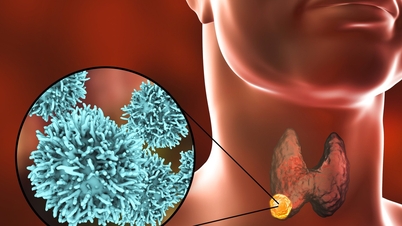
According to GLOBOCAN statistics, thyroid cancer ranks 9th among the most common types of cancer in Vietnam, and it has a high cure rate.
Thyroid cancer is divided into four types, including: papillary thyroid cancer (accounting for up to 80% of cases), which develops slowly, has a high cure rate, and rarely causes death;
Follicular thyroid cancer (accounting for up to 15%) has the potential to metastasize to the bones, lungs, and other organs; medullary thyroid cancer (accounting for about 2%) is often associated with a family history; undifferentiated thyroid cancer (accounting for about 2%) is difficult to treat, grows rapidly, and often metastasizes quickly to other organs.
To prevent thyroid cancer, doctors at K Hospital recommend that the best measures are improving physical fitness and health knowledge.
Therefore, it is necessary to develop healthy eating habits: Drink plenty of water, eat lots of green vegetables and fruits; limit fried, grilled, salted, canned, and processed foods... because these are unhealthy and risk factors for many types of cancer.
In addition, you should exercise for 30 minutes each day, which will help keep your body flexible, boost your immune system, and reduce stress and fatigue. Acquire knowledge about thyroid cancer and other types of cancer to proactively protect your health and detect malignancies early.
Therefore, the silent development of thyroid cancer leads patients to be complacent and not seek timely examination and treatment, increasing the risk of metastasis to other organs.
Some thyroid cancer tumors can affect thyroid function, compressing nearby organs and causing symptoms including shortness of breath, difficulty swallowing, hoarseness, loss of voice, and swelling and pain in the neck.
If thyroid cancer spreads to other parts of the body, the patient may experience symptoms such as fatigue, loss of appetite, nausea, vomiting, and unexplained weight loss.
According to Dr. Bich, to screen for thyroid cancer, young people should have a general health check-up once a year, especially those with high risk factors such as having parents or siblings with thyroid cancer or a history of previous radiation therapy to the neck area.
Additionally, if a lump is felt or seen in the neck area, or if symptoms such as hoarseness, difficulty swallowing, or a feeling of something stuck in the throat occur, patients should immediately go to a medical facility for examination and advice.
Proactive general health check-ups, including thyroid examinations and ultrasounds, are one of the measures for screening and early detection of thyroid cancer.
Early detection of thyroid cancer improves treatment outcomes and prevents metastasis, a potentially life-threatening complication.
Source: https://baodautu.vn/canh-bao-tinh-trang-tre-hoa-benh-ly-tuyen-giap-d227074.html

![[Photo] General Secretary and President To Lam presides over a meeting on preparations for the review of one year of operation of the three-tiered government system.](https://vphoto.vietnam.vn/thumb/1200x675/vietnam/resource/IMAGE/2026/06/02/1780391821195_a1-bnd-4595-9717-jpg.webp)

















































































Comment (0)