

1. Understanding urticaria correctly
- 1. Understanding urticaria correctly
- 2. Medications for hives
- 2.1. Antihistamines are the cornerstone of first-line treatment.
- 2.2. Montelukast
- 2.3. Corticosteroids should only be used for short periods during acute episodes.
- 2.4. Omalizumab treatment for refractory urticaria
- 3. Some notes
Urticaria (hives) occurs when mast cells in the skin release histamine and other inflammatory mediators, causing vasodilation and fluid leakage into the tissue, creating the characteristic itchy, red, raised bumps. It's important to distinguish between acute urticaria, which lasts less than six weeks and usually has a clear cause such as food allergies, medication allergies, or insect bites; and chronic urticaria, which lasts longer than six weeks and in most cases has no identifiable trigger, even after dietary and lifestyle changes.
Clinically, hives can appear anywhere on the body, changing location from day to day, causing itching and burning. Some more severe cases are accompanied by angioedema, which is swelling in the deeper layers of the skin, commonly around the eyes, lips, throat, or extremities. Angioedema accompanied by shortness of breath is a medical emergency requiring immediate medical intervention.
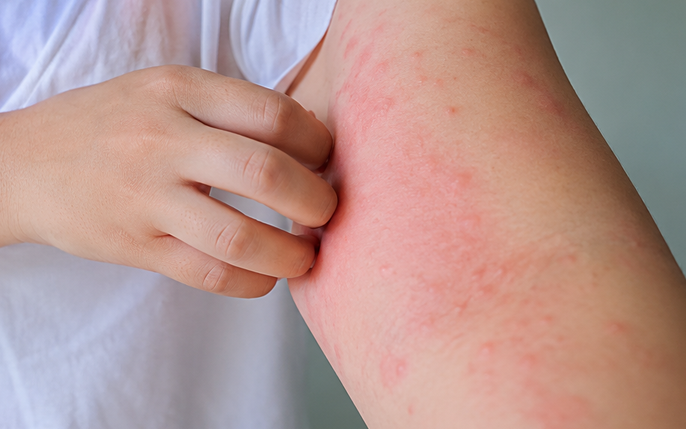
Hives, or urticaria, is a skin condition characterized by the appearance of red, swollen bumps that cause intense itching and can spread to many areas of the body.
2. Medications for hives
2.1. Antihistamines are the cornerstone of first-line treatment.
According to the international treatment guidelines of the European Society for Clinical Allergy and Immunology, second-generation H1 antihistamines that do not cause drowsiness are the preferred choice for treating urticaria, both acute and chronic. Common active ingredients in this group include cetirizine, loratadine, fexofenadine, and levocetirizine.
The significant advantage of second-generation antihistamines over older generations like chlorpheniramine or promethazine is their more selective histamine inhibition, less penetration across the blood-brain barrier, and therefore less drowsiness, poor concentration, and dry mouth. This is especially important for people who need to maintain their activity levels, such as working or driving, throughout their treatment.
The usual starting dose is one tablet daily, taken in the evening to take advantage of the effects that last overnight, when hives often flare up more intensely due to decreased body temperature and increased activity of the parasympathetic nervous system.
When is it necessary to add H2 antihistamines?
In addition to H1 receptors, histamine also acts on H2 receptors distributed in the gastrointestinal tract and partly in the skin. In cases of urticaria that do not respond adequately to H1 antihistamines alone, doctors may combine them with H2 antihistamines such as famotidine. The mechanism is that when both types of receptors are inhibited simultaneously, the effectiveness of symptom control is significantly enhanced, especially in patients with urticaria accompanied by facial flushing or gastrointestinal symptoms.
2.2. Montelukast
Leukotriene receptor antagonists, such as montelukast, are commonly used to treat asthma and allergic rhinitis, but they also play an adjunctive role in chronic urticaria. Leukotrienes are inflammatory mediators released alongside histamine from mast cells, contributing to allergic reactions. Adding montelukast to the regimen may help patients who do not respond adequately to antihistamines alone, particularly those with a history of aspirin intolerance or nonsteroidal anti-inflammatory drugs (NSAIDs).
2.3. Corticosteroids should only be used for short periods during acute episodes.
Oral corticosteroids such as prednisolone have a strong anti-inflammatory effect and are often prescribed for severe acute urticaria attacks, especially when angioedema is present. However, this is only a short-term measure, usually no more than five to seven days, aimed at controlling severe flare-ups while waiting for the underlying medication to take effect.
Long-term use of corticosteroids to control chronic urticaria is not recommended due to the risk of serious side effects such as osteoporosis, hyperglycemia, adrenal insufficiency, and immunosuppression.
2.4. Omalizumab treatment for refractory urticaria
For patients with chronic urticaria who do not respond to antihistamines after four to six weeks of intensive treatment, omalizumab is a third-line treatment option approved by the U.S. Food and Drug Administration. It is a monoclonal antibody that inhibits circulating free immunoglobulin E, thereby reducing mast cell activation and histamine release.
Omalizumab is administered subcutaneously every four weeks, usually providing significant improvement from the first week and good symptom control in the majority of patients with refractory urticaria. However, it is an expensive biological drug and requires monitoring at a medical facility after each injection due to the risk of anaphylactic reactions, although this rate is very low in clinical practice.

In addition to medication, combining it with other supportive measures can lead to better treatment outcomes.
3. Some notes
Medication treatment is much more effective when combined with supportive measures. Keeping a daily symptom diary, including the time of onset, intensity of itching, foods eaten, medications being taken, and stress levels, helps doctors and patients identify potential triggers and adjust treatment plans accordingly.
Regarding skincare, use fragrance-free body wash and lotion, and avoid bathing in excessively hot water, as high temperatures stimulate the release of histamine from mast cells in the skin. Applying a cool compress to the itchy area helps constrict blood vessels and temporarily reduces symptoms while waiting for medication to take effect. Stress management is also crucial, as cortisol and other stress hormones can amplify inflammatory responses and worsen hives.
For those requiring micronutrient supplementation, some studies suggest that patients with chronic urticaria often have lower vitamin D levels than the general population, and vitamin D supplementation in deficient individuals may somewhat improve treatment response, although current evidence remains modest.
While most cases of hives can be managed at home or with outpatient monitoring, some signs require emergency medical intervention. Swelling around the lips, tongue, throat, or larynx causing difficulty swallowing, hoarseness, or difficulty breathing is a life-threatening situation requiring immediate epinephrine injection and emergency medical attention. Additionally, chest pain, dizziness, low blood pressure, or loss of consciousness accompanying hives are signs of anaphylactic shock requiring immediate emergency treatment.
Urticaria is a condition that can be well managed with the right approach. It's important not to stop medication prematurely when symptoms temporarily improve, as chronic urticaria requires continuous treatment and regular monitoring to achieve long-term, sustainable control.
Please check out more videos of interest:
Source: https://suckhoedoisong.vn/su-dung-thuoc-gi-khi-noi-me-day-man-ngua-169260531153342033.htm
![[Photo] General Secretary and President To Lam presides over a meeting with the Central Organizing Committee.](https://vphoto.vietnam.vn/thumb/1200x675/vietnam/resource/IMAGE/2026/06/03/1780482764658_a1-bnd-4741-3342-jpg.webp)
![[Photo] Secretary of the National Assembly Party Committee, Chairman of the National Assembly presides over the meeting of the Standing Committee and Executive Committee of the National Assembly Party Committee.](https://vphoto.vietnam.vn/thumb/1200x675/vietnam/resource/IMAGE/2026/06/03/1780480353201_ndo_br_bnd-2585-jpg.webp)

![[Photo] First session of the 14th Congress of the Vietnam Trade Union](https://vphoto.vietnam.vn/thumb/1200x675/vietnam/resource/IMAGE/2026/06/03/1780465947883_ndo_br_img-3852-jpg.webp)






















































![[Video] Sunset at Lap An Lagoon – Where the sun sets over the fishing nets](https://vphoto.vietnam.vn/thumb/1200x675/vietnam/resource/IMAGE/2026/05/31/1780192137701_beach-landscape-sea-water-nature-grass-745871-pxhere-com.jpeg)







































Comment (0)