

Patient V.D.CT (19 years old) was admitted to the hospital in a state of lethargy, fatigue for several days, and severe altered consciousness.
According to the patient's family, since the beginning of 2026, CT has shown abnormal mental symptoms; she is easily agitated, occasionally screams for no reason, and self-harms. Her family took her to a medical facility for examination, where she was diagnosed with schizophrenia and prescribed tranquilizers.

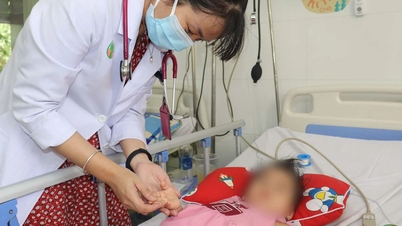
The patient has autoimmune encephalitis. (Photo: Provided by the hospital)
At the Department of Neurology, Nguyen Trai Hospital, doctors suspected this was not a common mental illness. Test results showed the patient had autoimmune encephalitis. This is a rare disease that occurs when the body produces antibodies that attack its own brain cells, causing pseudopsychiatric symptoms before devastating the nervous system.
Subsequently, the patient rapidly deteriorated, experiencing persistent high fever, lethargy, multiple episodes of generalized seizures, abnormal facial movements, severe respiratory failure, hypotension, and septic shock.
Dr. Lam Kim Bao, Specialist II, Department of Intensive Care and Toxicology, Nguyen Trai Hospital, said: "Given the patient's critical condition, the treatment team simultaneously implemented many intensive care measures such as endotracheal intubation, mechanical ventilation, using vasopressors to maintain blood pressure, multiple plasma exchanges to eliminate autoimmune antibodies causing the disease, and using high-dose corticosteroids and anticonvulsant drugs to control seizures."
Challenges continued to arise when patients developed hospital-acquired infections caused by multidrug-resistant bacteria. Based on antibiotic susceptibility testing results, doctors developed individualized treatment protocols using new generation antibiotics to control the infection.
After more than two months of persistent treatment, the patient's condition gradually improved. By March 23rd, the patient had stopped having seizures, their consciousness had improved significantly, and they were weaned off the ventilator. A week later, the patient was fully conscious, communicating normally, and had the breathing tube removed.
Doctors advise that people should not be complacent when family members, especially teenagers and young adults, suddenly exhibit unusual mental symptoms such as behavioral changes, agitation, rambling speech, unwarranted shouting, emotional disturbances, lethargy, or seizures. These may not simply be signs of mental illness but could also be early signs of autoimmune encephalitis – a rare but dangerous disease that is easily overlooked or misdiagnosed.
Autoimmune encephalitis occurs when the immune system produces antibodies that directly attack nerve cells, causing brain damage. If not detected and treated promptly, the disease can progress rapidly, leading to respiratory failure, severe neurological disorders, long-term sequelae, and even life-threatening conditions. Therefore, when abnormal symptoms of consciousness or behavior appear, patients should be taken to a medical facility with a neurology specialist for early examination and diagnosis.
The doctor also noted that treatment for autoimmune encephalitis is often prolonged and requires close cooperation between the patient, family, and healthcare professionals. After discharge, patients need to strictly adhere to the treatment protocol, use medication as prescribed, and have regular follow-up appointments to monitor for the risk of recurrence. Early detection, appropriate treatment, and long-term monitoring are crucial factors in helping patients recover neurological function and improve their quality of life.
Source: https://vtcnews.vn/co-gai-19-tuoi-mac-can-benh-tu-tan-cong-minh-hiem-gap-ar1021676.html
![[Photo] General Secretary and President To Lam presides over a meeting with the Central Organizing Committee.](https://vphoto.vietnam.vn/thumb/1200x675/vietnam/resource/IMAGE/2026/06/03/1780482764658_a1-bnd-4741-3342-jpg.webp)
![[Photo] First session of the 14th Congress of the Vietnam Trade Union](https://vphoto.vietnam.vn/thumb/1200x675/vietnam/resource/IMAGE/2026/06/03/1780465947883_ndo_br_img-3852-jpg.webp)
![[Photo] Secretary of the National Assembly Party Committee, Chairman of the National Assembly presides over the meeting of the Standing Committee and Executive Committee of the National Assembly Party Committee.](https://vphoto.vietnam.vn/thumb/1200x675/vietnam/resource/IMAGE/2026/06/03/1780480353201_ndo_br_bnd-2585-jpg.webp)
























































![[Video] Sunset at Lap An Lagoon – Where the sun sets over the fishing nets](https://vphoto.vietnam.vn/thumb/1200x675/vietnam/resource/IMAGE/2026/05/31/1780192137701_beach-landscape-sea-water-nature-grass-745871-pxhere-com.jpeg)








































Comment (0)