

AI music is booming, but it "lacks heart."
TRO - Music is one of the prime examples of this phenomenon. With over 139,000 subscribers and 163 videos , the channel has garnered over 45 million views. Its popularity stems primarily from tracks like "Van Ly Sau" (nearly 10 million views) and "Da Lat Con Mua Khong Em" (15 million views in three months). These figures demonstrate that listeners are not just interested temporarily, but are genuinely embracing AI music as a regular form of entertainment.
The song "AI Says I'll Live My Life for You" has become a sensation, attracting millions of views.
In addition, many other creators have contributed to this diversity. Ken Quách Official has attracted attention with his bolero and rumba songs with guitar arrangements in a rustic style. AI-generated love songs experiment with new arrangements, such as the rock-metal version of "Diễm xưa". Many other AI-generated music videos have also achieved millions of views, including "Mưa chiều" (4.4 million views), "Xin còn gọi tên nhau" (1.5 million views), and "Một lần nhìn nhau thôi" (1.2 million views).
The Vietnamese Music AI channel, despite having only nearly 13,000 followers, has created unexpected sensations. In November, a series of new videos exploded in popularity, notably "Rồi cũng già" (1.5 million views) and "Mưa chiều" (789,000 views). These successes demonstrate that with just an impressive arrangement, AI-generated content can spread rapidly regardless of the channel's size.
Previously, in October, "Say một đời vì em" (Ken Quách - Hương My Bông, 10% AI-assisted) garnered over 13 million views. The song spawned numerous AI-generated cover versions, demonstrating the "cloning" capability and rapid spread of AI-powered products.
Despite achieving relative technical perfection, AI music still faces its biggest obstacle: a lack of genuine emotion. After the initial curiosity, a segment of the audience realizes that AI music easily sounds repetitive, lacking the improvisation and natural vibrations that real artists bring. Comments like "it gets boring after listening to it many times" and "they all sound the same" are becoming increasingly frequent.
Many artists believe that emotion is the core value of music, and that's something AI cannot yet replace. Singer Tung Duong stated that AI can assist in songwriting and performance, but it cannot replace the heart of the artist. He once refused to sing AI-generated songs, even though they were gaining attention, because he wanted to maintain authenticity in expressing emotions and respect the intellectual property of the songwriter. According to him, artists in the digital age also carry the responsibility of preserving humanity – something AI lacks.
"I want the most genuine emotions, I want to appreciate the creativity and dedication of the musicians. AI should only be a supporting tool, not a complete replacement," - Singer Tung Duong

Singer Tung Duong.
People's Artist Thanh Lam shares the same view, believing that human intelligence and emotions are something AI can never reach. Singer Nguyen Vu, who once covered the song "AI Says a Lifetime Because of You," commented that only a genuine voice can move the audience because it contains personal stories and experiences.
From a creative perspective, musicians are also quickly realizing the limitations of technology. Nguyen Van Chung emphasized that AI is merely a tool and cannot yet become the creative subject. Musician Dong Thien Duc, after trying to compose using AI, believes the resulting product is quite "soulless," lacking personal experience – a crucial element for a song to endure.
Do listeners choose AI or the artist?
The rise of AI music has created a new competition among artists, especially young artists without a solid foundation. With listeners easily accessing a plethora of "perfect" AI recordings, real artists face pressure to improve their performances to avoid being unfairly compared.
However, many argue that the issue isn't whether AI can replace artists, but rather how artists choose to approach the technology. Viewing AI as a supporting tool allows artists to shorten the time from idea to product and experiment with new approaches. If they see AI as a competitor, they risk becoming passive and even losing confidence in their creative process.
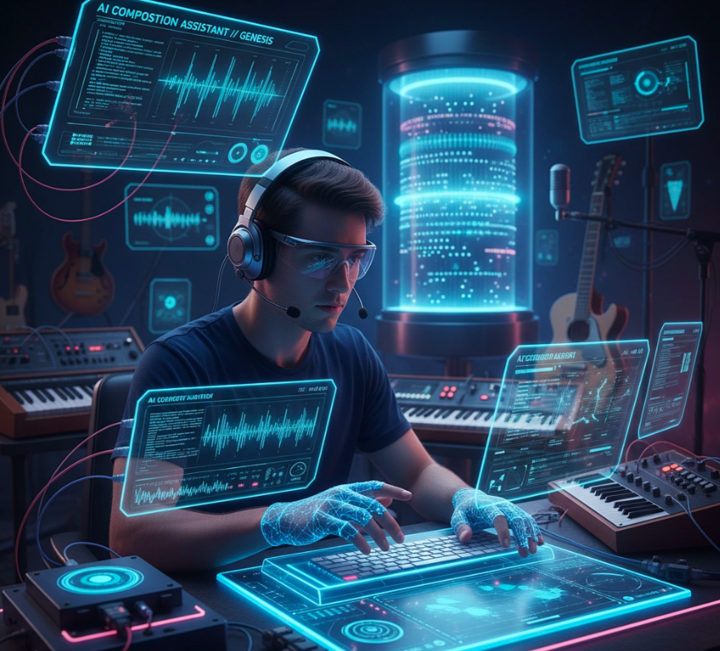
Image created using AI technology (Illustrative image).
Alongside the opportunities, challenges related to copyright have also emerged. Many artists worry about their voices or works being used illegally to create new AI products. This is not only a concern for economic rights but also for the artist's identity and integrity. In a context where technology can almost perfectly mimic voices, the line between real and fake is increasingly blurred, forcing artists to proactively protect their image.
Nevertheless, the common thread among these viewpoints is that the artist remains central. Audiences understand that AI may be technically perfect but emotionless; while humans may be imperfect but are rich in emotion. It is this imperfection that creates the personality, the story, and the depth that resonates with listeners.
When true artists maintain their identity and know how to utilize technology properly, music can enter a new phase: more modern, more flexible, yet still deeply human. AI music, therefore, is not necessarily a threat, but can become a catalyst for artists to reinvent themselves, improve quality, and affirm emotional value – something that technology can hardly replace.
Source: https://vtcnews.vn/canh-tranh-gay-gat-nghe-sy-cong-nghe-ar1003705.html
![[Photo] Reception to welcome General Secretary and President To Lam and his wife on their State visit to the Philippines](https://vphoto.vietnam.vn/thumb/1200x675/vietnam/resource/IMAGE/2026/06/01/1780295488620_vna-potal-chieu-dai-chao-mung-tong-bi-thu-chu-tich-nuoc-to-lam-va-phu-nhan-tham-cap-nha-nuoc-toi-philippines-8798060-7855-jpg.webp)




![[Photo] General Secretary and President To Lam and the President of the Philippines hold talks.](https://vphoto.vietnam.vn/thumb/1200x675/vietnam/resource/IMAGE/2026/06/01/1780286997787_anh-man-hinh-2026-06-01-luc-11-09-43.png)


































































![[Infographic] Key policies effective from June 2026](https://vphoto.vietnam.vn/thumb/402x226/vietnam/resource/IMAGE/2026/06/01/1780300598551_2_20260601144253.webp)













Comment (0)