

The nightmare called the highway
Returning from his trip during the April 30th - May 1st holiday , Mr. Pham Minh Tuan Duc, Marketing Manager of an automobile distribution company in Ho Chi Minh City, is still haunted by the experience: "I just had a long journey from Ho Chi Minh City to An Giang and back. Looking at the route map on the expressway showing the congestion, I immediately switched to National Highway 1A, but the situation wasn't any better. The volume of traffic was too high, mainly motorbikes, making the space for movement very narrow. The journey from Can Tho to Ho Chi Minh City normally takes a maximum of 3 hours, but on May 3rd, it took me 5 hours. National Highway 1A is still a vital route connecting Ho Chi Minh City and the Mekong Delta provinces, but it is frequently congested on weekends, especially during holidays, making people very tired."
Similarly, Mr. Nguyen Phong, a resident of Ben Tre (now part of Vinh Long province), also suffered because his journey of a few dozen kilometers felt long and exhausting. On the morning of April 30th, Mr. Nguyen Phong left Ho Chi Minh City for the Mekong Delta for the holiday. The journey, which normally takes just over two hours, was almost completely paralyzed during peak hours. From the western gateway of Ho Chi Minh City, especially along Le Kha Phieu street, vehicles lined up in long queues, often coming to a standstill. In some sections, it took nearly 30 minutes to travel less than 1 kilometer. "The problem isn't just the sudden increase in traffic, but also the infrastructure failing to keep pace with the growth in vehicles. Major intersections have become 'bottlenecks,' causing prolonged traffic congestion," Mr. Phong concluded.
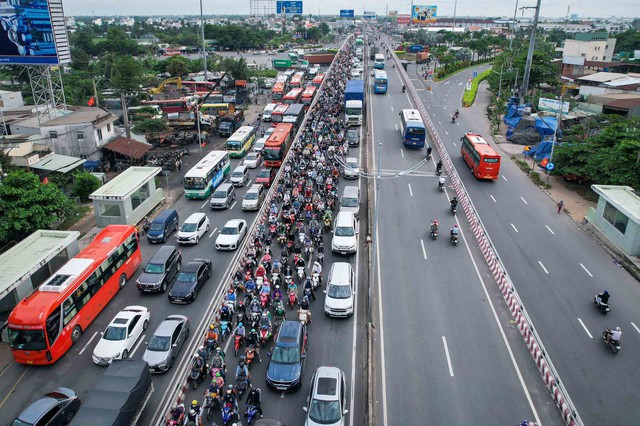
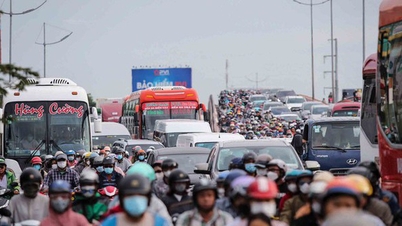
For many years, National Highway 1 has been frequently congested and poses a high risk of accidents due to its narrow width. (In the photo: Traffic jam on National Highway 1 heading from Ho Chi Minh City to the Mekong Delta)
PHOTO: NHAT THINH
In the eastern part of Ho Chi Minh City, National Highway 51 (QL51) is also a nightmare for drivers and commuters. Although the Ho Chi Minh City - Long Thanh - Dau Giay expressway has eased traffic congestion, QL51 remains the main route for many vehicles traveling to Dong Nai and Ba Ria-Vung Tau (formerly). In particular, whenever the expressway experiences problems, traffic is immediately diverted to QL51, creating intense pressure and frequent traffic jams.
Mr. Nguyen Thanh Phong, director of a transportation company in Phu My Ward (Ho Chi Minh City), said: "National Highway 51 is my daily commute route. The road is in very poor condition with many rough, peeling sections and potholes. What's more, this route frequently experiences prolonged traffic jams, causing losses in time, health, and costs for people; in addition, it poses a potential risk of accidents."
According to Mr. Phong, in the transportation process of businesses, the use of expressways will be prioritized because it is necessary to meet customer time requirements. However, expressways cannot yet cover the entire route; many branch routes still have to travel through national highways and need to be upgraded and expanded to accommodate the increasing volume of traffic.
Mr. Le Van Quyen, a long-time truck driver in Ho Chi Minh City, also acknowledged that the current situation shows that national highways around Ho Chi Minh City, such as National Highway 13, National Highway 1K, National Highway 22, etc., are all overloaded, with narrow roads while the volume of traffic is very high.

National Highway 1 is frequently congested and poses a risk of accidents due to its narrow road surface. (In the photo: Traffic jam on National Highway 1 heading from the Mekong Delta towards Ho Chi Minh City)
PHOTO: NHAT THINH
"There are stretches of road that are only a few dozen kilometers long, but they take a lot of time to travel. For example, National Highways 22 and 13 have many intersections, and there are constant stops at red lights. National Highway 13, although widened in some sections in Binh Duong (formerly), becomes a bottleneck right at the gateway to Ho Chi Minh City, frequently congested due to the large number of vehicles traveling to the city center every day. Or, traveling from Tay Ninh to Ho Chi Minh City, which is only about 60 km, can sometimes take up to 4 hours," Mr. Quyen lamented.
The series of upgrade and expansion projects are all progressing slowly.
In reality, national highways that are severely overloaded already have expansion and upgrading projects underway, but most are experiencing delays. For example, four "mega-projects" to expand national highways under the BOT (Build-Operate-Transfer) model on existing roads in Ho Chi Minh City, despite having been granted the necessary mechanisms by Resolution 98, are facing numerous obstacles in their implementation.
Among these, the expansion project of National Highway 13 is considered a chronic "nightmare" for the northeastern gateway, but the expansion plan has remained stalled on paper for over two decades. After the mechanism was opened, National Highway 13 was planned to be expanded to 60 meters, equivalent to 10-12 lanes, with a total estimated investment of nearly 21,000 billion VND, expected to start construction in early 2026. However, according to the latest report from the Ho Chi Minh City Department of Construction, the project is divided into two components: compensation, support, and resettlement in Hiep Binh Ward and investment in the construction of the main route, both of which are behind schedule. Given the actual implementation situation, the Department of Construction proposes adjusting the project schedule, postponing the start of construction until early next year. The remaining three projects include the expansion of National Highway 1 (section from Kinh Duong Vuong Street to the border of Tay Ninh province); National Highway 22; The North-South highway project is also facing difficulties; if all goes smoothly, construction may only officially begin at the end of this year.
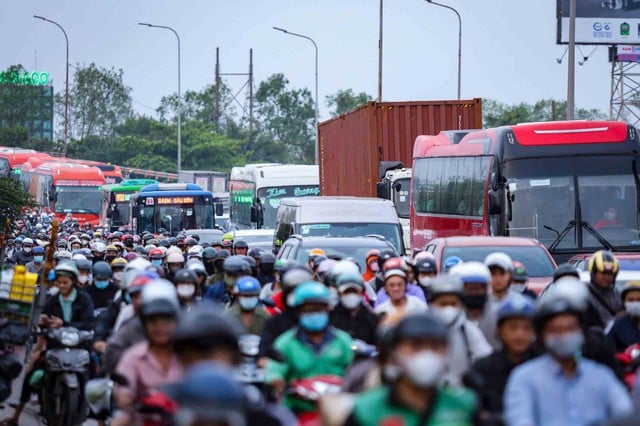
People crowded onto National Highway 1, returning to Ho Chi Minh City after the holiday.
PHOTO: NHAT THINH
In neighboring localities such as Dong Nai City, the situation is not much better, as many national highways such as National Highway 51, National Highway 1A, and National Highway 20, although handed over to local management since mid-2025, are still in serious disrepair with deep ruts; and most large-scale overhaul plans will not officially be implemented until the third quarter of 2026.
Since last year, the Ministry of Construction's mailbox has been overflowing with petitions from local voters, reflecting the paradox of expressways being extended but national highways becoming congested and dilapidated. For example, voters in Thanh Hoa province reported the serious deterioration of National Highways 16 and 217, sections passing through Ha Linh commune – a crucial interchange connecting to the North-South expressway, yet still only at the outdated Class V standard. Voters in An Giang and Vinh Long provinces requested the early expansion of National Highway 91 and the upgrading of provincial roads to national highways to synchronize infrastructure in the Mekong Delta. In the Southwest region, the project to upgrade three key national highways (53, 62, and 91B) was expected to begin construction early this year, but due to land acquisition issues, it remains on hold…
Voters nationwide have suggested that the Ministry of Construction focus on including national highway projects in the medium-term public investment plan for the 2026-2030 period, but the general response remains that localities should "self-review and prioritize" due to limited central government resources.
According to Mr. Le Trung Tinh, Chairman of the Ho Chi Minh City Passenger Automobile Transport Association, developing transportation infrastructure requires harmonious and strategic coordination between different types of road transport. While expressways are receiving significant investment, the national highway system remains the vital "backbone," ensuring smooth traffic flow and direct connectivity between provinces and cities nationwide.
Mr. Tinh clarified that expressways and national highways serve a complementary function, not a replacement for each other. Specifically, in terms of transportation needs, expressways prioritize speed and convenience for those who need to travel quickly. Meanwhile, national highways are a more economical option for goods that don't require strict time constraints, helping businesses optimize costs, as expressway tolls (especially for BOT projects) are often high. In other words, national highways give people and businesses more choices: either pay tolls for faster travel on the expressway or use the parallel national highway.

Rendering of the 6-lane elevated road along National Highway 51 connecting Ho Chi Minh City with Dong Nai City, soon to begin construction.
PHOTO: CII
Currently, the upgrading of national highways is sometimes not given adequate attention, largely due to insufficient funding to implement both systems simultaneously. However, Mr. Le Trung Tinh argues that once expressways have attracted socialized capital from businesses, reducing the burden on the national budget, the budget should focus resources on accelerating the upgrading and expansion of national highways.
When national highways are congested, expressways struggle to reach their full potential.
While highly appreciating the efforts of the Government and the construction industry in the past term in rapidly connecting the North-South expressway network, Dr. Nguyen Huu Nguyen, an urban planning expert from the Ho Chi Minh City Urban Development Planning Association, affirmed that expressways are not a "magic wand" that can solve the problem of inter-regional transportation and trade connectivity. In fact, if transportation is likened to the bloodstream of the economy, then expressways are the main artery, while the national highway network is like the veins. If the artery is clear but the veins are congested, the economic "body" will also fall into a state of stagnation. For the "main artery" of expressways to remain uncongested, the "veins" of national highways must also be strong enough to carry traffic. Only when these two systems operate harmoniously will investment capital truly flow into economic regions, creating real surplus value.
Particularly in the context of Vietnam having completed the reorganization of administrative units, such as the Ho Chi Minh City metropolitan area which now has four main hubs: Ho Chi Minh City, Binh Duong, Ba Ria-Vung Tau, and Dong Nai, the role of the national highway network becomes even more important. The larger development space poses enormous challenges in terms of management and connectivity.
According to Mr. Nguyen, when districts and communes merge, the national highway is the connecting link that ensures socio-economic unity. If the national highway network is not ensured to be smooth, intra-regional trade will still be fragmented by narrow, dilapidated roads, reducing the effectiveness of the new administrative boundaries.
Furthermore, national highways also serve as development axes for newly formed satellite cities after mergers. Without a robust system of access roads and branch lines from the national highway, remote and rural areas after mergers will find it even more difficult to access the economic flow of major centers. Not to mention, the vehicles on the highways are mainly cars, large trucks, private vehicles, and long-distance buses, while national highways serve a diverse range of vehicles, from bicycles and motorbikes to cars and even pedestrians. This means that the quality of the national highway system directly impacts people's lives.
"This illustrates that if national highways are congested, expressways cannot fully utilize their potential. Expressways help vehicles travel faster and save time, but only national highways can facilitate the movement of goods from factories to ports, and from major roads to individual communes and wards," Mr. Nguyen Huu Nguyen emphasized.
Regarding the frequent delays and prolonged construction of national highway expansion projects, Dr. Nguyen Huu Nguyen believes the biggest reasons are a lack of funding and land for transportation. Unlike expressways, which often pass through agricultural land or sparsely populated areas, national highways are usually expanded on existing roads in densely populated areas, making land acquisition difficult and requiring significant capital.
Meanwhile, newly constructed highway networks are allowed to attract capital from private enterprises, while the expansion and upgrading of existing national highways can only be funded by the state budget. Although Vietnam's infrastructure development is now heavily supported by the private sector, the budget allocated for infrastructure investment still falls short of demand. Therefore, upgrading national highways is often more difficult than building new highways.
However, this expert still emphasized that the need for a national highway network is now urgent. The Ministry of Construction and local authorities need to conduct a comprehensive review, comparing the economic losses incurred due to delays, and then determine priorities for the national highway network, ring roads, and inter-regional connecting roads.
Investment in national highways should not be allowed to become unbalanced.
Expressways help reduce travel time, but national highways bear the majority of essential goods and daily life traffic. If investment in national highways remains unbalanced for too long, it will increase operating costs, directly erode the competitiveness of businesses, and hinder the growth of local GDP.
Dr. Nguyen Huu Nguyen , Ho Chi Minh City Urban Planning and Development Association
Synchronized infrastructure is the foundation for sustainable economic development.
Delays in highway renovation will create disparities in infrastructure. Adequate investment in highways not only ensures the rights of road users but also provides a solid foundation for sustainable regional economic development.
Mr. Le Trung Tinh , Chairman of the Ho Chi Minh City Passenger Automobile Transport Association
Source: https://thanhnien.vn/cap-bach-mo-rong-quoc-lo-185260504222632574.htm
































































































Comment (0)