

In Go Market (Phu Trinh Ward, Phan Thiet City), right in the middle of the market, lived a family that specialized in selling groceries, considered one of the largest and most well-known businesses of that time – the Hoa family. Compared to the smaller households around and those who came from afar to sell their goods at the market, their large house on-site gave them a significant advantage. Their grocery store sold all the essential goods of the time, both wholesale and retail, catering to the needs of people in the surrounding area and even further afield like Phu Hoi and Trinh Tuong. However, with the ups and downs of time and changing circumstances, life transformed, and so did their business. But what left a lasting impression on the family were their children and grandchildren. Both of her sons, Tran Ta and Tran Neo, were excellent football players in Go Market. Tran Ta, in particular, was a national team player (Southern Vietnam). Mr. Tran Neo was a player for the Phu Trinh Star team, and later a player for the Binh Thuan provincial team. Following him was his son, Tran Thong Khai, who later became a provincial player and then coach of local youth teams. In the past, cultural and sporting activities were less organized, so having a large football field located a few hundred meters from Go Market was a great opportunity for training and development, attracting an entire generation. And surely everyone still remembers the provincial football team with unforgettable names: Neo, Phat, Xay, Ky, Chin, Duy Phoi, and later Thong Khai, Quang, Thang (goalkeeper), Binh Rom, Minh Chuyen. Notably, there was a disabled referee (with one arm amputated) who officiated very accurately and fairly. There was also a very special figure, Mr. Quan Dau, who specialized in organizing and arranging local football events and logistics. There's an anecdote about two people, Tran Ta and Do Thoi Vinh, both from Phan Thiet, who were skilled footballers and were directly recruited to play for the Saigon Port team. They were all from Phan Thiet, Cho Go.
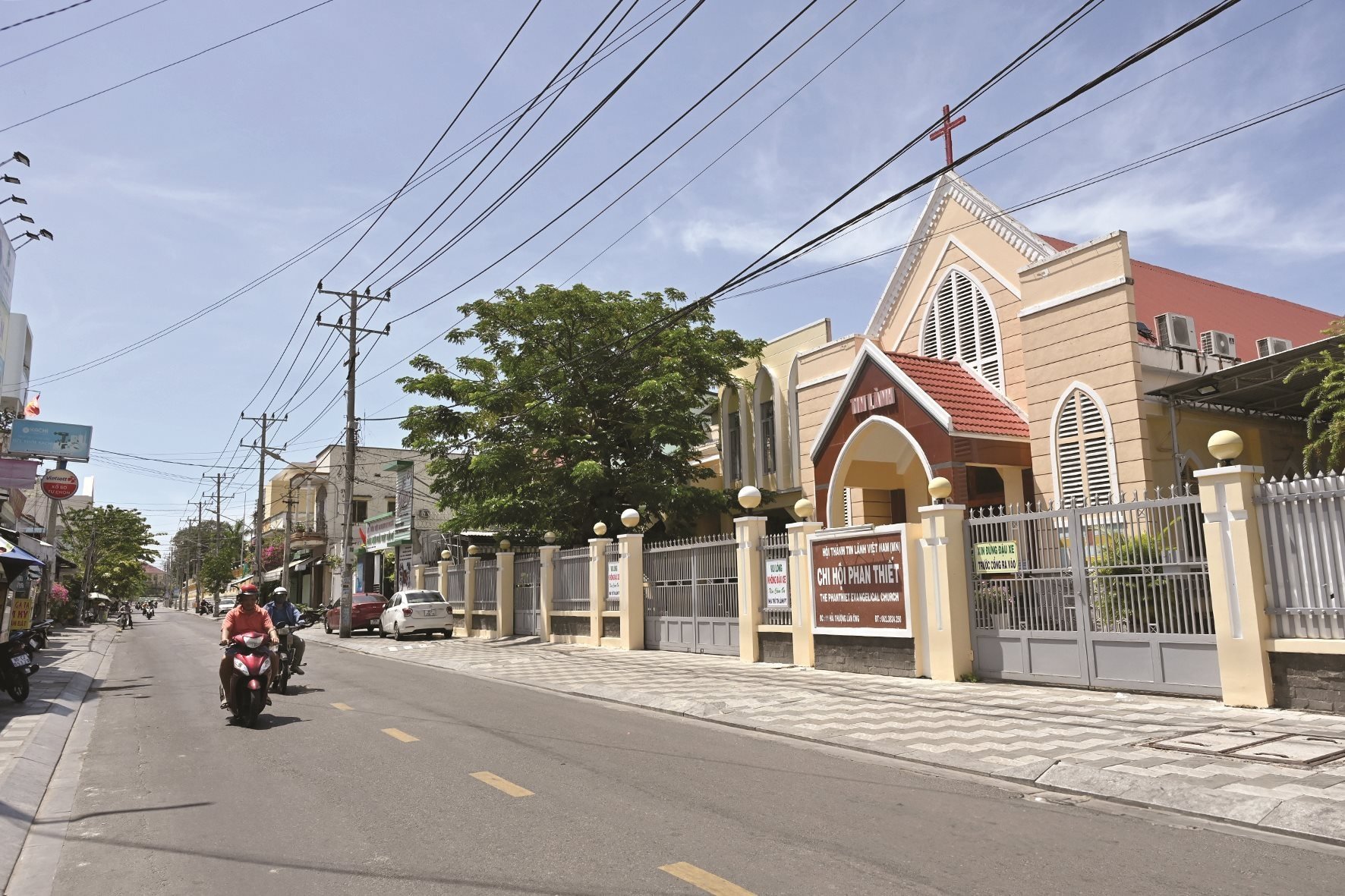
As the saying goes, "proximity to the market is best, proximity to the river is second best." The area around Go Market is close to administrative and military offices, so many rows of houses are concentrated along the streets surrounding the market, once home to prominent families working for the government or other sectors. Along Hai Thuong Lan Ong Street, starting from the post office intersection and going up to the left, you'll find Mr. Nam Trinh's traditional medicine shop (Duy Phoi's father), then the Protestant church… At the intersection with Tran Cao Van Street, along the same street is Mr. Tu Tan's garage, a branch of Luong Huu Company, specializing in public works and transportation, providing repair and logistical support for the company. At that time (the 1950s and 60s), the company owned 6 Dodge trucks, 2 bulldozers, a road roller, 2 excavators, and 2 large fishing boats. In particular, the first paved road from Phan Thiet to Mui Ne was constructed by Luong Huu Company under contract with Mrs. Luc Thi Dau, according to the road standards of that time. A few houses further up is the large alley leading to the center of Go Market. At the beginning of the alley, on one side is the row of townhouses belonging to Mrs. Hoa's family, and on the other side is Mrs. Phan Ninh's house. A few more houses further is the house of Mr. Tran Thien Chanh (father of musician Tran Thien Thanh), which he sold to someone else in 1960 and then moved his family to live near the old Chau Thanh commune. Next are the houses of Mr. Pham Ngoc Binh and Mr. Pham Ngoc Thin, who owned a lot of land around the market but sold it all and bought land on Gia Long Street (Nguyen Hue Street) to build the Modern Theater, later renamed Ngoc Thuy Theater. A little further up are the houses of Mr. Tam Tu, the referee, and the football player Minh Chuyen. On Yersin Street, along the side of the market, goes straight to the pig slaughterhouse, where the mansion of Mr. Tran Gia Hoa (Bat Xi) is located. If Mr. That Ngan was on the other side of the river, then Mr. Bat Xi was on this side. (In February 1888, King Đồng Khánh allowed wealthy people to buy official ranks; the ninth-rank rank cost 1,000 quan, and an additional 1,200 quan would increase the rank by one level). Further along, at the intersection of the hospital and Lương Ngọc Quyến (Nguyễn Hội) road, is the Quảng Đắc traditional medicine shop, then the house of Mrs. Hoàng Thị Hường, former principal of Phan Thiết Girls' School from 1949 to 1975 (mother of musician Phan Anh Dũng). A few houses further is the Thirty Houses row of houses built by Mrs. Lục Thị Đậu, who bought the land, built the houses herself, and then rented them out. Next is the stadium, and then the Xóm Tỉnh intersection (where the Bình Thuận Provincial Road is located).
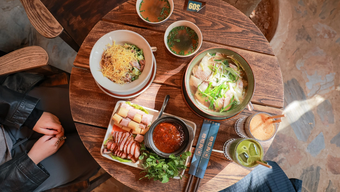
Right at the intersection of Tran Cao Van and Hai Thuong Lan Ong streets, at the other end of the road leading to the riverbank, there was no bridge at that time (a wooden bridge later called the My Bridge was built in 1968, after the Tet Offensive). There was a famous pho restaurant at that time called Pho Ba Hai, then the Phu Trinh hamlet headquarters, followed by a row of houses for rent. Two special families rented there for a while before moving to Saigon: the singer-songwriter couple Ngoc Cam and Nguyen Huu Thiet, along with their brother Nguyen Huu Sang and his wife, singer My The, who specialized in singing in tea rooms. Behind them, on a high hill, was Phan Thiet Girls' School (now the Binh Thuan Museum). At the beginning of the intersection on this side was the Phuc Chi maternity home (Ba Bao maternity home), whose husband, Mr. Bao, taught at Bach Van private high school. A little further on was a very special old family, the family of Mr. Phan Ly Ngu, whose sons all had names ending in Ly, such as Phan Thien Ly, Triet Ly, Kinh Ly, Chi Ly, Nguyen Ly, Dong Ly, Dieu Ly, and Chuong Ly. At the crossroads lies the Hospital, followed by Bach Van High School, then the Dinh Cong Trang military headquarters (opposite the stadium). From there, going up to the Binh Thuan Provincial Hall, is the area reserved for the ethnic minority association of Quang Dien district, Thua Thien Hue province, which followed Governor Ngo Dinh Diem when he took office in 1936. The Quang Dien Mutual Aid Association Hall still stands there today. The hamlet near the crossroads, commonly known as the Provincial Hamlet, later called the Old Provincial Hamlet since the Provincial Hall no longer exists, is also located there.
Source: https://baobinhthuan.com.vn/cau-chuyen-ve-cho-go-129497.html


![[Photo] Prime Minister Pham Minh Chinh presides over a meeting on private sector economic development.](/_next/image?url=https%3A%2F%2Fvphoto.vietnam.vn%2Fthumb%2F1200x675%2Fvietnam%2Fresource%2FIMAGE%2F2025%2F12%2F20%2F1766237501876_thiet-ke-chua-co-ten-40-png.webp&w=3840&q=75)



















































Comment (0)