


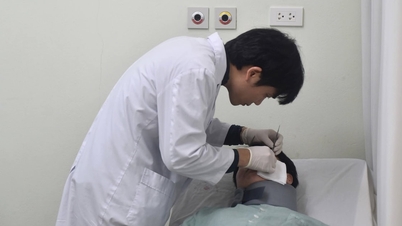
Dr. Nhung and her father, Dr. Nguyen Tai Son, during a surgery - Photo: Provided by the hospital.
It's said to be difficult and selective, requiring a lot of physical strength because there are always long surgeries, requiring you to stand all day or all night in the operating room.
At Hospital E and the Department of Oral and Maxillofacial Surgery, University of Medicine and Pharmacy (Vietnam National University , Hanoi ), there is one female doctor among these rare individuals: Dr. Nguyen Hong Nhung, Deputy Head of the Department of Oral and Maxillofacial Surgery.
The next generation
Dr. Nhung is the daughter of Professor Dr. Nguyen Tai Son, former head of the Department of Maxillofacial Surgery and Plastic Surgery at Military Central Hospital 108.
This March, Dr. Nhung and her father joined forces on a special case. The patient was a 44-year-old woman from Hai Phong who had suffered from facial paralysis for many years, causing significant facial disfigurement that affected her psychology and daily life.
Nearly 20 years ago, at the age of 25, the patient underwent surgery performed by Professor Son. The technique at that time required the surgery to be divided into two stages (2 phases). After the surgery, a doctor scheduled her to return two years later (for the second phase). However, due to various reasons, nearly 20 years passed. This time, before the Lunar New Year of the Horse, the same female patient returned, called Professor Son, and was scheduled for surgery in March 2026 by the doctor's daughter.
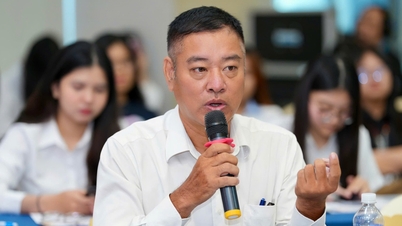
"After a long time, the muscles that had been paralyzed for a long time began to atrophy and lose their tone. The patient was not only affected when talking or smiling, but also faced many obstacles in communication and work, causing her to feel insecure. She decided to return to the hospital," Mr. Son recounted.
And earlier this week, the female patient underwent a second surgery, an operation that should have been performed nearly 20 years ago. The doctors decided to transfer the gracilis muscle to a nerve graft to restore facial muscle movement. The unique aspect is that the grafted muscle will be connected to multiple different nerve sources, increasing its recovery potential compared to using only one nerve source as before. The surgery was very complex but was performed perfectly.
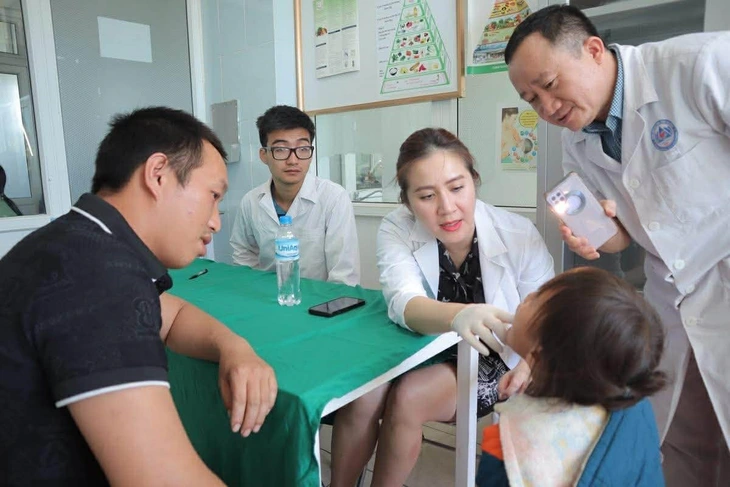
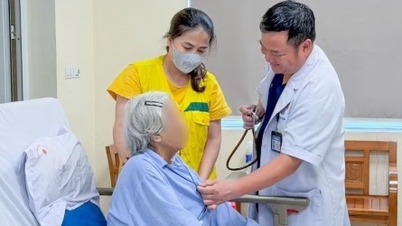
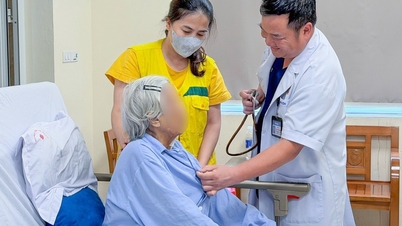
Dr. Nhung examines the patient.
A father's story
Some might say, "What's so difficult about being from a family of doctors?" But in the medical profession, it's a long and arduous journey of training. "My wife is an expert in glaucoma – the leading cause of blindness. We hoped our daughter would follow in her mother's footsteps in medicine, but in ophthalmology. That field is more suited to women," Mr. Son recounted.
Following in her parents' footsteps, young Hong Nhung went to Russia to study medicine, just as her father had done. From 2003 to 2010, she studied medicine in Russia, and from the summer of her second year, Nhung was fortunate enough to do her summer internship at Military Hospital 108. In the operating room, encountering difficult surgeries, the medical student "saw doctors as truly miraculous in giving life to critically ill patients," and from then on, she developed a passion for microsurgery.
Studying to become a surgeon is a grueling process, and it's even more challenging for women. Sometimes they spend the whole week at the hospital, only going home to change clothes, spending the rest of their time studying in the operating room. Some surgeries last from morning until night, others extend through the night. Only after all that can they gradually become independent.
"Every father wants his child to improve. In our family, dinner is when father and son talk about difficult cases, problems that the child is struggling with... But later on, young people like my son have become more skilled than I was."
"Our generation didn't have 3D modeling or pre-operative models. Today's young doctors, not just Dr. Nhung, receive more support thanks to technology and techniques, have foreign language skills, and receive training, so they progress very quickly, and the results are better compared to our time. Therefore, now we only support them in extremely difficult cases, and we only help them with things they are not confident in. The young doctors are already very skilled," Mr. Son shared.
The story of a daughter and...
Every doctor must overcome the fears of ordinary people to become a skilled professional: the fear of blood, the fear of wounds, the fear of difficult diseases, the fear of tumors that cover the entire face, causing patients to lose confidence and suffer pain, the fear of having to perform autopsies in the dissection room...
Dr. Nhung was the same; initially, she was very afraid of blood. How could she become a doctor if she was afraid of blood? "But my father was very hopeful; he spent his whole life in medicine, only hoping to train his daughter," Dr. Nhung recounted. And from her father's passion, his daughter gradually developed a passion for microsurgery.
Driven by passion, each case is a testament to her dedication and skill. To date, Dr. Nhung has performed over 1,000 surgeries, each patient a unique story: some had very large tumors, which had already been destroyed by the time they arrived at the hospital, affecting not only their functions but also causing immense pain and impacting their social interactions.
Some cancer patients become distraught upon receiving their diagnosis, and doctors often have to stand beside them to encourage them, urging them to remain calm and fight the disease together.
"There are patients I still keep in touch with. When they get married and have children, they call to let me know. After surgery, it's not the end for each patient once they're discharged; they need care and monitoring. Patients need a long period of support to recover, and they really need companionship and sharing. The more I work in medicine, the more I realize I need to understand and share so that patients feel more at ease, becoming a place where they can find support, not just a place to treat their illnesses," said Dr. Nhung.
Deep within the confines of years of arduous training, the greatest joy for Dr. Son and his son was the days when patients could leave the hospital and return home.
Source: https://tuoitre.vn/cha-va-con-chung-tay-mot-ca-mo-dac-biet-20260316063648183.htm










































































Comment (0)