

Caring for rice plants according to their growth stages.
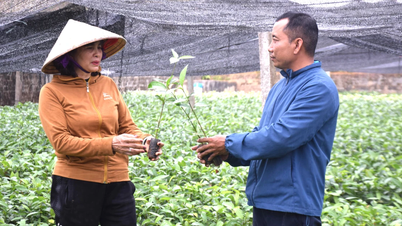
In the fields of Bong village, Tan Trao commune (Son Duong district), a vibrant green color of rice has spread across the land. Taking a break from tending the rice, Mrs. Ha Thi Duyen shared that this season her family planted 1 acre of rice, mainly with the Dai Thom 8 and BC15 varieties. At this time, the rice is in the vigorous tillering stage. To ensure healthy plants and strong tillering, her family is applying NPK compound fertilizer.
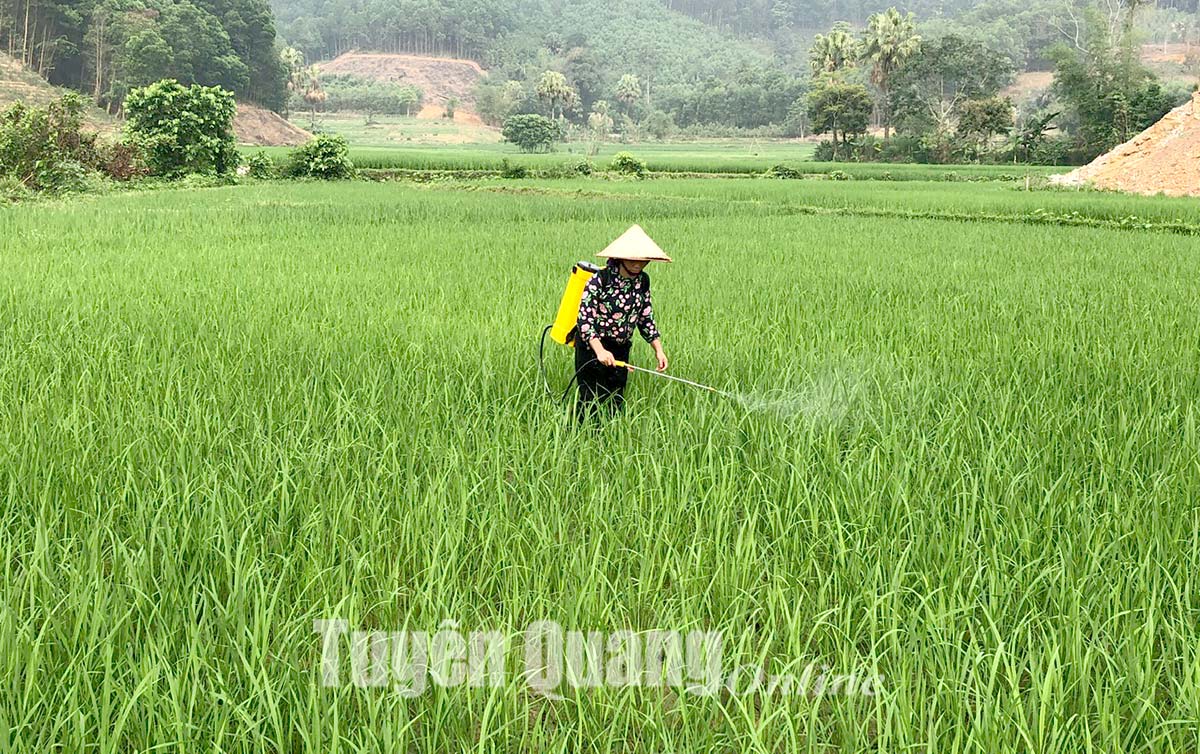
People in Nhan Ly commune (Chiem Hoa district) are spraying pesticides to protect their rice crops from diseases.
According to Mr. Phan Van Oanh, an agricultural extension officer at the District Agricultural Service Center in charge of Tan Trao commune, this year's crop in Tan Trao commune covers 141 hectares of rice, including 70 hectares of hybrid rice varieties and the rest being purebred rice varieties such as BC15, KM18, TBR 225, Nhi Uu 8, Dai Thom, Bac Huong 9, and glutinous rice. Currently, all the rice crops in the commune are in the tillering stage, and taking advantage of favorable weather, people are going to the fields to care for the rice.
According to Mr. Oanh, the period of rapid tillering in rice plants is a crucial time that can determine the yield of the entire crop because rice yield is determined by factors such as: the number of panicles (number of effective tillers) per unit area; the number of filled grains per panicle; and grain weight. Of these factors, the number of effective tillers is the most important. Therefore, to achieve the highest number of effective tillers, farmers need to understand the growth characteristics of the rice plant, its nutritional needs at each stage, and most importantly, choose the right type of fertilizer for rice.
Farmers need to strengthen the application of care measures according to the growth stages of rice plants. At this time, rice plants need supplemental potassium fertilization and additional foliar sprays of growth stimulants to promote healthy growth and development, and improve resistance to pests and diseases. Rice plants also need sufficient water to promote better tillering and simultaneously deter rodent damage...
Timely prevention and treatment of diseases are necessary.
According to a report from the Provincial Department of Crop Production and Plant Protection, the main rice crop is currently in the tillering stage, while the late-season rice crop is recovering its green color and tillering. Favorable weather conditions are also ideal for the emergence and spread of pests and diseases affecting rice plants. Field surveys have revealed several pest outbreaks, including: scattered rice planthoppers with densities of 7-10 individuals/m2; localized golden apple snails causing damage in some fields, with infestation rates of 3-5 individuals/m2 in some areas and 4-8 individuals/m2 in others, affecting 162.5 hectares across all districts and cities; scattered leaf-rolling caterpillars (4th generation) with densities of 3-4 individuals/m2; and scattered rat damage, affecting 3-4% of tillers in some areas.
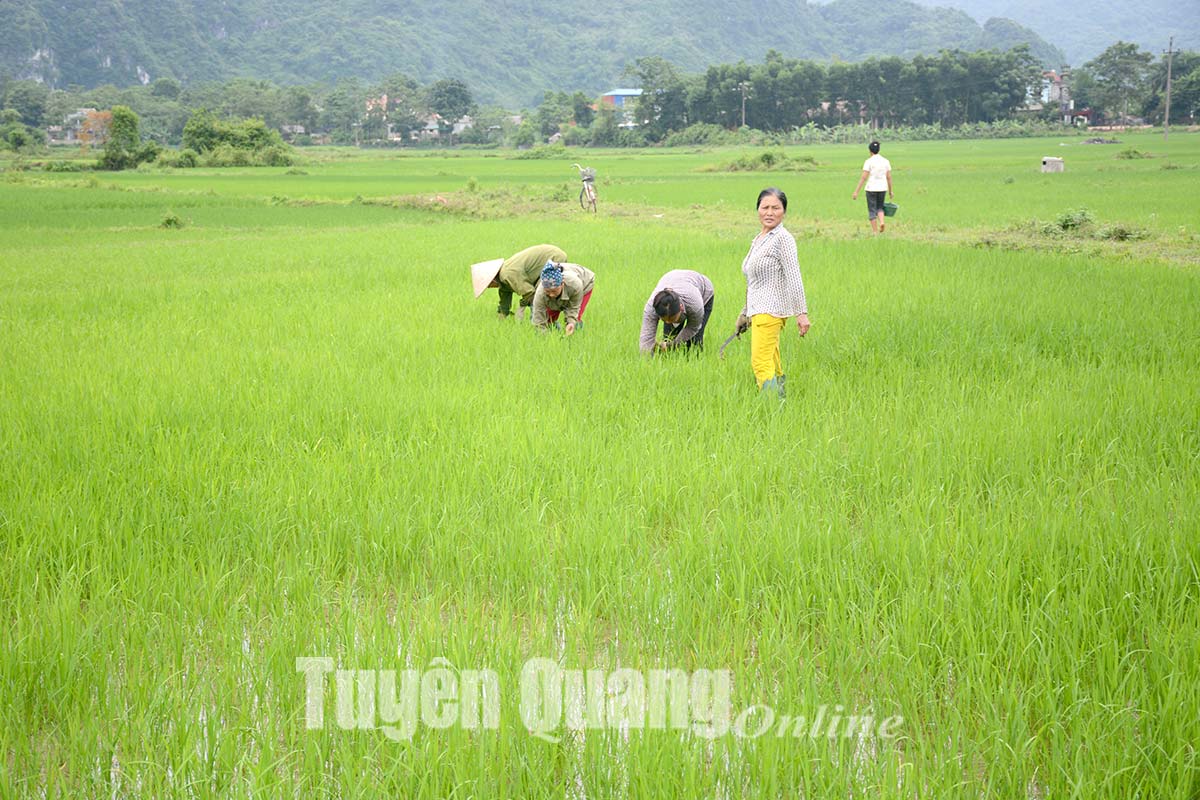
People in Thuong Lam commune (Lam Binh district) are weeding their rice fields.
In the fields of Thuong Lam commune (Lam Binh district), several households are spraying pesticides to control pests and diseases in their rice crops. Mr. Ma Van Sang, from Na Tong village, shared that this season his family planted 4 bung (4,000 m2) of Hung Long 555 and Nhi Uu 8 rice varieties. Due to recent rains and sufficient water in the fields, the rice is developing well. However, pests and diseases such as black stink bugs and leaf-rolling caterpillars have appeared in the fields. To prevent the pests and diseases from spreading and damaging the entire rice crop, his family has already sprayed pesticides once and will continue spraying again in the next 2-3 days to completely eradicate them.
According to current observations, pests and diseases have appeared in rice crops in various localities; however, they are under control and are not causing significant damage to rice fields. According to Mr. Tran Ngoc Thanh, Head of the Technical Department of the Provincial Crop Production and Plant Protection Sub-Department, the coming period will be the peak of pest and disease outbreaks. Specifically, the fifth generation of rice planthoppers will hatch and cause increased damage from the end of July to the beginning of August, with a common density of 300-700 individuals/m2, and localized densities of 1,000-2,000 individuals/m2. The fifth generation of rice leaf rollers will hatch and cause increased damage from the end of July onwards, with a common density of 10-20 individuals/m2, reaching 30-60 individuals/m2 in some areas, and localized densities exceeding 100 individuals/m2. Rice blast, bacterial leaf blight, and rat infestations will increase from the beginning of August onwards.
To minimize damage caused by pests and diseases, the Provincial Department of Crop Production and Plant Protection requests that the Agricultural Service Centers of districts and cities assign agricultural extension workers to actively visit fields to inspect and assess the level of infection in each rice variety, and inform and guide farmers on timely and effective care and control measures. When the density of small leaf-rolling caterpillars reaches 25 to 50 individuals/m2, use one of the following specific insecticides for spraying: Voliam Targo 063SC, Prevathon 5SC, Amate 150SC, Takumi 20WG, Clever 150SC, Virtako 40WG, Opulent 150SC, Obaone 95WG, etc. In addition, strengthen the dissemination of information to farmers on using pesticides according to the "4 correct principles" and at the concentrations and dosages indicated on the product packaging. Spray when the caterpillars are young, from 1 to 3 days old, and collect used pesticide packaging in designated areas to protect the environment.
Authorities advise farmers to closely monitor their fields, keeping a close eye on the emergence and spread of pests and diseases in order to take timely and effective control measures. Farmers should also regularly monitor weather developments to proactively respond to adverse weather conditions.
Source link


![[Photo] Prime Minister Pham Minh Chinh presides over a meeting on private sector economic development.](/_next/image?url=https%3A%2F%2Fvphoto.vietnam.vn%2Fthumb%2F1200x675%2Fvietnam%2Fresource%2FIMAGE%2F2025%2F12%2F20%2F1766237501876_thiet-ke-chua-co-ten-40-png.webp&w=3840&q=75)

































































Comment (0)