

The Iranian military announced on March 25 that it had attacked the aircraft carrier USS Abraham Lincoln with naval cruise missiles.
Later that evening, President Donald Trump announced that Iran had launched 101 missiles targeting the USS Abraham Lincoln aircraft carrier, but all had been intercepted by the U.S. Navy. Trump emphasized, "Every single one was shot down and is lying at the bottom of the sea."
Press TV broadcast a video claiming that Iranian armed forces launched missiles at a US aircraft carrier, while IRNA quoted naval officials detailing the operation.
According to IRNA, Iranian Navy Commander Rear Admiral Shahram Irani stated that the activities of the US aircraft carrier are being continuously monitored and will be attacked if it enters the range of Iranian missile systems.
"Ship Killer" Qader
Unlike ballistic missiles, which are launched high into space and then fall freely to their target in a parabolic trajectory, cruise missiles operate much like small unmanned jet aircraft.
This weapon maintains aerodynamic lift thanks to its wings and flies entirely within the atmosphere using jet engines.
The real danger of cruise missiles lies in their flight trajectory. Compared to ballistic missiles, they don't fly high, meaning they are difficult to detect from a distance. Instead, they are capable of skimming the terrain or flying just below the sea surface at extremely low altitudes.
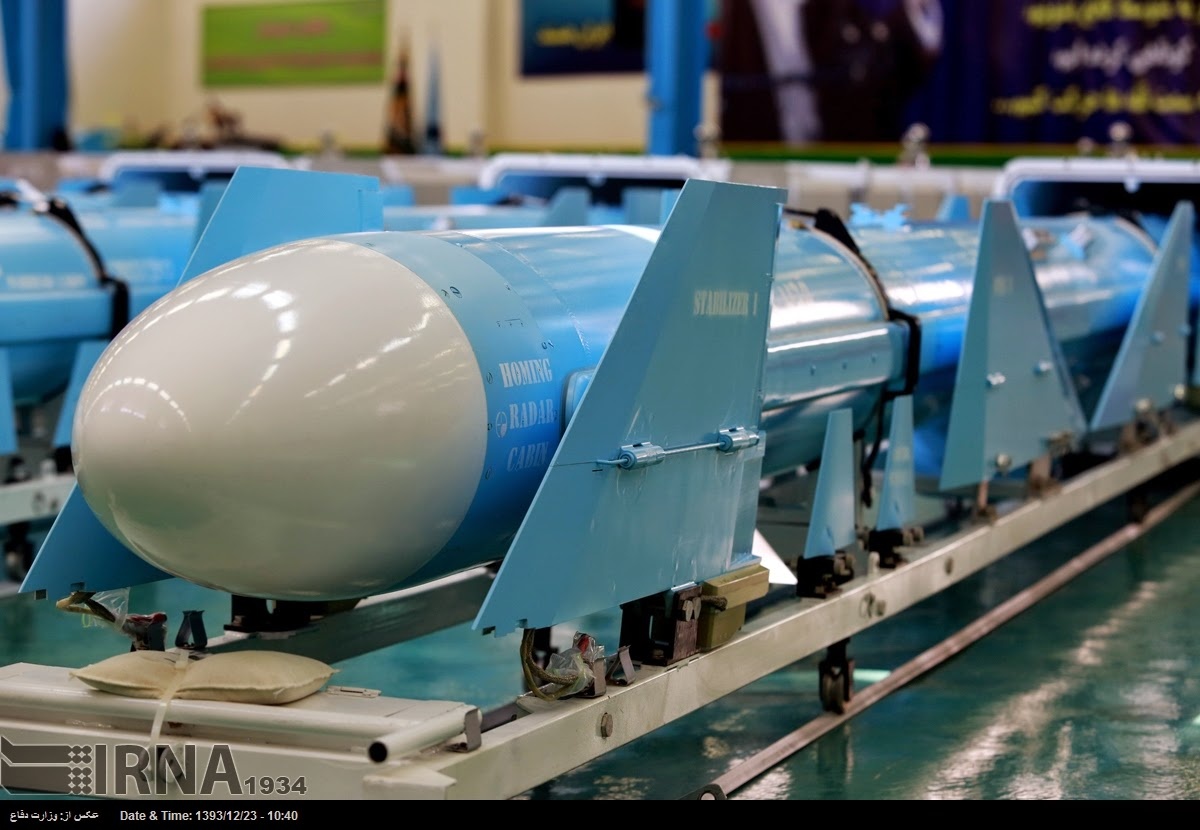 |
Iranian cruise missiles. Photo: IRNA. |
Equipped with a sophisticated guidance system combining inertial navigation system (INS), satellite positioning (GPS), and terrain image matching technology (TERCOM), cruise missiles can automatically maneuver through mountain ranges and valleys, or fly close to waves to bypass the "blind spots" of early warning radar stations.
Launched in 2011, the Qader cruise missile is an upgraded version of Iran's Noor series of missiles, which originated from the Chinese C-802 prototype.
The most formidable aspect of the Qader is its ability to skim the surface of the sea and travel at subsonic speeds (around Mach 0.9). For most of its flight, the weapon maintains an altitude of 20-30 meters above the water to remain "invisible" to early warning radar stations.
As it enters the final phase of approaching its target, the Qader will suddenly descend to an altitude of only 3-5 meters above sea level. This maneuver, closely following the waves, significantly shortens the reaction time of the enemy warship's air defense systems.
With a combat range of 200-300 km, this weapon allows Tehran to blockade vital shipping lanes, creating a vast no-accessible zone stretching from the coast.
In terms of destructive power, the missile carries a semi-armor-piercing warhead weighing between 165-200 kg. Combined with a delayed fuse, the warhead will penetrate the outer steel hull before exploding inside the ship's body to maximize damage.
Equipped with an active radar system in its nose and excellent electronic jamming resistance, the Qader is highly versatile, capable of being launched from mobile shore-based launchers, warships, and even fighter jets such as the F-4 Phantom.
Could Iran land a hit on a US aircraft carrier?
Although the Qader cruise missile boasts impressive technical specifications, international military analysts believe that the prospect of a few of these missiles sinking a US supercarrier is almost impossible.
 |
The heart of the ship's power is the state-of-the-art Aegis combat system, with its primary sensor being the AN/SPY-1B radar. It is one of the best maritime radars in the world . Photo: US Navy. |
An aircraft carrier like the USS Abraham Lincoln never travels alone. It is always heavily protected by a carrier strike group with a multi-layered defense network.
At the core of this system are guided missile destroyers equipped with the renowned Aegis combat system.
Specifically, this system is capable of tracking and processing over 100 targets simultaneously and can perform calculations to prioritize the most urgent threats.
To detect threats like the Qader, modern U.S. destroyers utilize the SPY-6 radar system. These systems feature multiple arrays providing continuous, 360-degree situational awareness with no blind spots.
The SPY-6 is significantly more sensitive than older generation radars, allowing it to detect smaller, faster objects at greater distances. It simultaneously tracks ballistic missiles, cruise missiles, and hypersonic missiles while eliminating electronic interference.
The primary interceptor missile in this defense system is the SM-6, designed to destroy targets in the terminal phase of their trajectory.
In addition, to overcome the weakness in response time, aircraft carriers like the USS Abraham Lincoln also maintain early warning aircraft such as the E-2D Advanced Hawkeye.
According to information from the military analysis website Military Chronicles , from its aircraft carriers and forward bases, the US Navy is deploying 20 F/A-18E and 10 F/A-18F Super Hornet, 10 F-35C stealth fighters, and 7 EA-18G Growlers – aircraft specializing in jamming and suppressing enemy air defense and communication systems.
In addition, four E-2D Hawkeye early warning aircraft ensure real-time airborne combat command and control.
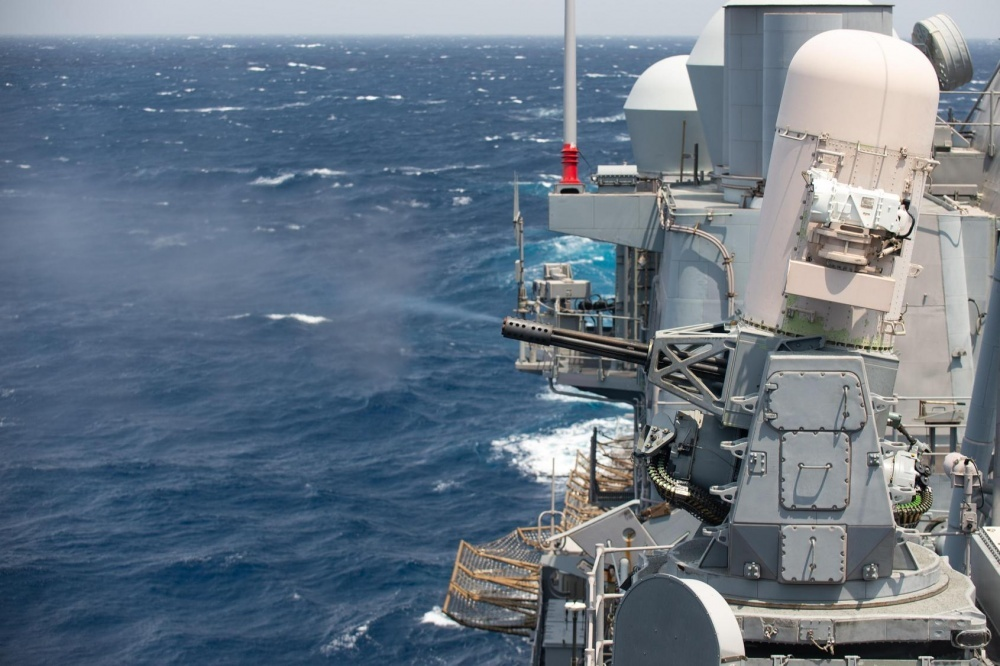 |
The Phalanx Close-In Weapon System (CIWS), consisting of a 6-barreled, 20 mm caliber gun, is used to intercept enemy missiles and guided weapons targeting warships. Photo: US Navy. |
Thanks to the E-2D's "all-seeing eye" observing from above, the entire trajectory of the Qader can be detected from the moment it leaves its launch pad off the Iranian coast, transmitting target data directly to the Aegis supercomputer on the warship. At this point, the multi-layered defense network of the combat group will immediately activate a series of interceptions.
In the outermost defensive line, F/A-18 Super Hornet fighters or SM-6 long-range anti-aircraft missiles would be launched to destroy the Qader before it could even see the carrier group.
In a worst-case scenario, even if the Qader penetrates both outer shields and engages in close combat, the Phalanx Close-In Weapon System (CIWS) would still have enough time to react. With a firing rate of up to 5,000 rounds per minute, it is used for intercepting enemy missiles and guided weapons targeting the warship. Phalanx can also provide close-range air defense and engage small surface targets.
Source: https://znews.vn/chi-tiet-ten-lua-iran-dung-de-ban-vao-tau-san-bay-my-post1638100.html

































































































Comment (0)