

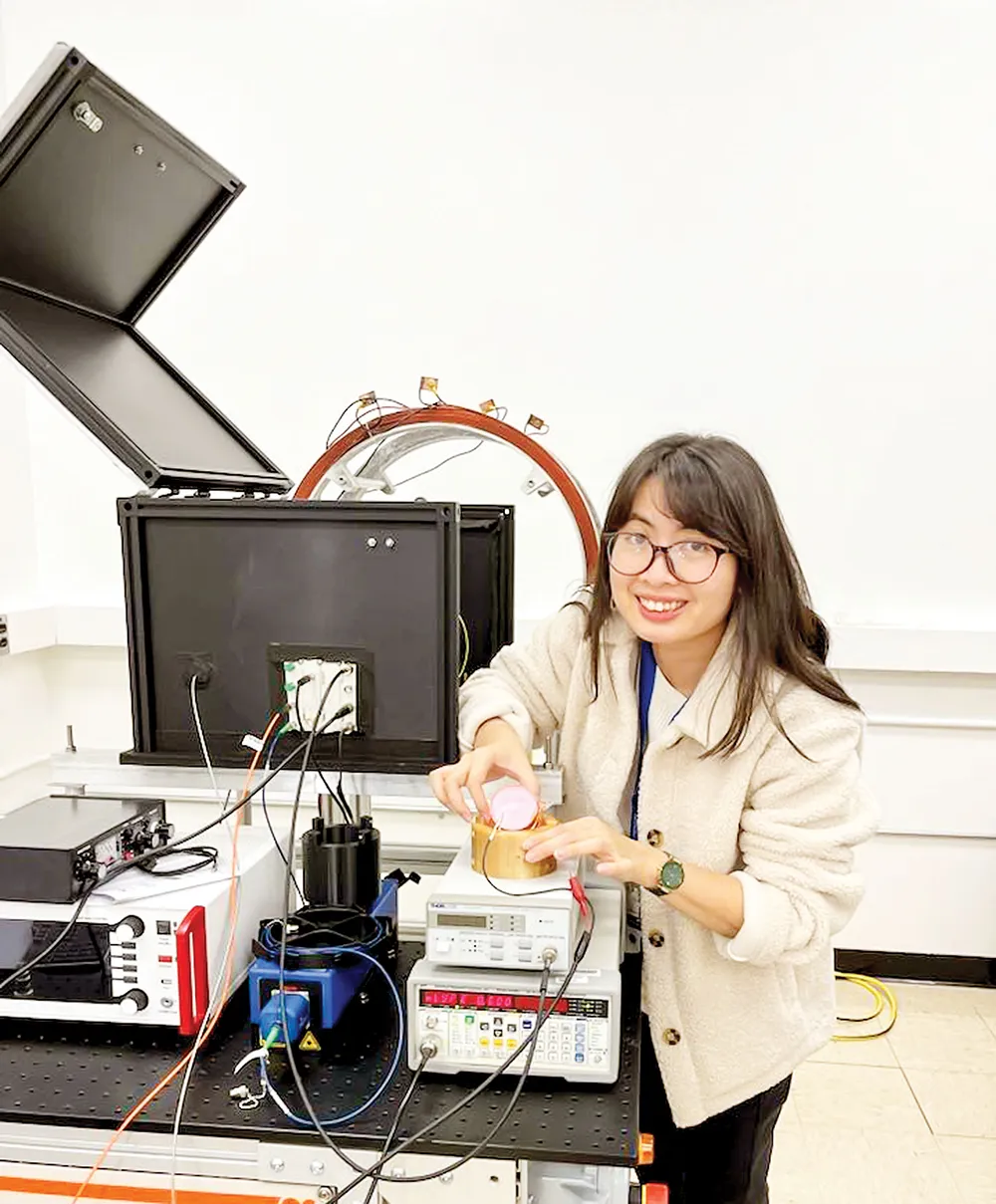
From a small village to the world
Growing up in Cat Loi village (now Hop Tien commune, Thanh Hoa province), a small but peaceful village nestled at the foot of Nua Mountain - Den Nua, Dien was very active and playful as a child, to the point that her mother had to "escort" her to school. However, once she sat down to study, Dien quickly absorbed information and excelled in most subjects. "When I was little, I dreamed of excelling in Literature to become a novelist. But later, I wanted to become a scientist and work at NASA," she recounted. She passed the entrance exam for 10th grade at a specialized school, but due to her family's financial difficulties, she chose to attend a village school to lessen the burden on her parents. During her high school years, Dien was still torn between pursuing science or literature. Fortunately, her physics teacher helped her make the right choice. Afterward, Dien was accepted into university and decided to study education to further her physics education.
This is the path that helped young Nguyen Thi Dien take her first steps on her research journey, becoming one of the first 25 students in the Advanced Physics Program piloted by the Ministry of Education and Training. The program was supported by the University of Virginia (UVA, USA), with Professor Pham Quang Hung, a renowned Vietnamese-born particle physicist, as the coordinator. He brought the entire training framework from UVA to Vietnam and invited many prestigious professors and scientists from the US to participate in teaching. After four years, Dien graduated with honors, her thesis receiving the highest score in the entire cohort. “At the graduation ceremony, I was granted direct recruitment by the Rector of Hue University, becoming a lecturer at Hue University of Education. That was a great honor, and I am very proud!” she recounted. Despite having job opportunities that not every student could attain, Dien still chose to study abroad, continuing to pursue her passion of becoming a scientist.
In August 2011, she began her doctoral program at UVA under the guidance of Professor Pham Quang Hung and Professor Donal Day. After two years, she was transferred to the Thomas Jefferson National Laboratory (Jefferson Lab) to prepare for her dissertation, under the supervision of Dr. Douglas Higinbothom, an expert in nuclear structure and detector design. There, the Vietnamese intern first encountered a laboratory located 20 meters underground, housing a gigantic detector that resembled a building. She was overwhelmed by its modernity and thought to herself, "Oh no! I'm practically clueless here. I'm sure I'll be eliminated sooner or later." Seeing her student's almost complete lack of practical skills, Dr. Douglas patiently searched for instructional materials. From then on, she practically "residing" in the laboratory, self-learning, experimenting, and asking anyone she encountered difficulties. In just two months, she had mastered the operation and designed her own signal and data receiving equipment. This rapid progress greatly pleased Dr. Douglas...
She began to integrate, participating in major projects and being assigned to lead an independent project. From an intern, she became a key figure in nuclear physics projects, taking on the role of experimental team leader while still a graduate student…
Outstanding young researcher in America.
In December 2018, at the age of 30, Nguyen Thi Dien successfully defended her doctoral thesis at UVA. Her research focused on the interaction between nucleons (protons and neutrons) at extremely short distances using electron scattering on neutron-rich nuclei. The work was considered by the American scientific community to be of significant importance in clarifying the structure and formation mechanisms of atomic nuclei, opening up new avenues for application in nuclear physics and astrophysics.
Her outstanding work led to job offers from many American universities, including the Massachusetts Institute of Technology (MIT), a world-leading research institution with 93 Nobel Prize winners. She chose MIT for her postdoctoral research under the guidance of Professor Or Hen and Professor Richard Milner. Her secret was "open learning, not hiding her ignorance." Thanks to this, she quickly matured even in the high-level training environment at MIT.
During this time, she conducted research on the structure of light nuclei, performing highly accurate measurements to verify new theoretical models. “These measurements helped confirm the validity of complex theoretical models of nuclear structure, laying the groundwork for research on heavy nuclei and applications in many technological fields,” she said candidly about her specialization. The research results were published in Physical Review Letters (PRL) – one of the world's most prestigious scientific journals.
With two outstanding publications, the Vietnamese-American doctor was honored with the Nathan Isgur Fellowship from Jefferson Laboratory (part of the U.S. Department of Energy) – a prestigious award for the most outstanding young researchers in the United States. She is also the first female scientist to receive this award in its 25-year history. Following this success, she returned to Jefferson Lab and continued to develop her independent research program on neutron spin structure, while also developing the new "polarization target" technique – a key research direction for Jefferson Lab in finding answers to the big question of modern nuclear physics: the origin of spin in matter. The results of this research are expected to open up many scientific applications, including nuclear medicine and high-precision radiotherapy for cancer treatment.
Following a string of impressive achievements, in January 2024, she was appointed a professor at the University of Tennessee (UTK, USA). Recently, she received more good news when she won the DOE Career Award from the US Department of Energy. This award will help the young Vietnamese-American professor continue developing her research project on neutron spin and polarization targets to conquer new heights. In the near future, the US will build a new particle accelerator, one of the world's key projects in the study of atomic nuclear structure, expected to be operational between 2030 and 2035. "I hope to be one of the first to participate in this colossal project," Professor Nguyen Thi Dien expressed her hope.
Following in the footsteps of our teacher.
Speaking about her future plans, Professor Nguyen Thi Dien shared her desire to continue the path of the late Professor Pham Quang Hung, a teacher who made many contributions to basic science in Vietnam. “I plan to return to Vietnam soon, and together with my colleagues, organize workshops and develop short-term courses on nuclear physics for young people in the country to get closer to this field. For outstanding students, I will support and connect them so they have the opportunity to study abroad at higher levels and return to contribute to their homeland,” Professor Nguyen Thi Dien emphasized.
Source: https://www.sggp.org.vn/chinh-phuc-nhung-dinh-cao-post837928.html




![[Image] A brilliant symphony and explosive power in the skies of Da Nang.](https://vphoto.vietnam.vn/thumb/1200x675/vietnam/resource/IMAGE/2026/05/31/1780196945787_anh-man-hinh-2026-05-31-luc-10-08-51.png)









![[Video] Sunset at Lap An Lagoon – Where the sun sets over the fishing nets](https://vphoto.vietnam.vn/thumb/340x192/vietnam/resource/IMAGE/2026/05/31/1780192137701_beach-landscape-sea-water-nature-grass-745871-pxhere-com.jpeg)


























































Comment (0)