

The amended Value Added Tax (VAT) law will impose a 5% tax rate on fertilizers, instead of the current tax exemption.
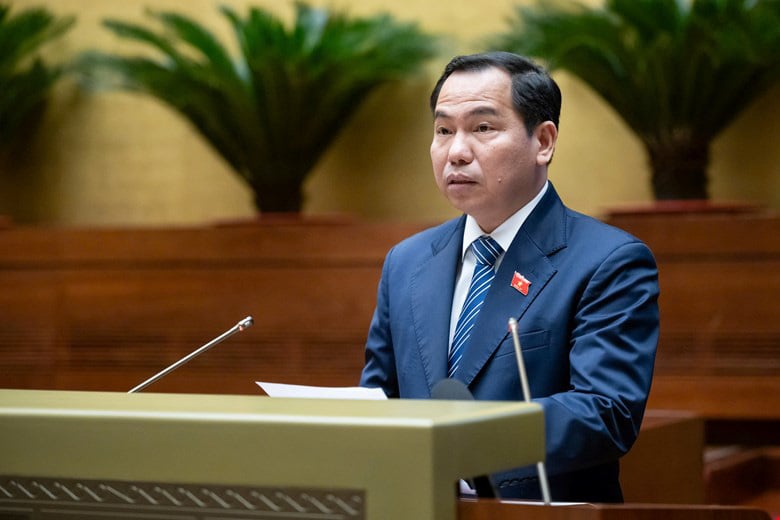
Chairman of the National Assembly 's Finance and Budget Committee, Le Quang Manh - Photo: GIA HAN
On the afternoon of November 26th, with a majority of votes in favor, the National Assembly passed the amended Value Added Tax (VAT) Law. Prior to this, Le Quang Manh, Chairman of the National Assembly's Finance and Budget Committee, presented a report explaining the revisions and amendments to the draft law.
Will farmers bear the brunt of increased fertilizer costs?
The delegate previously argued that imposing a 5% VAT on fertilizers would increase the budget by 1,500 billion VND, and that farmers would bear the burden.
Mr. Manh stated: "If a 5% tax rate is applied, fertilizer importers will have to pay 1,500 billion VND in VAT to the state budget from the import stage (based on import turnover in 2023)."
However, fertilizer imports are expected to decrease due to the 5% VAT rate, resulting in actual revenue for the state budget being lower than the 1,500 billion VND figure."
According to Mr. Mạnh, the VAT collected from imported fertilizers will have to be offset against the VAT collected from domestic businesses, and will also have to be refunded to domestic enterprises. Therefore, the impact on budget revenue due to the application of a 5% VAT is insignificant, and if there is any increase, it will be much lower than the 1,500 billion VND figure.
Furthermore, the purpose of this policy is not to increase budget revenue; the revenue collected, after offsetting any reimbursements to businesses, can be used by the State to support the production, processing, and consumption of agricultural products.
On the other hand, according to Mr. Manh, the budget revenue collected will not be entirely passed on to the selling price, thus not burdening farmers, because farmers can choose to buy domestically produced fertilizers at a lower price instead of imported fertilizers.
Importing companies will have to balance their selling prices with the general market level in the domestic market to ensure sales.
According to the fertilizer association and domestic fertilizer manufacturers, the implementation of the new policy also has some positive impacts on farmers. Specifically, when businesses receive input VAT refunds, they have additional capital to invest in research, technological innovation, and the production of high-performance fertilizers and new-generation fertilizers.
This contributes to increasing crop productivity, improving product quality, and thus sustainably enhancing the efficiency of farming. When businesses increase investment in domestic production, it will gradually reduce the amount of imported fertilizers," Mr. Mạnh explained.
If taxes are waived, the government will have to spend trillions of dong.
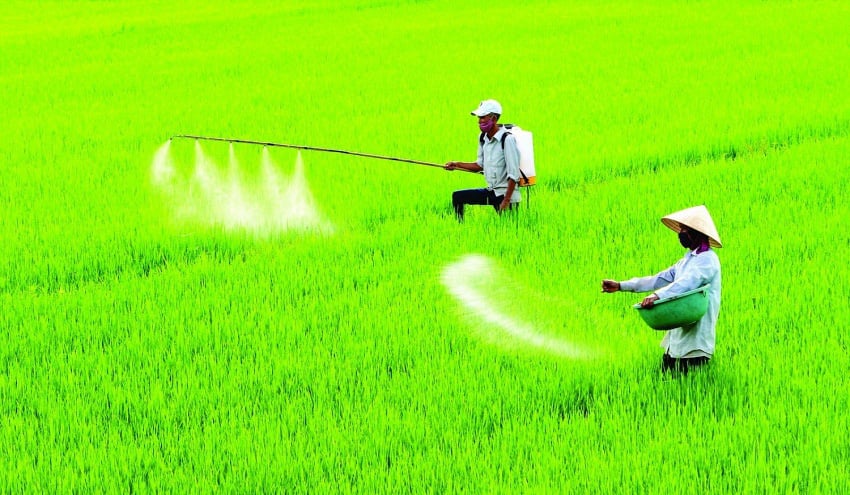
Farmers are concerned that the 5% VAT will increase fertilizer prices - Photo: TT
One of the issues that delegates were most concerned about was the bill's provision to impose a 5% tax rate on fertilizers.
Some opinions suggest continuing the tax exemption for fertilizers and specialized machinery and equipment used in agricultural production as currently in effect.
This opinion stems from the delegates' belief that applying a 5% tax would increase fertilizer prices, benefiting businesses and boosting state revenue by 1,500 billion VND (from imported fertilizers), while farmers would bear the brunt of the losses.
Explaining this issue, Mr. Mạnh stated: "As the delegates pointed out, applying a 0% tax rate to fertilizers would ensure benefits for both domestic fertilizer manufacturers and fertilizer importers, because both imported and domestically produced fertilizers would receive a refund of the input VAT already paid and would not have to pay value-added tax on fertilizers when sold."
However, the Standing Committee of the National Assembly believes that in this case, the state budget would have to spend trillions of dong annually to refund input value-added tax for businesses.
Statistics from the General Department of Taxation show that the total amount of input value-added tax for fertilizer production in the years 2019-2023 that is not deductible (due to current policy that fertilizers are not subject to tax) is over 8,900 billion VND. If a 0% tax rate is applied, the budget will have to refund this input tax to businesses.
Besides the budgetary drawbacks, Mr. Mạnh argued that applying a 0% tax rate to fertilizers contradicts the principles and practices of value-added tax, which stipulates that a 0% tax rate should only apply to exported goods and services, not to domestic consumption.
"Applying this approach would disrupt the neutrality of tax policy, set a bad precedent, and be unfair to other industries. Setting a 1% or 2% tax rate on fertilizers would also be inconsistent with the objectives of VAT reform. Therefore, the number of tax rates should be reduced, not increased, compared to current regulations," Mr. Mạnh said.
Concerns that fertilizer companies are colluding to raise prices are well-founded, and measures will be taken to prevent it.
Le Quang Manh, Chairman of the National Assembly's Finance and Budget Committee, also expressed concern that domestic fertilizer manufacturers might collude with private traders to import fertilizers and increase their market prices, arguing that this concern is justified because the goal of these businesses is profit.
However, fertilizers are currently a commodity subject to state price stabilization. Therefore, when the new policy is implemented, if there are signs of instability in the market, state management agencies can take measures to stabilize prices.
The Standing Committee of the National Assembly will also include in the draft resolution of the session a request for the Government to direct state management agencies to ensure market management measures and strictly handle cases where domestic fertilizer production enterprises take advantage of newly issued policies, collude with private traders to engage in profiteering activities that cause large price fluctuations in the market, affecting the agricultural sector.
Source: https://tuoitre.vn/chinh-thuc-danh-thue-5-doi-voi-phan-bon-20241126164028319.htm
![[Photo] Standing Committee member of the Party Central Committee Tran Cam Tu working with the Central Inspection Committee](https://vphoto.vietnam.vn/thumb/1200x675/vietnam/resource/IMAGE/2026/05/28/1779969579668_ndo_br_bnd-2495-jpg.webp)

















































































Comment (0)