

Be proactive from the start.
Immediately after the World Health Organization (WHO) declared the Ebola outbreak in several African countries a public health emergency of international concern (May 17), the provincial health sector activated emergency response plans. In particular, international health quarantine measures were tightened to the highest level at Cam Ranh International Airport.
These days, international health quarantine personnel are on duty 24/7 at Cam Ranh International Airport. Seven to ten remote body temperature scanners are placed along passenger flow routes to monitor 100% of incoming and outgoing passengers. In addition, numerous billboards, posters, and information boards in multiple languages are displayed in the border area to help passengers stay updated on the disease situation and necessary preventive measures.
 |
| Staff at the Khanh Hoa International Health Quarantine Center monitor passengers' body temperature. |
Mr. Le Van Tung, Director of the Khanh Hoa International Health Quarantine Center, said that as soon as the Ministry of Health issued a directive, the unit developed a plan for epidemic prevention and control with specific coordination scenarios; at the same time, it strengthened personnel, equipment, and medical supplies to be ready to respond. Mr. Tung said: “In addition to doubling the number of body temperature monitoring devices and requiring health declarations from incoming passengers, those coming from Africa or who have traveled through epidemic areas are thoroughly screened to detect early signs of suspected illness. In particular, the center has established a rapid response team with full professional components. When a case with suspected symptoms such as fever, fatigue, etc., is detected, the authorities will take them to a temporary isolation area to gather information, assess the risk, and coordinate transfer to a medical facility for sample collection, diagnosis, and treatment.”
In addition, the center has strengthened quarantine measures at Cam Ranh International Seaport, which regularly receives international cruise ships and many industrial cargo ships. Quarantine staff directly board ships to monitor passengers, crew members, and cargo in order to minimize the risk of disease outbreaks.
Mr. Nguyen Duc Tinh - Deputy Director of the Khanh Hoa Center for Disease Control: Although Vietnam has not yet recorded any cases, the local health sector is absolutely not complacent. The Center has developed response plans, closely coordinating with treatment facilities to monitor people returning from affected areas, organizing sample collection for testing when necessary, and implementing isolation according to regulations if a positive case is detected. Hospitals are also preparing isolation areas, protective equipment, medicines, and personnel to be ready to receive suspected cases. The Provincial Hospital for Tropical Diseases has been identified as the unit to receive and treat Ebola patients. The entire sector will intensify public awareness campaigns on disease prevention measures such as: limiting travel to affected areas, avoiding contact with wild animals such as bats and monkeys; eating cooked food and drinking boiled water, maintaining personal hygiene, and proactively reporting any suspected symptoms.
Urgently implement disease prevention measures.
According to updated information from the WHO, as of May 22nd, Congo had recorded 750 suspected cases of Ebola, with 177 deaths; Uganda had recorded 2 imported cases, including 1 death. The causative agent is the Bundibugyo strain of the Ebola virus - one of the strains capable of causing dangerous disease in humans.
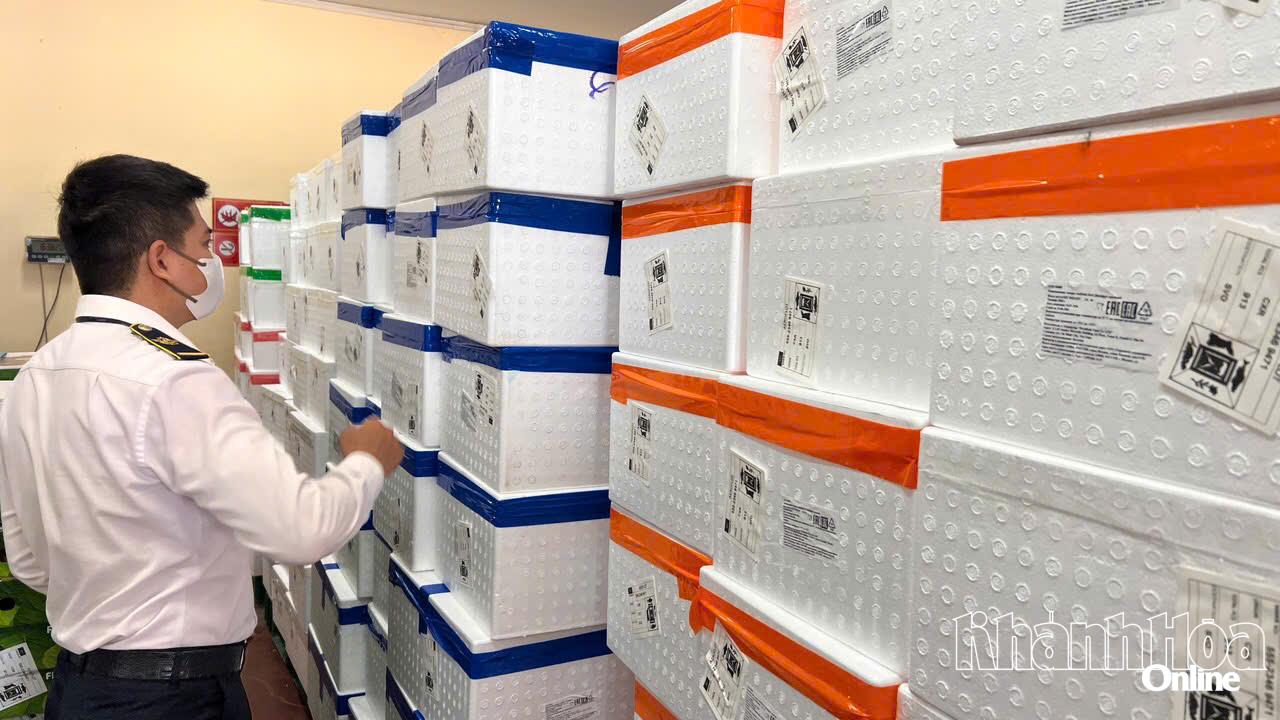 |
| Staff from the Khanh Hoa International Health Quarantine Center inspect goods on ships. |
Given the above developments, on May 24th, the Department of Medical Examination and Treatment Management under the Ministry of Health issued an urgent dispatch requesting provincial health departments and medical facilities nationwide to urgently strengthen measures to prevent and control Ebola virus disease. Accordingly, hospitals must organize screening, classification, and strict isolation of suspected cases; paying particular attention to those who have traveled to countries with outbreaks within the past 21 days. At the same time, they must ensure isolation conditions and diagnostic capacity to be ready to respond if cases appear in Vietnam... In addition, the Ministry of Health also issued a new professional document on guidelines for the diagnosis and treatment of Ebola virus disease, updating many important contents compared to the 2014 version, such as: adding more Ebola virus strains, updating testing methods, diagnostic criteria for suspected cases, and modern treatment measures. According to these guidelines, a suspected case must have a fever of 38 degrees Celsius or higher accompanied by at least one specific symptom such as headache, vomiting or diarrhea, abdominal pain, unexplained bleeding, and a relevant epidemiological link within the past 21 days.
According to health experts, Ebola is a dangerous acute infectious disease with a mortality rate ranging from 25% to 90% (averaging around 50%).
THAO LY
Source: https://baokhanhhoa.vn/xa-hoi/y-te-suc-khoe/202605/chu-dong-phong-dich-ebola-4651754/


![[Image] Checking the security conditions at the exam site, ready for the 10th grade exam.](https://vphoto.vietnam.vn/thumb/1200x675/vietnam/resource/IMAGE/2026/05/28/1779943458889_z7872507660648-d764421a26e8cd7b61d70d142a48a685-jpg.webp)


![[Photo] Opening Ceremony of the National People's Council Conference on the Implementation of Directions and Tasks for the 2026-2031 Term](https://vphoto.vietnam.vn/thumb/1200x675/vietnam/resource/IMAGE/2026/05/28/1779939257690_ndo_br_bnd-1991-jpg.webp)





















































































Comment (0)