


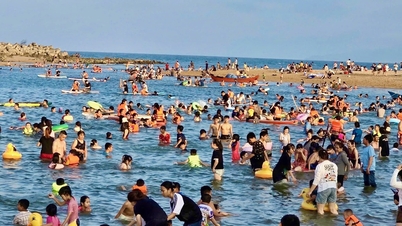
A group of young people traveling to Phu Quy Island (Lam Dong province) - Photo: Q.D.
In recent years, the term "healing" has frequently appeared on social media. It appears in every context: from "healing travel," "healing drinking," "healing karaoke," "healing scalp massage," to "healing workplace" instead of high salary.
This trend has even become a part of the lifestyle of many young people, reflecting the need for mental health care in the context of modern life pressures.
In many dictionaries, this word accurately means the process of treatment to restore health, primarily related to physical illness. In written documents or in everyday use, "healing" has been used to mean being able to cure a disease: "a curable disease," "a healed wound," etc.
"Healing" is often used in the context of healthy psychology: the process of recovering from physical, mental, or emotional trauma, helping people find balance and peace again. It can include mindfulness meditation, traveling, journaling, talking to friends, seeking mental health support, or simply getting proper rest.
Over time, the term "healing" has shifted from a specific medical meaning to an abstract psychological meaning, expanding its scope of expression. Initially a specialized term, it spread through social media and became a widely used word (a hot trend).
There has been a phenomenon of misuse and semantic degradation where words with profound meaning (a persistent inner journey) have been reduced to superficial "trends": "drinking to heal," "karaoke to heal," "healing through shopping"... In other words, anything can be labeled "healing," while it neither "heals" nor "heals"!
Following the COVID-19 pandemic, work pressure, rising living costs, social media exaggerating negative emotions, and various life risks have left many feeling exhausted, lonely, and anxious. Young people are openly admitting to "mental fatigue" and seeking ways to take care of themselves – something that previous generations often kept secret or considered a weakness.
This is a positive aspect: Vietnamese society is gradually becoming more open to mental health, no longer viewing depression or anxiety as "madness" or "weakness." Many people are actually benefiting from simple activities like listening to podcasts, living at a slower pace, connecting with nature, or prioritizing a healthy work environment.
However, the misuse and commercialization of the word "healing" is distorting the concept. Many people use this word to "cure" everything: feeling a little sad is considered "trauma," feeling tired is seen as "needing immediate healing," and even unemployment leads people to "seal the deal" on expensive vacations instead of facing reality.
Some psychologists warn that abuse can lead to "toxic positivity," oversimplifying serious psychological problems or creating the illusion that all trauma can be quickly healed with a trip or course.
This trend has been exploited for commercial purposes: courses and workshops on "healing" costing tens of millions of dong, self-proclaimed "healers," spiritual tourism services... turning pain into opportunities to make money. A segment of young people abuse "healing" to evade responsibility, become lazy, and avoid facing difficulties – this does not help recovery but may push them into deeper crises.
It can be said that "healing" is a legitimate and necessary need in modern society, where mental health has been neglected for far too long. It encourages self-awareness, self-care, and reduces psychological stigma.
But when it becomes a mainstream trend, it easily becomes distorted: from a profound inner journey to a superficial fad, from self-healing to dependence on commercial services.
Source: https://tuoitre.vn/chua-lanh-dang-bi-lam-dung-den-meo-mo-20260526083032915.htm
![[Photo] General Secretary and President To Lam presides over the meeting to approve the draft report on the results of the second inspection by the Politburo of the Standing Committee of the Hanoi City Party Committee.](https://vphoto.vietnam.vn/thumb/1200x675/vietnam/resource/IMAGE/2026/05/26/1779789811432_a2-bnd-4430-9620-jpg.webp)


























































Comment (0)