

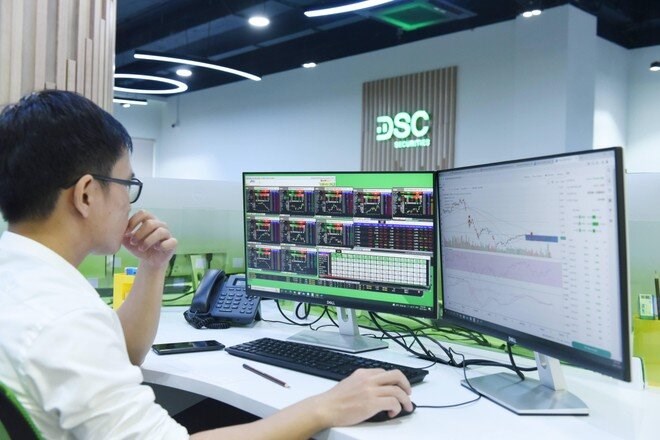
There are many conflicting views on market trends in September. The VN-Index is predicted to have many opportunities to return to the 1,290 - 1,300 point range, but instead of rising immediately, the market continues to hover around the 1,250 - 1,260 point range.
The stock market experienced a significant decline in the first two weeks of September, accompanied by weak liquidity. The VN-Index faced downward pressure for five consecutive sessions, falling from 1,270 points to around 1,250 points. The only positive aspect was perhaps the holding of the 1,250-point support level and the attraction of investment to a few stocks in the agriculture and food sectors.
The market experienced a rather sluggish trading week, with the last two trading sessions seeing the lowest trading volumes since April 2023, as investors appeared to be heavily influenced by the developments and severe consequences of Typhoon Yagi .
Following the less-than-optimistic market developments, many experts have expressed cautious and somewhat negative views, suggesting that the VN-Index could correct further, possibly even falling to support levels of 1,220-1,230 points. They also recommend that investors maintain an average stock allocation and wait for clearer reversal signals before increasing their positions.
However, many remain optimistic about the factors that will support the stock market in the near future, believing that risks have decreased and the market is preparing for a rally towards the end of the year.
According to the analysis team at ABS Securities, the basis for this assessment is that there will be two key macroeconomic factors impacting the market.
Firstly, following the devastating consequences of Typhoon Yagi, people and businesses will need significant time and resources to restore their lives and return to normal production and business operations.
Inflationary pressures due to cost-push factors will also increase as the supply of both essential and non-essential goods will be affected. However, some sectors will still benefit from this reconstruction effort.
Secondly, a key factor expected to significantly impact the economy and markets in the coming period is the possibility of the Fed reversing its monetary policy, beginning to cut the benchmark interest rate by 0.25% from the FOMC meeting on September 18th.
This aligns with the recent trend of major central banks around the world beginning to lower their policy interest rates as inflation has fallen to expected levels.
In Vietnam, the State Bank of Vietnam (SBV) has aimed to maintain low and stable interest rates to support the economy. However, the continued high USD interest rates have put significant pressure on the exchange rate. The Fed's interest rate cut means the SBV will have more room to manage monetary policy more flexibly.
The State Bank of Vietnam is implementing various solutions to promote credit growth to support the economy, such as: gradually lowering interest rates; implementing preferential measures; and implementing solutions to support customers in overcoming the consequences of Typhoon No. 3.
As of September 7th, outstanding credit had increased by 7.15% compared to the beginning of the year. Credit growth consistently improves liquidity in the economy and the stock market.
Furthermore, solutions to upgrade the market status, such as a circular allowing foreign institutional investors to purchase securities without having to have sufficient funds immediately, may be issued (expected in September) and implemented early in the fourth quarter. This could help increase foreign capital inflows into Vietnam.
Source: https://laodong.vn/kinh-doanh/chung-khoan-cho-tin-hieu-dao-chieu-1394424.ldo
![[Image] Close-up view of the interchange connecting the two expressways and Long Thanh Airport.](https://vphoto.vietnam.vn/thumb/1200x675/vietnam/resource/IMAGE/2026/05/25/1779703378210_ndo_br_z7863716673926-224453a31600126cce10622af6290afd-4549-jpg.webp)




![[Image] Hanoi's urban life under the challenge of a "scorching hot" environment](https://vphoto.vietnam.vn/thumb/1200x675/vietnam/resource/IMAGE/2026/05/25/1779706979265_nang-nong-t5-2026-minh-duy-7-4636-jpg.webp)




















































































Comment (0)