

Following this trend, promoting digital transformation in the work of protecting the Party's ideological foundation and combating erroneous and hostile viewpoints will help form solid "shields" contributing to the firm protection of the Party's ideological foundation, consolidating and strengthening scientific belief in Marxism-Leninism and Ho Chi Minh Thought, maintaining unity and cohesion within the Party, social consensus and trust in the Party; preventing and repelling the decline in political ideology, morality, and lifestyle, the manifestations of "self-evolution" and "self-transformation" within the Party; preventing harmful and toxic information and spreading official and positive information to all levels of the people; and thwarting all conspiracies, schemes and subversive activities of hostile and reactionary forces in the new situation.
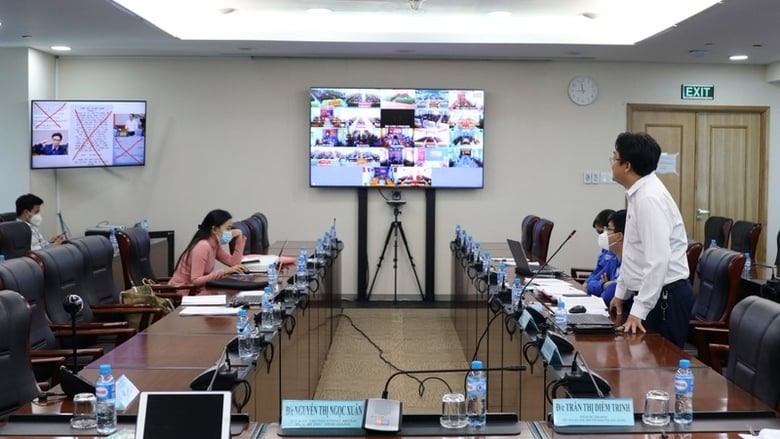
Orientation training on smart social media use for youth union members and teenagers in Binh Duong province.
On June 3, 2020, the Prime Minister officially approved the "National Digital Transformation Program to 2025, with a vision to 2030," which defines the vision for 2030 as: "Vietnam becoming a digital nation, stable and prosperous, pioneering in testing new technologies and models; fundamentally and comprehensively reforming the management and operation of the Government, the production and business activities of enterprises, the way of life and work of the people, and developing a safe, humane, and widespread digital environment."
Over the years, under the wise and timely leadership of the Party and Government, digital transformation in Vietnam has undergone significant changes, promoting the development of many sectors and making a considerable contribution to protecting the Party's ideological foundation.
Through digital transformation, the Party's synergistic strength is effectively enhanced in various forms, such as applying digital technology to leadership, management, information, reporting, and updating and backing up data of Party organizations and members; digital transformation provides strong support for the management of cadres and Party members, Party committee and branch activities, inspection and supervision work... and the work of propaganda, research, study, and thorough understanding of Party resolutions throughout the Party and the people; perfecting the leadership, guidance, and management methods of Party committees through information technology applications, putting into use electronic document systems and Party work reporting information systems in the operational activities of the Party and government systems... In some provinces and cities, almost 100% of communes, wards, and towns have implemented the "Electronic Party Member Handbook".
Digital transformation helps the Party's leadership and the Government's administration to be more effective and efficient, enhances transparency, strengthens closer linkages, reduces corruption, and creates healthy social development.
This can be considered one of the breakthroughs that significantly contributes to achieving the goals set in Party building, protecting the Party's ideological foundation, creating unity in awareness, thought, will, and action within the Party, and consensus in society.
With its wide reach, rapid dissemination, and diverse forms of expression, digital transformation helps the Party's leadership and the Government's administration to be more effective and efficient, enhancing transparency, strengthening closer linkages, curbing corruption, and creating a healthy development for society. Digital transformation also helps strengthen interaction between the Party, the Government, and the people, thereby consolidating and enhancing trust and responsibility of each individual, creating opportunities for people to participate in the management, supervision, and decision-making processes of public agencies.
In the work of protecting the Party's ideological foundation, digital transformation promotes innovation in activities implemented in practice. Because with modern technologies, we can build and organize many diverse activities and products, meeting the diverse needs of the community and adapting to the new demands of society.
However, digital transformation also presents enormous challenges to management, administration, and national security, especially in the fight to protect the Party's ideological foundation in the current period. With its open nature, cyberspace is a favorable environment for hostile forces to intensify their subversive activities, employing increasingly sophisticated and insidious methods. These groups establish websites, blogs, Facebook pages, YouTube channels, create "forums," "clubs," and form online groups to disseminate information, documents, images, and video clips with harmful and toxic content; they post false information to attack and deny the achievements of our country, slander Party and State leaders, distort the Party and State's policies, and deny the path to socialism in Vietnam.
Digital transformation also presents enormous challenges to management, administration, and national security, especially in the fight to protect the Party's ideological foundation in the current period.
In the context of today's rapid digital transformation, hostile and reactionary forces both domestically and internationally are thoroughly exploiting the internet to collect state secrets for their dark political schemes. Statistics from relevant agencies show that over 1,000 cases of leaking state secrets have been discovered in the past 10 years.
Besides cases of intentional disclosure of state secrets that have been severely punished by law, there are still many cases of information leaks stemming from negligence, lack of vigilance, lack of understanding of digital technology, weak infrastructure and equipment, limited security technology, etc. These are "lucrative opportunities" for hostile forces to exploit and undermine the country. This has, to varying degrees, negatively impacted the thinking and awareness of a segment of cadres, Party members, and the people; causing confusion, suspicion, and a decline in trust in the country and the Party's leadership. Given this situation, we need specific strategies and solutions to ensure that the digital transformation process yields the highest possible effectiveness, contributing to the firm protection of the Party's ideological foundation.
Resolution No. 35-NQ/TW dated October 22, 2018, of the Politburo on "Strengthening the protection of the Party's ideological foundation and effectively refuting erroneous and hostile viewpoints in the new situation" affirms: Firmly protecting the Party's ideological foundation and effectively refuting erroneous and hostile viewpoints is a fundamental, crucial, and vital content in the work of Party building and rectification, and is a top priority task for the entire Party, army, and people.
The resolution clearly states the need to innovate the content and methods, improve the quality and effectiveness of political propaganda; proactively and persuasively combat and refute false and hostile viewpoints; and strengthen positive information while effectively preventing, handling, and eliminating harmful and toxic information on the internet and social media. To achieve this, one of the first things to do is to improve the quality and effectiveness of managing and using the internet and digital platforms. This includes thoroughly disseminating and implementing the Law on Cybersecurity and the "Code of Conduct on Social Media" issued by the Ministry of Information and Communications; and strictly adhering to the principles of using social media and exploiting the internet effectively, practically, and healthily.
It is necessary to strengthen the application of digital technology in protecting the Party's ideological foundation. Based on digital transformation, we need to create high-quality media content and products that are suitable for different audiences in society. Currently, media formats such as videos, podcasts, infographics, etc., are popular. These are diverse and engaging forms of information transmission, helping different audiences access propaganda information more easily and quickly. Therefore, in the work of propaganda and protecting the Party's ideological foundation, it is necessary to exploit and effectively promote new forms of expression that are relatable, persuasive, and engaging.
Authorities need to strengthen cyberspace management, promptly detect false and distorted information, resolutely combat, prevent, remove, and strictly handle violations in accordance with the law. Maximize the advantages of information technology and the network of mainstream media, proactively report and reflect on issues of public concern in a timely manner, resolutely refute false, harmful, and toxic information, and contribute to shaping public opinion. It is necessary to strengthen the understanding of public sentiment through social media groups, fan pages, blogs, etc.; build information pages that promote good examples and good deeds, uphold the spirit of solidarity, sharing, and mutual support, with the goal of using "beauty to overcome ugliness," contributing to the elimination of harmful, toxic, distorted, and misrepresented information.
Statistics from relevant authorities show that over 1,000 cases of leaking state secrets have been discovered in the past 10 years.
Besides cases of intentional disclosure of state secrets that have been severely punished by law, there are still many cases of information leaks stemming from negligence, lack of vigilance, lack of understanding of digital technology, weak infrastructure and equipment, limited security technology, etc.
Training courses should be organized for cadres and Party members on the skills and knowledge of using information technology in protecting the Party's ideological foundation, so that each individual understands the operating mechanisms of social networks and electronic information websites and uses them proficiently and effectively. Continue to promote propaganda and education on information security and data confidentiality in the work of protecting the Party's ideological foundation.
Emphasis should be placed on training and developing specialized forces and a network of collaborators, supported by technology, to promptly detect, prevent, and even proactively attack and eliminate products containing distorted and harmful information. In propaganda work, special attention should be paid to the younger generation, helping them raise awareness of the opportunities and challenges in digital transformation, recognize the subversive plots and tactics of hostile and reactionary forces in cyberspace, strengthen their resilience and immunity, and actively participate in combating and refuting false and hostile viewpoints on social media.
Regarding infrastructure, during the digital transformation process, it is necessary to focus on building and developing a synchronized national data infrastructure, investing in and equipping systems for collecting, storing, processing, and protecting public data. It is also crucial to promote the application of scientific and technological achievements to improve network security, portal security, and website security; strengthen solutions to ensure network security and safety at agencies and units; and create "firewalls" to effectively prevent and combat hacker attacks and the theft of internal information and state secrets through networked computer systems.
Source link
![[Photo] Prime Minister Pham Minh Chinh presides over a meeting on private sector economic development.](/_next/image?url=https%3A%2F%2Fvphoto.vietnam.vn%2Fthumb%2F1200x675%2Fvietnam%2Fresource%2FIMAGE%2F2025%2F12%2F20%2F1766237501876_thiet-ke-chua-co-ten-40-png.webp&w=3840&q=75)
























































































Comment (0)