

Recently, the Vietnam National Tourism Administration collaborated with Google to launch the "Google Arts & Culture: Wonders of Vietnam" project – a digital museum preserving and promoting the finest values of Vietnamese culture, art, history, and tourism globally. A video- based communication program on the YouTube platform, themed "Vietnam: Travel to Love!", with initial support from Google, was honored with Second Prize at the 8th National Award for External Information in 2022, organized by the Central Propaganda Department. This was coupled with numerous strong communication and promotion activities for Vietnamese tourism on popular websites and social media platforms such as Facebook, YouTube, Instagram, Zalo, and Viber.
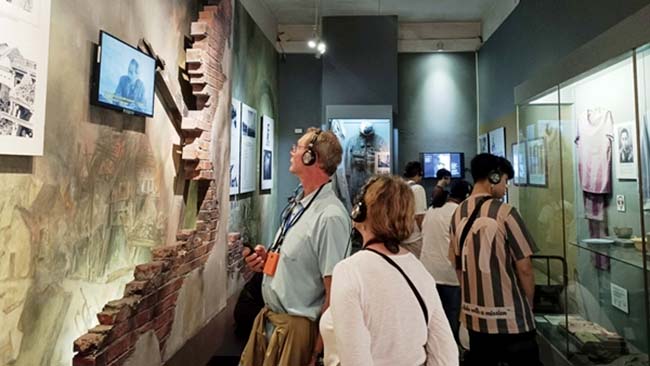
In Hanoi , in recent years, many institutions have actively participated in digital transformation to attract tourists. The Thang Long - Hanoi Heritage Conservation Center, the Vietnam Fine Arts Museum, the National History Museum, the Vietnam Fine Arts Museum, the Hoa Lo Prison historical site, etc., all have online exhibitions. In particular, the 3D online tour technology of the Vietnam Fine Arts Museum is not only attractive to visitors but also highly regarded by experts.
According to Mr. Tran Trung Hieu, Deputy Director of the Hanoi Department of Tourism , the city has implemented a comprehensive tourism database software (dulich.myhanoi.vn) and put it into operation since the beginning of 2023. Tourism businesses in Hanoi, including travel agencies, accommodation providers, transportation companies, and tourist destinations, are increasingly applying e-commerce in their business operations…
Information from the Ho Chi Minh City Department of Tourism also indicates that, after the Smart Tourism Project for the period 2020-2030 was approved by the Ho Chi Minh City People's Committee, the Department has developed and implemented many projects and plans, including digital transformation in the operation and management of tourism. One of the city's outstanding successes is the application of 3D technology in tourism information and promotion, including the application of high-tech 3D aerial scanning technology and the interactive 3D/360 Smart Tourism Map of Ho Chi Minh City with features such as virtual tour guides at destinations scanned with 3D images, video data, 2D images, and audio in Vietnamese and English about the scanned destinations, and an automated tour system based on tour programs designed by travel businesses.
The application of technology in tourism development has also been promoted by many other localities with outstanding successes, such as Da Nang City with its multilingual tourism information website and portal, the Danang FantasticCity application, chatbots - virtual assistants interacting with tourists, and the VR360 application "One touch to Da Nang"... Quang Binh has been very successful with its project to bring its image to the world through 360-degree photos from National Geographic. Sa Pa also has a 3D technology application to provide information and virtual tourism services for tourist destinations directly managed by Sa Pa town, and has implemented software to reflect the situation on the ground, providing interactive channels between the government and the people...
However, digital transformation in tourism still faces many limitations. The Ho Chi Minh City Department of Tourism also stated that, during the development of the Ho Chi Minh City Smart Tourism Project for the period 2020-2030, the city conducted research on the current state of digital transformation in tourism in Ho Chi Minh City and 13 provinces and cities in the Mekong Delta, as well as some other provinces and cities nationwide. The results showed that tourism in these provinces and cities is developing smart tourism at various levels.
Despite initial efforts, the implementation of smart tourism in key tourist provinces and cities across the country remains fragmented and limited to scattered investments in a few applications. Furthermore, Vietnamese tourism businesses are primarily small and medium-sized enterprises (SMEs) with limited capital and small-scale operations, resulting in low financial capacity for technology investment and limited access to smart tourism. The lack of shared online data connectivity also hinders the achievement of a crucial goal of smart tourism: creating synchronized connections between elements within the tourism ecosystem to provide convenience for tourists.
Regarding this issue, Minister of Culture, Sports and Tourism Nguyen Van Hung frankly pointed out that, in addition to the achievements, the tourism industry also needs to acknowledge that the digital transformation process still faces many obstacles and limitations. These include fragmentation and disjointedness in implementation, making it difficult to form a unified and synchronized ecosystem throughout the industry. Due to varying levels of development, there are still significant disparities in digital technology across different localities.
Furthermore, the tourism industry suffers from a shortage of modern technology, financial resources, and a digital workforce with the necessary knowledge and skills. Digital technology solutions, platforms, and infrastructure are still incomplete. Data is not yet fully updated from various sources... Therefore, the digital transformation process requires decisive action and innovation in both thinking and action from the entire tourism industry, from the role of management agencies to the efforts and endeavors of businesses, organizations, and local governments.
Source








![[Infographics] - 5 types of money transferred into personal accounts that are subject to tax.](https://vphoto.vietnam.vn/thumb/402x226/vietnam/resource/IMAGE/2025/7/11/18141e7ce49d4ad2815e79e2084362f1)






















































































Comment (0)