

The need for a green transition is becoming increasingly evident.
Speaking at the Vietnam Sustainable Construction Forum (VSCF) 2025, organized by the Ho Chi Minh City Association of Construction and Building Materials (SACA) on December 19th, Mr. Bui Xuan Cuong, Vice Chairman of the People's Committee of Ho Chi Minh City, emphasized that as the economic , financial, and special urban center of the country, Ho Chi Minh City is well aware of its pioneering responsibility in achieving sustainable development goals.
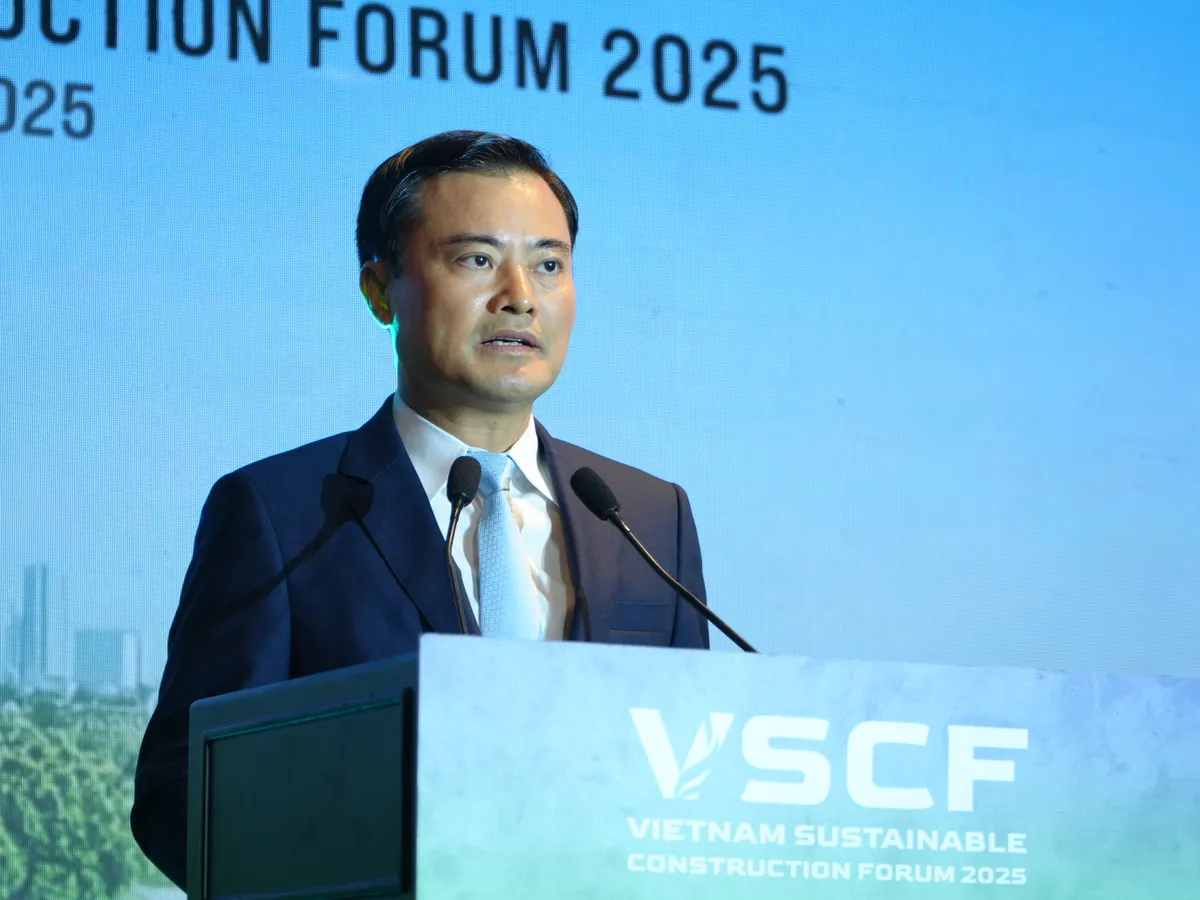
Mr. Bui Xuan Cuong, Vice Chairman of the People's Committee of Ho Chi Minh City, shared his views at the forum.
The city currently contributes over 23% of the national GDP and has a rapid rate of urbanization, resulting in a huge demand for infrastructure investment. In this context, sustainable development of the construction industry is not only aimed at meeting environmental commitments but also serves as a fundamental solution to enhance competitiveness, improve quality of life, and increase resilience to climate change.
From the perspective of urban planning and architecture, Dr. Ngo Viet Nam Son, an architect, argues that the current development approach still has many limitations. According to him, Vietnam has made significant progress in growth, construction, and urbanization, but it is precisely these rapidly developing areas that often face intractable problems such as flooding, traffic congestion, and environmental pollution. This reflects the reality that development still prioritizes "quantity" over "quality."
"It is unacceptable for an urban area to be considered upscale but suffer from flooding, traffic congestion, and pollution," Mr. Son emphasized, adding that Vietnam needs to shift from a growth-first mindset to one that prioritizes quality of life and sustainable development, if it does not want to pay a heavy price in the future.
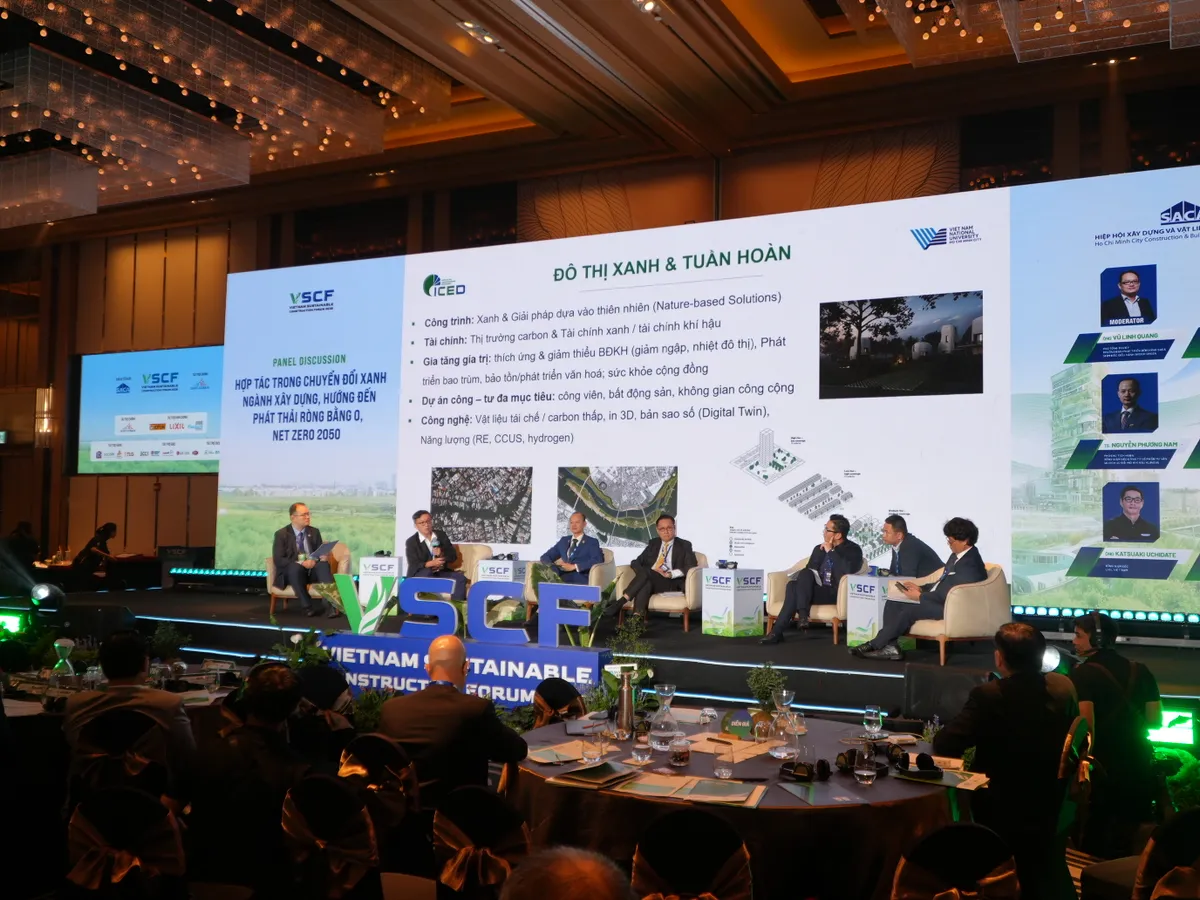
Speakers shared models and solutions for developing a sustainable construction industry in Vietnam.
The pressure for transformation also stems from the scale of emissions within the industry itself. According to Mr. Dinh Hong Ky, Chairman of the Ho Chi Minh City Construction and Building Materials Association (SACA), emissions across the entire construction ecosystem, including construction, building materials, infrastructure construction, and real estate, currently account for approximately 37-38% of the total emissions of the economy. With this proportion, if the construction industry does not successfully transform, Vietnam's Net Zero target by 2050 will be significantly impacted.
Beyond policy pressures, the market is becoming an increasingly stringent "filter." In the near future, Grade A and B buildings that do not meet green building criteria may face reduced rental prices, increased vacancy rates, and even difficulty finding tenants. Competitive pressure is forcing developers to restructure according to green models if they want to maintain their position.
However, according to Mr. Ky, businesses are still facing many obstacles, the biggest of which are a reluctance to change and the cost issue. Renovating existing buildings to meet green building criteria is a very large investment. According to international experience, this cost can be up to 50% compared to building new. Meanwhile, in Vietnam, green building criteria have not yet become a mandatory condition for factories, urban areas, or buildings to be allowed to operate, resulting in insufficient motivation for transformation.
Green criteria have become the "benchmark" for each project.
Warnings about the urban environment are making the need for sustainable development more urgent than ever. According to architect Ngo Viet Nam Son, Ho Chi Minh City is currently subsiding at an average rate of about 13 mm per year, while sea levels continue to rise. If the city continues to develop in the old way, without adapting to climate change, the risks will only increase.
"Sustainable development is no longer an option, but the only way to avoid long-term losses," Mr. Son stated.
In this context, green building and sustainability criteria are gradually becoming the "benchmark" for project quality and developer responsibility. In the real estate market, projects that meet green standards are not only highly valued in terms of environmental impact, but also demonstrate a long-term vision and level of commitment from businesses to their customers.
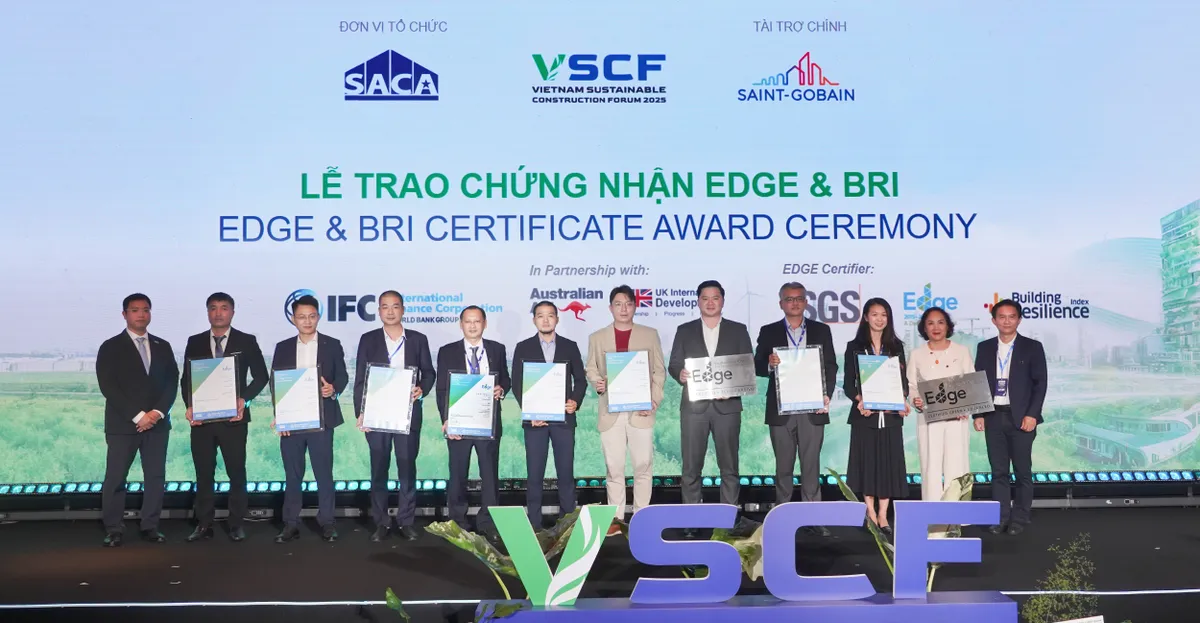
Many businesses have been awarded international green building certifications, contributing to guiding the construction industry towards sustainable development in the future.
As the global economy moves deeper into a green growth trajectory, sustainable development in construction has moved beyond a strategic option to become a mandatory requirement. The commitment to achieving net-zero emissions by 2050 not only places a national responsibility but also compels major emitting sectors like construction to undergo significant restructuring.
Projects pursuing green certification demonstrate that sustainable transformation is not only a mandatory requirement but also a foundation for improving product quality and the long-term value of Vietnam's construction industry.
Source: https://vtv.vn/chuyen-doi-xanh-bai-toan-song-con-cua-nganh-xay-dung-100251219201856401.htm
![[Photo] Prime Minister Pham Minh Chinh attends the Conference on the Implementation of Tasks for 2026 of the Industry and Trade Sector](/_next/image?url=https%3A%2F%2Fvphoto.vietnam.vn%2Fthumb%2F1200x675%2Fvietnam%2Fresource%2FIMAGE%2F2025%2F12%2F19%2F1766159500458_ndo_br_shared31-jpg.webp&w=3840&q=75)












































































Comment (0)