

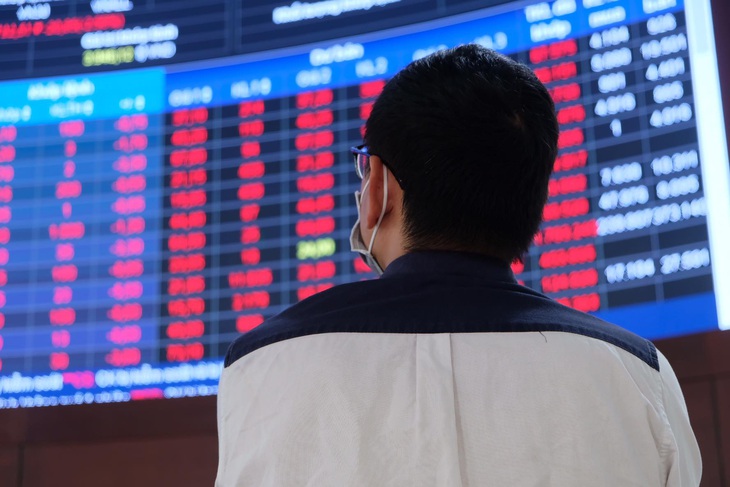
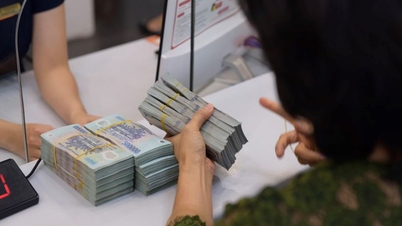
Real estate stocks have been under selling pressure in recent sessions - Photo: BONG MAI
Message on controlling real estate speculation.
Mr. Ho Huu Tuan Hieu - an investment strategy expert at SSI Research - believes that the market's cautious reaction is understandable because real estate is an industry with a large ripple effect on many economic sectors, from banking and construction materials to consumer goods.
He argued that the issue should be viewed from a long-term perspective rather than reacting solely to short-term sentiment. Compared to China's period of strict real estate controls from 2016-2020, the current context in Vietnam is significantly different.
Vietnam is still undergoing rapid urbanization, with a young population and significant demand for real estate. The rate of new urbanization is around 38%, much lower than China's nearly 60% when the country entered a period of oversupply.
According to Mr. Hieu, the number of homebuyers aged 30-40 in Vietnam remains high, creating a foundation for continued expansion of real estate demand in the coming years. The current control measures are primarily aimed at curbing speculation, regulating capital flows, and bringing housing prices closer to the affordability of the people.
He emphasized that the issue of controlling housing prices or curbing speculation is not a new one. The noteworthy point is that, alongside controlling speculation, the authorities are also actively removing legal obstacles and boosting supply. Many projects are expected to restart in 2025 after a long period of stagnation.
The regulatory body's approach has also shifted towards greater flexibility, allowing for the resolution of legal obstacles in stages so that projects can be implemented sooner, instead of waiting for the entire procedure to be completed as before.
Thus, businesses focusing on real housing needs and developing projects in inner-city areas or suburban areas of major cities with good infrastructure still have room for growth. Meanwhile, businesses owning land far from the city center and heavily reliant on speculative capital will face greater pressure as regulatory policies become increasingly stringent.
According to Mr. Hieu, the outlook for the real estate industry in the coming period will be highly differentiated rather than experiencing uniform growth like in previous cycles. Instead of viewing the entire industry as a single trend, investors need to carefully select businesses and focus on those that benefit from the demand for actual housing as well as the expansion of supply in major cities.
What will happen to real estate stocks?
Speaking to Tuoi Tre Online , Ms. Nguyen Thi Thanh Nhan, an analyst at FinSuccess Investment Joint Stock Company, said that in the short term, real estate stocks are likely to remain under downward pressure as market sentiment is sensitive to factors such as credit, project legal issues, and tightened trading mechanisms aimed at preventing speculation.
The impact will not be uniform across the industry, leading to significant differentiation. Businesses with high leverage, reliance on bonds, and large inventories will face the greatest risks. In Q2 2026, approximately 59 trillion VND of bonds will be issued, with real estate bonds accounting for 79%, or nearly 46 trillion VND. Around 120 trillion VND of real estate bonds will mature in 2026.
In addition, the inventory of residential real estate held by more than 70 listed companies has reached nearly 430,000 billion VND. Some companies such as Phat Dat, Dat Xanh, and Novaland still record high inventory-to-debt ratios.
According to Ms. Nhan, the current management orientation is not aimed at "stifling" businesses that genuinely develop projects, but rather focuses on controlling speculation. The goal is to maintain the proportion of real estate credit around 25% of total outstanding loans, direct capital towards genuine housing needs, increase market data transparency in accordance with Decree 357/2025, and prioritize the development of social housing.
Shares of leading companies with clean land reserves, sound finances, and low debt pressure will stabilize sooner once sentiment returns to balance. Additionally, the valuations of companies with strong fundamentals have returned to around their 5-year average.
According to her, investors should be cautious in the short term, avoid buying speculative stocks that have fallen sharply, and wait for signs of stable cash flow to select stocks with truly good financial foundations and projects.

Source: https://tuoitre.vn/chuyen-gi-dang-xay-ra-voi-co-phieu-bat-dong-san-20260522101449725.htm




![[Image] Close-up view of the interchange connecting the two expressways and Long Thanh Airport.](https://vphoto.vietnam.vn/thumb/1200x675/vietnam/resource/IMAGE/2026/05/25/1779703378210_ndo_br_z7863716673926-224453a31600126cce10622af6290afd-4549-jpg.webp)































































































Comment (0)