

That's the assertion of Mr. Do Van Tuan, Chairman of the Vietnam Biofuel Association, an expert with many years of research and study on biofuels, when speaking about the quality of E10 gasoline that has been causing a stir in public opinion in recent days.
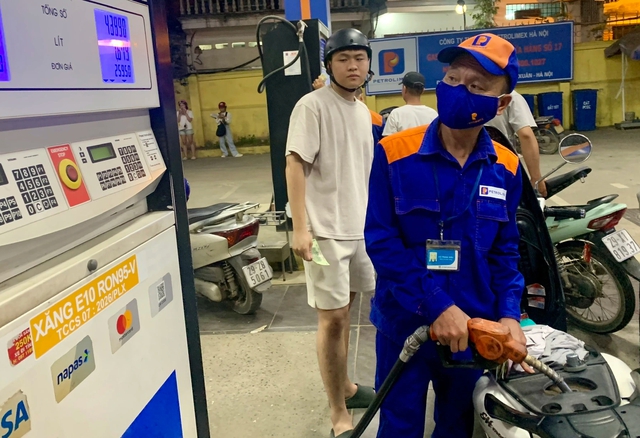
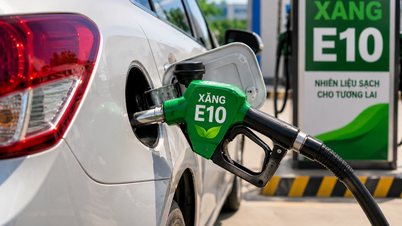
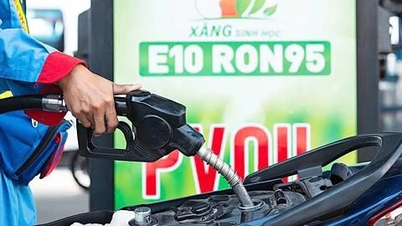
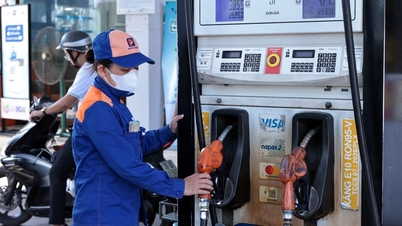
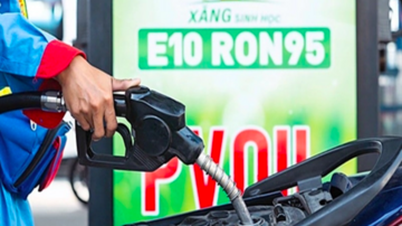
E10 gasoline has been widely available throughout the Petrolimex system since May 20th.
PHOTO: PHAN HAU
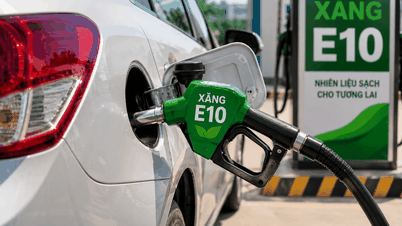
E10 gasoline does not separate into layers.
Mr. Tuan stated that the first misconception is that E10 gasoline, when left in a vehicle's fuel tank while not being used, will absorb moisture from the outside air, causing separation and condensation at the bottom of the tank.
Mr. Tuan asserted that gasoline always tends to evaporate. Therefore, when gasoline is in a sealed container, the pressure inside the container will be higher than the pressure outside. Thus, gasoline in the container will never tend to absorb moisture from the outside; the evaporation will push the gasoline from the inside to the outside.
Therefore, if E10 gasoline is left in the tank for a long time without being used, the higher-pressure evaporation trend from the inside out will not create a reverse airflow from the outside in, and will not cause moisture to be drawn in from the outside, resulting in delamination.
Mr. Tuan believes that, in reality, there is a possibility of water condensation in E10 gasoline during storage at wholesale depots or gas stations. However, this is not a cause for concern, as the Ministry of Industry and Trade and relevant authorities are currently strictly managing the storage, blending, and distribution of petroleum products in general and E10 gasoline in particular. Petroleum companies themselves are also conscious of protecting product quality, so this (the presence of water in the gasoline) is highly unlikely to occur.
The second piece of misinformation is that E10 gasoline can clog fuel lines and injectors.
Mr. Tuan asserted that if such a situation were to occur, it would not be due to E10 gasoline. This is because E10 gasoline is a type of gasoline with solvent properties; when poured into a vehicle that has been unused for a long time and is currently using conventional gasoline, it will accumulate dirt and sediment in the fuel lines and injectors.
When E10 gasoline is introduced, it acts as a solvent for cleaning fuel injectors and fuel lines, causing blockages the first time it's used. If the vehicle experiences these problems, simply cleaning the fuel lines and injectors will resolve them immediately, and the issue will never recur after the second use.
Therefore, E10 gasoline is not the cause of the aforementioned phenomenon, but rather the cause of the vehicle's "problem".
Absolutely do not use additives in E10 gasoline.
The third piece of misinformation concerns the use of additives in E10 gasoline. Mr. Tuan believes that "this is probably advertising from those selling additives." He argues that all motorcycle and car associations, as well as major businesses, advise against adding any kind of additive to gasoline.
The reason is that unregulated additives can cause engine damage, and vehicle owners cannot determine whether the problem is caused by the additive or by the E10 gasoline.
3 unfavorable "rumors" about E10 gasoline - The Chairman of the Biofuel Association clarifies them.
Associate Professor Pham Huu Tuyen, Director of the Center for Research on Power Sources and Autonomous Vehicles at Hanoi University of Science and Technology, who has years of research experience in E10 gasoline, also affirmed that the use of additives or water-absorbing substances to separate ethanol in E10 gasoline has no scientific basis and poses many risks.
Because no one can guarantee that the additives used to separate ethanol in E10 gasoline have any effect on the engine, or whether their quality has been verified, people who arbitrarily use chemicals and additives to separate ethanol and then use this gasoline for their vehicles risk affecting the engine and operational safety.
Mr. Tuyen advised that people should not follow videos instructing how to separate ethanol from E10 gasoline, as this could affect their vehicles and compromise safety during fuel use.
According to the roadmap stipulated in Circular 50 of the Ministry of Industry and Trade, from June 1st, businesses will sell E10 gasoline to replace conventional gasoline. The Ministry affirms that, based on trials and distribution of E10 gasoline from August 2025 in some localities and from mid-May 2026 nationwide, the Ministry of Industry and Trade and businesses have not received any official complaints regarding the quality of E10 gasoline or any negative impacts on engine performance and lifespan from users.
Source: https://thanhnien.vn/chuyen-gia-canh-bao-3-thong-tin-sai-lech-ve-xang-e10-185260528054805186.htm
![[Image] Nearly 125,000 Hanoi students completed the Literature exam for the 10th grade entrance exam.](https://vphoto.vietnam.vn/thumb/1200x675/vietnam/resource/IMAGE/2026/05/30/1780117233041_ndo_br_thiet-ke-chua-co-ten-2-png.webp)



































































































Comment (0)