

Fake news causes public panic.
In the context of the social media boom, online scams are becoming increasingly sophisticated, exploiting crowd psychology and the compassion of the community. Recently, in Hoai Nhon Dong ward, Gia Lai province, a Facebook post caused a public outcry.
An account named "Bao Nguyen" posted an image of a masked man carrying a baby, along with a caption claiming a kidnapping had just occurred in the Lo Dieu residential area. The post used urgent language, calling on the community to share it widely and suggesting financial support for the family to search for the child.
In a short time, this information attracted hundreds of shares and comments. Many people, worried about the safety of young children, hastily spread the information without verification, inadvertently contributing to the spread of fake news.
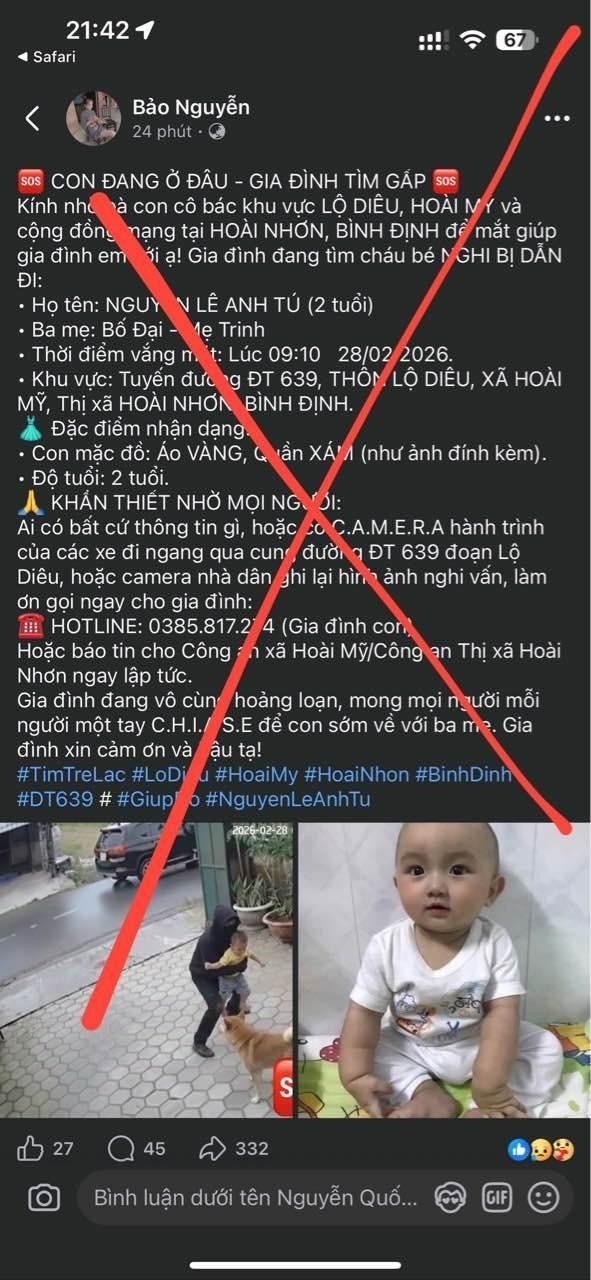
Given the complex situation, the Hoai Nhon Dong Ward Police quickly verified and confirmed that no kidnapping had occurred in the area as rumored. The account "Bao Nguyen" was identified as a "fake account" using manipulated images from the internet to create a fabricated scenario aimed at misleading viewers into donating money.
According to authorities, this is not an isolated case. The perpetrators often choose specific locations with little public knowledge to easily deceive people. The scam typically involves three steps: creating emotionally charged images, generating a sense of urgency, and finally, obtaining personal account information to receive donations.
The consequences of this behavior extend beyond simply misappropriating property. Fake news about child abductions causes panic in the community, affects local security and order, and disrupts official information. More seriously, sharing false information can inadvertently lead social media users to violate the law.
Recommendations from the police and experts.
Given the increasing number of tech scams, the police force advises people to be especially vigilant against "urgent" information calling for donations on social media.
People should verify information by checking official news agencies or government websites. Newly created accounts, those lacking clear personal information, using blurry images, or requesting money transfers to personal accounts are all signs to be wary of.
Authorities also emphasized that when people discover content that they suspect is fake news, they should not share it impulsively but should report it to the social media platform or inform the nearest police station for timely action.
Cybersecurity expert Le Phuoc Hoa, co-founder of the Anti-Fraud Project (chongluadao.vn), advises people to be cautious when receiving information soliciting charity on social media: These scammers often use images and content of real tragic cases to create sympathy and solicit donations, but use their own personal accounts to collect money. Although social media platforms like Facebook have managed and removed some violations, many other fake pages are constantly being created.
Regarding prevention, Mr. Hoa recommends that people be vigilant and not blindly trust information on social media. Instead, they should verify information through official hospital channels, such as contacting the hospital directly or via hotline. He also suggests that relevant authorities, hospitals, and cybersecurity organizations should strengthen cooperation to promptly detect and address these fraudulent activities.
Mr. Hoa also suggested that competent authorities should establish specific principles and regulations for social media platforms in managing and handling fake pages. At the same time, local authorities and organizations should strengthen propaganda and guidance for people on how to identify and respond to various forms of online fraud on social media.

(Photo: Cybersecurity Department)
The situation regarding online fraud and embezzlement is becoming increasingly complex and unpredictable, with many new and highly sophisticated methods. To combat these types of scams, the Cybersecurity Department advises people to carefully research charitable and support activities on social media. This is a reprehensible situation where the kindness of philanthropists is exploited for personal gain, eroding public trust in genuine charitable activities.
"Therefore, to ensure that kindness is given to the right place, those with good intentions should choose charitable funds and programs organized by the State, organizations, social funds, and charitable funds licensed by competent authorities. In case of suspicion of fraudulent activities or misappropriation of assets, it is necessary to report to the nearest police station for timely handling," the Information Security Department advises.
Source: https://khoahocdoisong.vn/chuyen-gia-canh-bao-chieu-lua-dao-tu-mot-bai-viet-tren-mang-post2149091147.html




















![[GALLERY] Amazon shocked by $200 billion AI scam, employees rush to build bots.](https://vphoto.vietnam.vn/thumb/402x226/vietnam/resource/IMAGE/2026/06/01/1780307801611_am-1-png.webp)




![[GALLERY] 5 email habits that boost work efficiency](https://vphoto.vietnam.vn/thumb/402x226/vietnam/resource/IMAGE/2026/06/01/1780291585408_g-1-png.webp)
![[Photo] Reception to welcome General Secretary and President To Lam and his wife on their State visit to the Philippines](https://vphoto.vietnam.vn/thumb/1200x675/vietnam/resource/IMAGE/2026/06/01/1780295488620_vna-potal-chieu-dai-chao-mung-tong-bi-thu-chu-tich-nuoc-to-lam-va-phu-nhan-tham-cap-nha-nuoc-toi-philippines-8798060-7855-jpg.webp)





































































Comment (0)