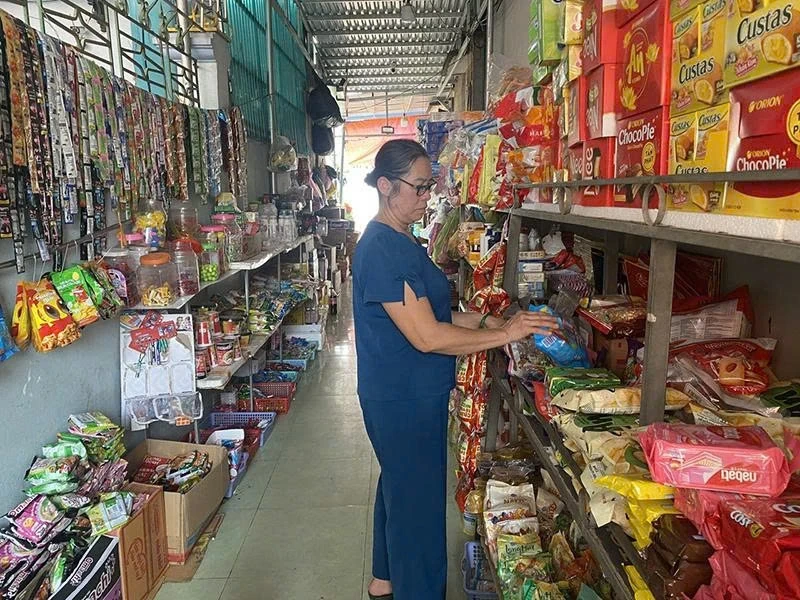
With the encouragement of the commune and the support of her relatives, Ms. Cao Thi Xuyen in Bac Son village, Hoang Thanh commune, has set up a grocery stall right at the entrance to her house.
To help Ms. Cao Thi Xuyen's family in Bac Son village, Hoang Thanh commune, escape poverty, the Hoang Thanh commune authorities appealed to and mobilized relatives to provide support and create a livelihood through a grocery store business. Thanks to this, Ms. Xuyen's family's life has become less difficult, and they have escaped poverty.
Ms. Xuyen said: “Because my husband is frequently ill, besides paying for medicine and treatment, I also have to raise two children and pay for their education, so our family life is very difficult. Almost our entire lives, my husband and I have been living in the church house. Fortunately, the commune and village authorities mobilized relatives and neighbors to support us, helping our family get capital and a location to open a grocery store worth nearly 30 million VND. Nearly three years after opening the grocery store right on the path to our house, neighbors come to buy goods and support us, giving me an income of 3-4 million VND per month, and our family has escaped poverty.”
As an elderly woman who has been caring for her sick husband for many years, Mrs. Nguyen Thi Hoi (75 years old) in Qua Cam village, Thang Loi commune, is classified as a poor household. However, when commune and village officials came to her house to explain and encourage her to leave the poor household list, she happily agreed and requested to be removed from the list by the end of 2025. Mrs. Hoi said: “For nearly 10 years, my husband, Mr. Le Van Ban (86 years old), has been bedridden due to a stroke, and I have to help him with all his personal activities. Because I have to take care of him, I haven't been able to farm for many years, but the social allowances for stroke victims (1.2 million VND/month) and caregivers (500,000 VND/month) have helped me ease the burden of buying medicine for him and covering living expenses for both of us. Therefore, when commune and village officials came to my house to explain and encourage me to leave the poor household list, I agreed and supported it.”
According to Ms. Hoi, whether her family is on the list of poor households or not doesn't affect them much. Because, if they were still classified as poor, preferential policies such as loans and job creation wouldn't be suitable for her family. As for health insurance and medical check-ups, both she and her husband have insurance and are currently receiving medical care under the policy for the elderly. Furthermore, even though they are no longer a poor household, the commune still cares for them during holidays, festivals, and when philanthropists donate gifts. "The only thing is that now that we're no longer a poor household, we won't receive the monthly government subsidy for electricity, but for the common good, a little sacrifice is acceptable," Ms. Hoi said.
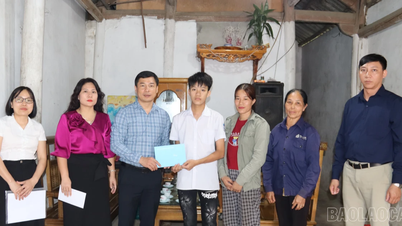
Reportedly, after stabilizing the two-tiered local government structure, Thang Loi commune was assigned to reduce 38 poor households, while Hoang Thanh commune was assigned to reduce 25 households. Mr. Vu Thanh Tung, Head of the Economic Department of the Thang Loi Commune People's Committee, and Ms. Nguyen Thanh Nga, civil servant in charge of poverty reduction at the Economic Department of the Hoang Thanh Commune People's Committee, stated that to reduce poverty, the localities have reviewed and reassessed the poor households, and simultaneously developed specific poverty reduction plans for each household. If poor households (excluding those receiving social assistance) lack capital, they will be provided with capital; if they lack employment, jobs will be created, and production development and restructuring of crops and livestock will be linked to the conditions and capabilities of each household. In addition to actively promoting and encouraging poor and near-poor households to strive for economic development and effectively utilize loan capital, the local authorities also mobilized and called on relatives and the community to join hands... As a result, the number of poor households in Thang Loi commune decreased by 33 out of 68 households and in Hoang Thanh commune by 31 out of 57 households.
It is known that the current number of poor households in Thang Loi and Hoang Thanh communes are all chronically poor households, belonging to the categories of beneficiaries and facing very tragic circumstances. They no longer have the health to do so and therefore do not need capital or livelihood support to escape poverty. For example, the family of Mrs. Tran Thi San (81 years old) in Gia Mai village, Thang Loi commune, is elderly, mentally unstable, and currently lives alone, relying on relatives for care. Or, in the case of those who are still healthy, like the family of Mrs. Truong Thi Vien (born in 1954) in Bac Son village, Hoang Thanh commune, she has to spend time simultaneously caring for three mentally ill family members: her husband, Mr. Nguyen Van Sinh (born in 1951), and two sons, Nguyen Van Truong (born in 1979) and Nguyen Van Ngu (born in 1986), but only Mr. Sinh and his youngest son receive social welfare benefits...
The difficulty in achieving poverty reduction targets for those eligible for social welfare is not only a problem in Thang Loi or Hoang Thanh communes, but also a reality in other communes where the number of poor households has already been reduced to the maximum limit. Therefore, when assigning poverty reduction targets, it is necessary to base them on reality, considering the specific circumstances of each locality to set appropriate targets and ensure their achievement.
Text and photos: Minh Ly
Source: https://baothanhhoa.vn/chuyen-giam-ngheo-286764.htm




![[Photo] National Assembly Chairman Tran Thanh Man working with the Standing Committee of the Law and Justice Committee](https://vphoto.vietnam.vn/thumb/1200x675/vietnam/resource/IMAGE/2026/05/21/1779378929214_ndo_br_1-4610-jpg.webp)


![[Photo] General Secretary and President To Lam presides over a working session with the Central Policy and Strategy Committee on the development of the materials industry.](https://vphoto.vietnam.vn/thumb/1200x675/vietnam/resource/IMAGE/2026/05/21/1779359935432_a3-bnd-3129-1412-jpg.webp)

















































































Comment (0)