

"Longing across vast distances, love across the universe."
The poet Anh Thơ (real name Vương Kiều Ân) hailed from Phủ Lạng Thương, Bắc Giang province. Educated in a strict, feudal family, she was nevertheless a keen reader, eager to learn, and passionate about poetry from a young age. When she encountered the New Poetry movement, her young soul was deeply moved.
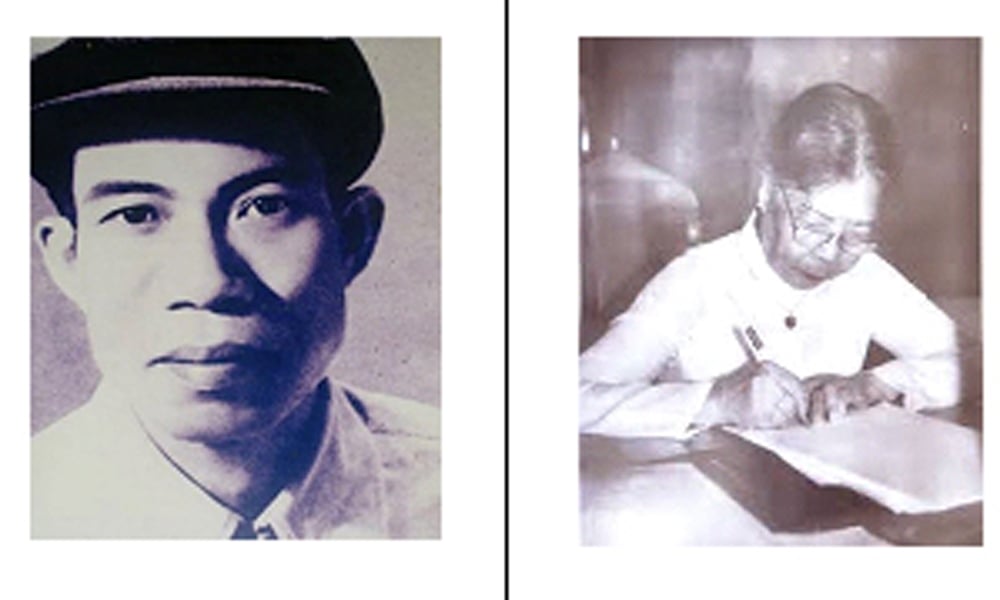 |
Poet Nguyen Binh (1918-1966) and female writer Anh Tho (1918-2005). |
In 1939, when her first poetry collection, "Rural Landscape," won the Encouragement Prize of the Self-Reliance Literary Group, her name became widely known. Nguyen Binh, already a famous poet known for his poems imbued with the essence of rural life, had won the Encouragement Prize for poetry from the Self-Reliance Literary Group a year before Anh Tho. Originally a wandering poet, he had experienced many failed relationships. Seeing a muse who had just appeared on the literary scene and was already famous for her poems describing rural landscapes, Nguyen Binh was deeply admired. He published the poem "Wandering" in the Saturday Newspaper as a special gift to "the muse in the white dress of the Thuong River." He also sent many letters to Anh Tho, calling her "the princess of his heart" and expressing his desire to marry her. Needless to say, the poet Anh Tho was overjoyed. Longing for love and a life partner who was also a poet, she was deeply moved by the declaration of love from a famous poet. She yearned day and night to meet her soulmate.
Unfortunately, when Nguyen Binh went to Phu Lang Thuong to "meet" Anh Tho, seeing her short stature, rough manner of speaking, and somewhat casual demeanor, the poetess Anh Tho was disillusioned and severed all ties. After that meeting, Nguyen Binh visited Bac Giang many times, sending letters and poems to her, but he could not change the situation. In his poetic legacy, readers still find the poem "Seven Words"—written in Bac Giang in 1940, dedicated to Anh Tho: "I quickly scribbled a few strokes on the sky…/ This afternoon she caught the blue sky/ After reading the seven words, she felt so much love/ 'Ten thousand miles of longing, a cosmic love'."
Sharing the same path of resistance
Although their romantic paths diverged, the poet Anh Thơ and the poet Nguyễn Bính walked together on the path of resistance. In early 1945, Anh Thơ joined the revolution. From a sheltered young woman, she became a strong and determined women's affairs cadre. She served as the Secretary of the Women's Association in the districts of Việt Yên, Lục Ngạn, Hữu Lũng (Bắc Giang) and Bắc Sơn ( Lạng Sơn ). Her romantic poetry, though still imbued with the firm and poignant realities of the resistance, remained warm with the love of her homeland and the compassionate heart of a woman. Notable examples include "Telling the Story of Vũ Lăng" (1948) and "The Sound of the Cuckoo" (1954). In his memoirs, journalist Vu Manh, former Editor-in-Chief of Ha Bac Newspaper and a fellow resistance fighter of poet Anh Tho, recounted: In mid-August 1945, before leaving Yen Dung (Bac Giang) to take on a new assignment, poet Anh Tho bid farewell and presented her fellow resistance fighters in Yen Dung with a poem. It included lines such as: “One goes with the mountains and rivers / One goes as a soldier, the love for home is light / Stopping here, with a single heart / Stopping here, alone with the mountains and rivers, filled with sorrow / Remembering so many comrades / Soon, amidst bullets and fire, life will be a struggle…”
In 1945, poet Nguyen Binh went to the South and joined the revolution. In 1947, he joined the National Guard. He was present on battlefields throughout Southern Vietnam. Like two pages in a book of life, Nguyen Binh, who followed the resistance in Southern Vietnam, was a poet with a vigorous and spirited voice praising the victories of the National Guard, quite different from the melancholic, rustic poet Nguyen Binh of the North in the past. In 1950, his poem "Cuu Long Giang" was set to music by composer Nguyen Huu Tri as the song "Battalion 307," which thrilled the soldiers and people of Southern Vietnam and remains relevant to this day: "The Battalion's departure that year / The whole Battalion swore under the golden star / The soldier did not regret shedding blood…". In 1954, he relocated to the North, working at the editorial office of the Literature and Arts Newspaper, becoming the editor-in-chief of the "Hundred Flowers" Newspaper, before transferring to the Department of Culture in Nam Ha. His poetic spirit remained strong, passionately writing to serve the resistance against the American invasion.
Let's all be captivated by spring.
Despite their differing personalities, life circumstances, and poetic styles, both Nguyen Binh and Anh Tho dedicated most of their poems to spring, or composed them around the time of Tet (Vietnamese New Year) and the arrival of spring. Readers today remember most fondly the poems of these two authors about spring. Nguyen Binh's spring poems include: "Spring Poem," "Spring Girl," "Spring Rain," "Spring Arrives," "Green Spring," etc. Whether in six-eight or seven-syllable verse, spring in his poems is always vibrant, colorful, and in its youthful prime, symbolizing youth, freshness, and hope. Within that spring color, there is always a longing, a deep love for his homeland. Like "The spring girl dreams of getting married" in "Spring Girl" or the disappointment of the girl at the village festival: "Waiting for him to come, but he doesn't come" in "Spring Rain."
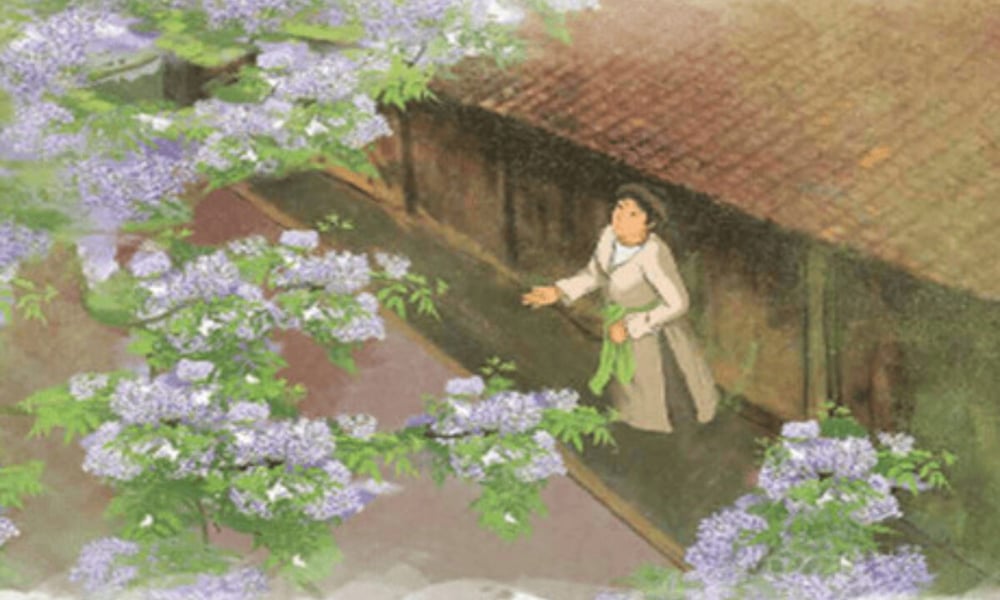 |
Illustration. |
Not boisterous, not colorful, not stirring up the "springtime" like Nguyen Binh's poetry - the spring in Anh Tho's "Rural Landscape" is subtly and gently depicted: "The rain falls softly on the deserted dock / The lazy ferry lies still, letting the river flow / The thatched hut stands silently in the stillness / Beside the cluster of apricot blossoms, purple flowers fall profusely" (Spring Afternoon). Or, even when writing about "spring girls" with a longing for love, the poetess touches upon it with very discreet poetic strokes: "On the flowing red silks / The girls casually wear their straw hats" (Spring Market)...
With their unique writing style, deeply imbued with the spirit of the countryside, both poets have depicted a very personal spring in their poems, leaving a legacy for posterity. Both were posthumously awarded the Ho Chi Minh Prize by the State for their literary and artistic works. Today, reading the spring poems of these two talented poets born in the Year of the Horse, our hearts are filled with a sense of longing: "A thousand miles of yearning, a cosmic love."
Source: https://baobacninhtv.vn/bg2/dulichbg/chuyen-ve-hai-nha-tho-tuoi-ngo-postid439353.bbg
![[Photo] The courage of new recruits of Brigade 144 on the training ground.](https://vphoto.vietnam.vn/thumb/1200x675/vietnam/resource/IMAGE/2026/05/27/1779881651341_anh-man-hinh-2026-05-27-luc-18-32-52.png)
![[Photo] The heat at the fireworks display site on the opening night of the Da Nang International Fireworks Festival 2026](https://vphoto.vietnam.vn/thumb/1200x675/vietnam/resource/IMAGE/2026/05/27/1779889741485_ndo_br_z7872039145157-fecaba5112f39e8352544099d7ef4738-5140-jpg.webp)
















































![[Photo] The courage of new recruits of Brigade 144 on the training ground.](https://vphoto.vietnam.vn/thumb/402x226/vietnam/resource/IMAGE/2026/05/27/1779881651341_anh-man-hinh-2026-05-27-luc-18-32-52.png)






















Comment (0)