

 |
| Comrade Nguyen Manh Tuan, Member of the Standing Committee of the Provincial Party Committee and Permanent Vice Chairman of the Provincial People's Committee, inspected the work of forest management and protection in Trung Son commune. |
Savings potential
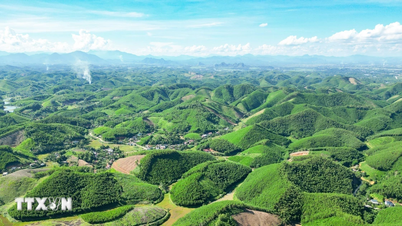
Tuyen Quang is not only the largest paper pulp raw material forest capital in the country, but also a locality with a very high carbon sequestration and absorption capacity. According to estimates from the forestry sector, on average, each hectare of natural forest can absorb 100-250 tons of CO2, while planted acacia and pine forests can absorb about 50-100 tons of CO2 in one cycle. With the total forest area currently available, Tuyen Quang could store tens of millions of tons of CO2, equivalent to hundreds of billions of VND worth of forest carbon credits if exploited and traded on domestic and international markets.
Besides its forest advantages, in recent years, the province has focused on expanding the area of organic and circular agriculture . By 2025, the entire province will have over 30,000 hectares of oranges and tea grown organically or with VietGAP and GlobalGAP certification, concentrated in areas such as Bac Quang, Hung An, Khuon Lung, Ham Yen, Na Hang, Quang Binh, Chiem Hoa, and Yen Son. Organic agricultural models do not use chemical fertilizers and synthetic pesticides, thereby significantly reducing emissions (N2O) and contributing to the potential for carbon credits in the future.
In particular, several cooperatives and large farms have adopted circular agriculture models, utilizing agricultural by-products to produce organic fertilizer, reducing the use of inorganic fertilizers, limiting emissions, and improving soil. Notably, the province is collaborating with several businesses to research models for collecting and converting methane from large-scale livestock farms to be used in calculating emission reduction credits. When the domestic carbon market mechanism is fully operational, farms applying emission reduction processes according to standards can generate credits to sell to high-emission businesses.
At the household level, the agricultural sector encourages biological livestock farming solutions, such as silage, and biological bedding, to reduce direct emissions, minimize pollution, and ensure disease safety. These solutions, though small, when applied comprehensively on a large scale, will contribute significantly to the overall reduction of emissions across the entire sector.
Opportunities from selling carbon credits
The opportunities presented by carbon credits are creating a strong demand for innovation in the management, planning, and production organization of Tuyen Quang's agricultural sector. First and foremost is the completion of carbon databases for each sector: forestry, crop cultivation, and livestock farming; and the development of sets of indicators for measurement, reporting, and verification according to international standards. This will serve as a foundation for the province to access the voluntary carbon credit market, and subsequently the mandatory market when the Government implements the exchange, expected in the 2028-2030 period.
Simultaneously, the province needs to strengthen communication efforts to help people and businesses understand the benefits of carbon credits, especially in the forestry and livestock sectors. With changing perceptions, people will be more proactive in maintaining sustainable production processes. Having businesses lead the way will help form raw material areas for crops that meet carbon standards, creating a closed value chain from input - production - processing - consumption. This group also has the financial resources to invest in a systematic measurement and registration system for carbon credits, thereby enabling households to collaborate and share the benefits.
Mr. Nguyen Van Hieu, Director of Tuyen Quang Forestry Company, shared: "Currently, the company manages over 4,500 hectares of acacia, pine, and bodhi trees; on average, we plant about 450-600 hectares of new production forest each year. The company is researching and coordinating with a consulting unit to measure and determine the carbon reserves in the company's acacia plantations. If we can participate in the carbon credit market, the profits of forest planters will increase by at least 10-15% without needing to expand the planted forest area."
Authorities also need to promptly issue guidelines on carbon standards, criteria, and measurement methods to screen models that have the potential to generate credits. Programs such as OCOP, new rural development, and support for planting large timber forests need to integrate emission reduction content, creating conditions for green agricultural products to become a competitive advantage.
With its vast forest potential, organic farming foundation, and efforts to reduce emissions in livestock farming, Tuyen Quang has many opportunities to become a leading province in the green transformation of the northern mountainous region. When exploited correctly, carbon credits will not only bring new revenue but also help enhance the value of agriculture, opening up a future of sustainable development that harmonizes the economy, the environment, and people's livelihoods.
Topaz
Source: https://baotuyenquang.com.vn/kinh-te/nong-lam-nghiep/202602/co-hoi-lon-tu-tin-chi-cac-bon-a4f4728/



















































































Comment (0)