


There are many effective ways to walk - Photo: TA
In fact, there are many effective walking styles, suitable for different people. And if categorized by speed, there are two well-known walking styles.
These are alternating walking (fast-slow walking) and power walking (fast, controlled walking). While both are far superior to regular leisurely walking, each method is suitable for different groups of people and goals.
Here is the scientific analysis:
Alternating fast and slow walking
This method is based on the well-known "HIIT" (High-Intensity Interval Training) training principle.
When applied to walking, exercisers alternate between walking fast (near maximum exertion) and walking slowly for recovery. For example, walk fast for 1 minute, then slow for 2 minutes, repeating the cycle for 20-30 minutes.
According to research from Tsukuba University (Japan), people over 60 who practiced interval walking for 5 months (4 sessions/week, 30-40 minutes each session) showed significant improvements in oxygen absorption, cardiovascular endurance, and blood pressure control. They even achieved results comparable to those who did light jogging.
Furthermore, research from the American Academy of Sports Medicine (ACSM) also indicates that interval training exercises like interval walking burn 20-30% more calories than steady walking, thanks to the body maintaining a high metabolic rate after the workout (the afterburn effect).
Who should choose this style?
- People who want to lose fat effectively but can't run.
- People with limited time who want "high-quality" exercises.
- Young or middle-aged individuals with good cardiovascular health or who are already accustomed to physical activity.
However, due to variations in intensity, individuals with cardiovascular disease, high blood pressure, or older age should consult a doctor before starting.
Controlled brisk walking (power walking)
Power walking is a form of high-speed walking (6-7 km/h), characterized by long strides, strong arm swings, a straight back, and tightened abdominal muscles. Although it lacks the distinct slow-down and rest phases of interval walking, power walking requires practitioners to maintain speed and technique throughout the entire workout.
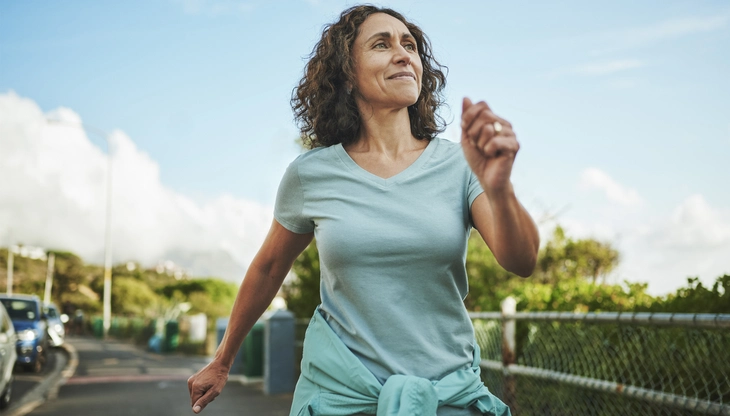
The power walking method is suitable for older adults - Photo: HINGE
According to a study by Harvard University (USA), power walking can burn 240-300 calories every 30 minutes (depending on body weight and speed).
Additionally, it helps improve cardiovascular health, reduce the risk of diabetes, increase bone density, and reduce stress. This exercise is also gentle on the joints, making it suitable for people who cannot run.
Dr. Edward Laskowski (USA) stated: "Walking briskly with the right technique is an ideal full-body workout – it increases heart rate and activates major muscle groups without the intense shock of running."
Who should choose this style?
- For those who want to exercise regularly, safely, and sustainably.
- Older adults, those new to exercise, or those recovering from physical activity.
- People who prioritize stability and dislike changes in intensity.
Source: https://tuoitre.vn/co-nen-di-bo-that-nhanh-20250619195003107.htm
![[Photo] Prime Minister Pham Minh Chinh presides over meetings of the Government Standing Committee to discuss several important issues.](https://vphoto.vietnam.vn/thumb/1200x675/vietnam/resource/IMAGE/2026/03/16/1773674631996_ndo_br_img-5789-jpg.webp)

![[Photo] Secretary of the National Assembly Party Committee, Chairman of the National Assembly presides over the fourth meeting of the National Assembly Party Committee Executive Board.](https://vphoto.vietnam.vn/thumb/1200x675/vietnam/resource/IMAGE/2026/03/16/1773656046264_ndo_br_bnd-0533-jpg.webp)
![[Photo] General Secretary To Lam receives the Chinese Ministers of Foreign Affairs, National Defense, and Public Security attending the Conference on the “3+3” Strategic Dialogue Mechanism](https://vphoto.vietnam.vn/thumb/1200x675/vietnam/resource/IMAGE/2026/03/16/1773659640884_a1-bnd-0963-2144-jpg.webp)
![[Photo] Prime Minister Pham Minh Chinh receives the Ministers of Foreign Affairs, Defense, and Public Security of China.](https://vphoto.vietnam.vn/thumb/1200x675/vietnam/resource/IMAGE/2026/03/16/1773659638054_ndo_br_dsc-4386-6157-jpg.webp)
![[Photo] Prime Minister Pham Minh Chinh holds a phone call with Angolan President João Manuel Gonçalves Lourenço](https://vphoto.vietnam.vn/thumb/1200x675/vietnam/resource/IMAGE/2026/03/16/1773674632171_ndo_br_dsc-4772-jpg.webp)





























































Comment (0)