

Granary
Associate Professor Vo Cong Thanh, who once lived in Japan, brought 5kg of Koshihikari rice from Japan to Can Tho just so his colleagues could hear about this exquisite rice from the Land of the Rising Sun and try it. The Japanese have many stories to tell about the miraculous nature of this rice; even when cooked cold, it becomes a fine powder in the crevices – which is used to make delicious Koshi cakes with bean or sweet potato fillings.
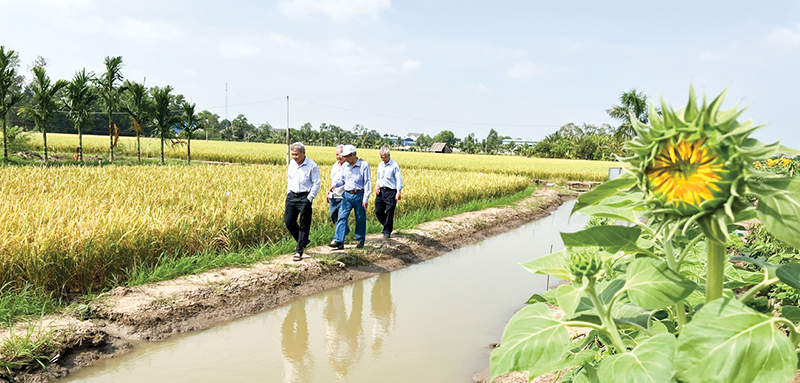
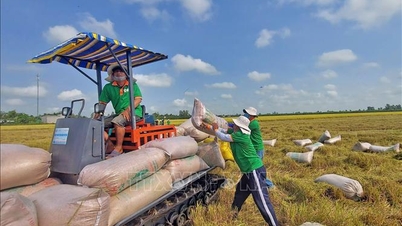
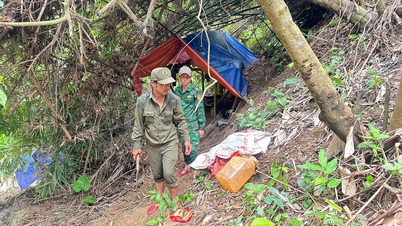
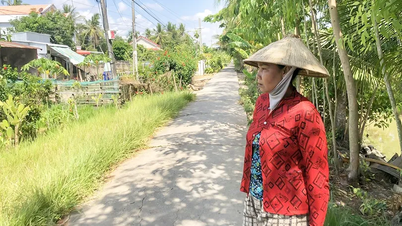
The ST rice model field of Labor Hero Ho Quang Cua.
Japan's rice-growing area has decreased from 1.458 million hectares to 1.454 million hectares, and production has fallen from 7.294 million tons to 7.280 million tons over the past two years. In the first seven months of this year, 21 million tourists visited Japan, and news reports indicate a dramatic increase in total food and beverage consumption. Experts predict that Japan's rice demand will increase by at least 100,000 tons annually.
To be fair, the increase in rice prices in Japan is due to several factors: Following months of crop failures due to climate change, the stockpiling mentality of the population after warnings of a potential 2024 Nankai super-earthquake, and the surge in foreign tourists (who are rice-eaters). Meanwhile, since June 2024, private sector rice stocks in Japan have fallen to their lowest level since 1999. The price of a 5kg bag of rice has reached 3,000 yen (US$21), a 60% increase compared to the same period last year. Increased stockpiling by buyers is driving prices up.
According to information from Japan, Associate Professor Vo Cong Thanh learned that if he were to conduct in-depth research on salt-tolerant, drought-tolerant, and flood-tolerant rice varieties, he would find that the cultivation of heat-tolerant rice is becoming increasingly common in Japan. Japan is a "superpower" in exporting high-quality rice, so when the first 500-ton shipment of reduced-emission rice from Trung An High-Tech Agriculture Joint Stock Company (Trung An Company) was exported to Japan at a price of 850 USD/ton (FOB) or over 1,000 USD/ton (CIF), it was a miracle. Businessman Pham Thai Binh once exported ST 24 rice at a price of 1,000 USD/ton. Mr. Pham Thai Binh, Chairman of the Board of Directors of Trung An Company, said: "The first 'green' low-emission Vietnamese rice to be exported to Japan was organized by the Vietnam Rice Industry Association (VIETRISA) in Can Tho City on the afternoon of June 5, 2025. The company is cooperating with Murase Group (Japan), with the rice grown in Kien Giang province, under the project 'Sustainable Development of 1 Million Hectares of High-Quality, Low-Emission Rice'. Japan has criteria for controlling over 600 active ingredients to ensure food safety and pesticide residue levels. To export rice to the Japanese market, rice from Vietnam must meet many strict standards; reducing emissions is just one of Japan's criteria."
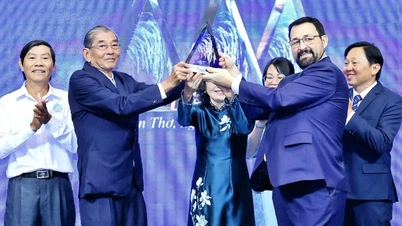
Following Trung An Company, companies that participated in the Rice Value Chain Transformation Project to Respond to Climate Change and Sustainable Development in the Mekong Delta (TRVC) received a total prize money of AUD 200,000 (equivalent to over VND 3.1 billion) and were granted certificates of right to use the "Green Vietnamese Rice with Low Emissions" trademark for a total of 19,200 tons of rice – certainly, export traders will create a surprise. Among them, Chon Chinh Import-Export Co., Ltd. received AUD 73,285 (equivalent to VND 1.67 billion), Vietnam Rice Co., Ltd. received AUD 28,633 (equivalent to VND 456 million), and Xuan Phuong Kien Giang Co., Ltd. received AUD 22,075 (equivalent to VND 351.7 million)…
Reduce your carbon footprint.
The results of the 2024 summer-autumn crop showed that the average profit of farming households reached over 59%, while the TRVC Project set a target of a minimum profit of 30% for small-scale farming households. One company won an award of over 1 billion VND for cultivating over 1,500 hectares of rice, achieving an average greenhouse gas emission reduction of 6.57 tons of CO2 e/ha, with the average profit of farming households exceeding 68%.
According to the World Bank (WB), rice cultivation accounts for 48% of total greenhouse gas emissions and over 75% of methane (CH₄) emissions from the agricultural sector. Developing sustainable, low-emission rice farming is becoming an urgent requirement for Vietnam to fulfill its international commitments on climate change. The project will be implemented from 2023-2027 in An Giang, Dong Thap, and Kien Giang provinces. In the first season, businesses have partnered with 12 cooperatives and 27 cooperative groups, involving a total of over 1,700 farming households and an area of over 6,100 hectares, to implement sustainable rice production processes.
Trung An Company received a reward of over 370 million VND, participating in an area of over 679 hectares, achieving a reduction in greenhouse gas emissions of over 3,100 tons of CO2 , and a profit increase for farmers of over 43%. ThaiBinh Seed Group Joint Stock Company participated with an area of over 660 hectares, involving 165 households in An Giang, Kien Giang, and Dong Thap provinces. The reward received for emission reduction was over 318 million VND, achieving a reduction in greenhouse gas emissions of over 2,700 tons of CO2 , and a profit increase for farmers of over 53%.
Eight businesses participated in this project, covering a total area of 6,100 hectares and involving 1,719 farming households, equivalent to over 4,000 farmers. The businesses implemented numerous technical support activities and established close links with farmers. Participating farming households achieved an average profit margin of 59%, specifically 64% in Dong Thap, 56% in An Giang, and 54% in Kien Giang, exceeding the project's target, according to Ms. Tran Thu Ha, Project Director.
"Vietnamese green rice with low emissions" is not just a trademark, but also a commitment to environmental and social responsibility," affirmed Dr. Bui Ba Bong, Chairman of the Vietnam Rice Industry Association (VIETRISA).
Smart farming model
Managing rice straw in the fields, and what else to do with this resource and its by-products, is attracting the participation of businesses. According to Mr. Pham Minh Thien, CEO of Thanh Binh Company, Dong Thap province is experimenting with a circular model, utilizing straw for mushroom cultivation and cattle feed. Rice husks are used for pelleting for export; yellow bran is pressed to extract oil and the residue is used as animal feed. Rice by-products (broken rice, broken rice) are used to make flour. Mr. Thien once invested millions of USD in researching the post-harvest rice product chain. Unfortunately, this model is outside the scope of the TRVC project and the 1 million hectare high-quality, low-emission rice project.
Similarly, farmers participating in the ST rice production network, guided by Engineer Ho Quang Cua on how to use Trichoderma fungi to promote the conversion of rice straw into organic fertilizer, utilize nitrogen-fixing bacteria, phosphorus-dissolving fungi, etc., to reduce production costs and restore the microbial community in the soil, seem to be still a long way from larger projects. Engineer Ho Quang Cua, the initiator and visionary of the fragrant rice - clean shrimp model, patiently uses microorganisms and fungi to increase soil fertility, and employs white fungi, green fungi, and biological preparations to protect crops according to a systematic approach to soil management.
Last year, statistics on the area of rice-shrimp farming in the Ca Mau peninsula showed that Kien Giang had the largest area, over 100,000 hectares, followed by Bac Lieu with approximately 46,000 hectares, and Ca Mau with about 38,000 hectares... The rice-shrimp farming areas, guided by Engineer Cua, have linked up with farmers to jointly control water sources, natural predators, and implement measures using biological products. However, the area remains modest.
Mr. Pham Thai Binh proposed selecting ST25 rice as the representative variety to be the national rice brand. However, the ST rice brand is being manipulated and counterfeited to the point that the police have to intervene. Engineer Ho Quang Cua, who has spent 25 years researching the ST rice variety, suggested connecting everything to operate in a chain before discussing this matter. Experts believe that the shrimp-rice model deserves to be recognized as a smart agricultural model, adapting to the trend of sustainable development, and requires complete investment in digitizing this smart agricultural model and positioning each growing area in a chain, connecting it to the project of 1 million hectares of high-quality, low-emission rice.
With the evidence from the past decades, people might overlook the role of those who led this pioneering model, and that's fine. But if we had a different perspective on pioneering models, connecting resources, the amount of rice exported to demanding markets like Japan would certainly have skyrocketed.
And, this will also facilitate the digitalization process – increasing transparency in farming systems, smart growing areas, and enhancing the effectiveness of trade defense against counterfeit goods; the fight against counterfeit ST rice will also be more successful.
Text and photos: CHAU LAN
Source: https://baocantho.com.vn/com-gaothat-lai-nhung-moi-day-a187752.html

![[Photo] General Secretary and President To Lam presides over a working session with the Central Policy and Strategy Committee on the development of the materials industry.](https://vphoto.vietnam.vn/thumb/1200x675/vietnam/resource/IMAGE/2026/05/21/1779359935432_a3-bnd-3129-1412-jpg.webp)















































Comment (0)