In 1948, shortly after Myanmar gained independence from Britain, conflicts erupted, beginning in April 1948 between the Myanmar government and small armed rebel groups, and communist forces resisting the government in Karen Province, located in eastern Myanmar, demanding autonomy. The situation worsened when Buddhism was adopted as the official religion, impacting the Rohingya , Karen , Chin , and Kachin peoples. With the government fragmented, the People's Freedom Party Against Fascism was brought in as the interim government from 1958 to 1960.

General Min Aung Hlaing (right) meets with Brunei's Second Foreign Minister Erywan Yusof in Myanmar's capital Naypyidaw on June 4 - Photo: AFP
Today, it is primarily Karen and Shan organizations in eastern Myanmar that continue to fight against the government. In addition, smaller conflicts persist in other regions, such as Mujahideen fighters in the west using Bangladeshi refugee camps as bases. The fighting has forced over 160,000 Myanmar refugees to flee to Thailand and other countries. Since 1962, conflict has been constant in Myanmar. Minority groups argue that the Panglong Agreement and proposals for autonomy have not been respected. Numerous peace talks have been arranged, but they have been unsuccessful or very short-lived.
By 2011, then-President Thein Sein of Myanmar had negotiated with armed ethnic groups for lasting peace. As a result, in 2013, 16 armed groups agreed to join a nationwide ceasefire coordination group, paving the way for a nationwide ceasefire proposed by the government. In October 2015, eight armed groups, along with the federal army and the government, signed a nationwide ceasefire agreement. This year, the 2nd Panglong Conference is taking place with the expectation that a long-term nationwide ceasefire will be signed, involving all armed ethnic groups and the government.
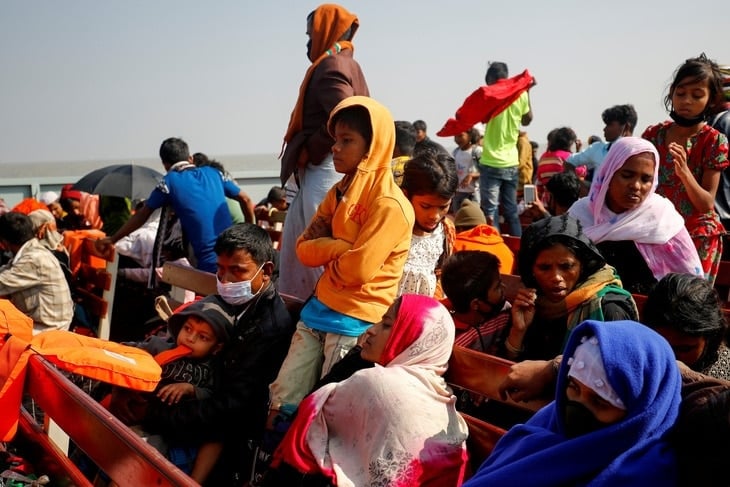
Rohingya refugees in Bangladesh in December 2020 - Photo: REUTERS
On August 31, the Myanmar government and the armed forces of ethnic minorities were scheduled to participate in a national peace conference dubbed the "21st Century Panglong Conference." This conference was hoped to end decades of conflict in Myanmar and pave the way for new development. However, the conference's prospects have been overshadowed by recent outbreaks of conflict in Kachin and Shan states, considered strongholds of major ethnic groups.
The peace process aimed at ending the conflict in Myanmar has been a key objective for Aung San Suu Kyi since her National League for Democracy party came to power last November. Ethnic conflicts in Myanmar have killed more than 130,000 people since the country gained independence from Britain in 1948. The Brotherhood, comprising the Ta'ang National Liberation Army (TNLA), the Myanmar National Democratic Alliance Army (MNDAA), and the Arakan Army (AA), launched Operation 1027 on October 27, attacking a series of Myanmar military bases in Shan State and Kachin State. On November 2, the Myanmar military acknowledged losing control of the strategic town of Chinshwehaw, bordering China's Yunnan province. The coordinated anti-government offensive launched in Shan State in northeastern Myanmar targeted several towns and more than 100 military outposts near the border with China.
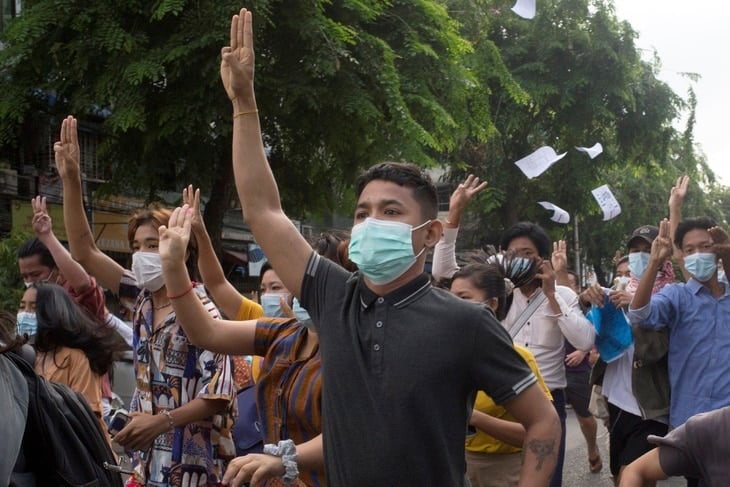
Myanmar protesters take to the streets in Yangon - Photo: REUTERS
On November 4, the Brotherhood announced they had seized dozens of outposts, four towns, and blockaded key trade routes to China. The Myanmar military has not commented on the Brotherhood's November 4 announcement, but previously stated that the armed group's claims of "capturing several towns" were merely "propaganda."
On November 12th, in villages in northern Rakhine, approximately 60 armed militants attacked government soldiers. The army returned fire but at times had to request helicopter support due to being outnumbered. The bodies of six attackers were found after the fighting, while 36 people believed to be involved in the violence were arrested. According to AFP, at least 28 people were killed in clashes between the Myanmar army and Rohingya Muslim rebels. Satellite images from November 13th showed hundreds of homes in Rohingya villages burned. Ethnic minority rebel groups attacked security checkpoints in Myanmar on Monday (November 13th), as fighting erupted on two new fronts and thousands of people fled to neighboring India. “UN Secretary-General Antonio Guterres condemned all forms of violence and reiterated the need for civilian protection. He called for restraint, de-escalation of tensions, and access to humanitarian aid for the people,” spokesman Dujarric added. The UN said key roads were blocked by checkpoints set up by both sides, and telephone and internet services were disrupted. The main airport in Lashio, the largest town in Shan State, has been closed since the fighting escalated.
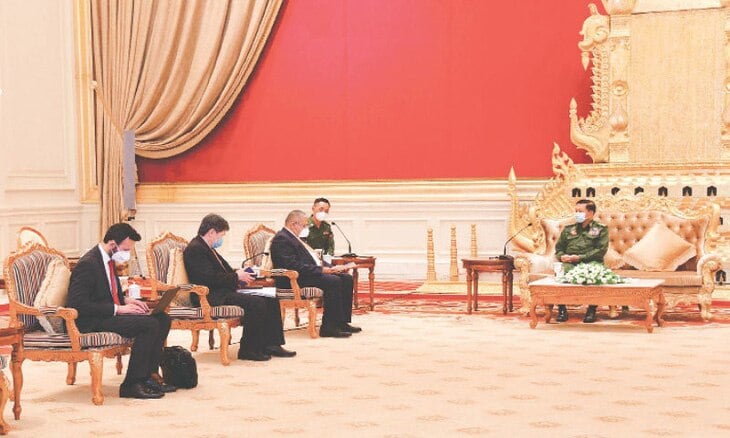
Myanmar's General Min Aung Hlaing (right) holds talks with ASEAN leaders in Myanmar on June 4-6 - Photo: AFP
Across Myanmar, two million people are displaced, many of them having left their homes multiple times. Amidst the complex fighting across Myanmar, many countries in the region have voiced their concerns and begun repatriating their citizens. On November 19th, the Thai Ministry of Foreign Affairs announced that over 260 Thai citizens in northern Myanmar would be evacuated via China to return home, following escalating fighting between the military government and armed ethnic minority groups, according to the Bangkok Post . The Thai Ministry also stated that Filipino and Singaporean citizens stranded due to the fighting in Myanmar would be evacuated along with the Thai group. Previously, Thailand indicated that some of those stranded due to the fighting in Myanmar were victims of human traffickers, and some may be linked to telecommunications fraud gangs.
Regarding Vietnam, in late October 2023, the Ministry of Foreign Affairs instructed the Vietnamese Embassy in Myanmar to work with local authorities and request that Myanmar ensure the safety and basic living conditions for Vietnamese citizens. In addition, they also needed to facilitate the movement of Vietnamese citizens out of the conflict zone. On the afternoon of November 23rd, at the Ministry of Foreign Affairs' regular press conference, spokesperson Pham Thu Hang provided information on the protection of 700 Vietnamese citizens in Myanmar, stating, "Our working groups are working 24/7 on this issue." In the coming period, the Ministry of Foreign Affairs will continue to closely monitor the situation, maintain contact with Vietnamese citizens in the refuge areas, and prepare to deploy consular protection efforts.
The spokesperson also stated that the security situation in several northern states of Myanmar continues to be complex. To date, approximately 700 Vietnamese citizens are temporarily safe, and many others are awaiting verification. The Ministry of Foreign Affairs and Vietnamese representative offices in Myanmar and China are coordinating and sharing information with foreign representative offices whose citizens are in the region, working with Chinese authorities to request assistance in protecting Vietnamese citizens. Against the backdrop of years of conflict in Myanmar between the military government and armed ethnic minority groups, which is escalating, many commentators and analysts believe that the path to peace in Myanmar may be long and not end anytime soon, and will involve many sacrifices and challenges.
Bui Tue (compiled, analyzed, and commented)




![[Image] Hanoi's urban life under the challenge of a "scorching hot" environment](https://vphoto.vietnam.vn/thumb/1200x675/vietnam/resource/IMAGE/2026/05/25/1779706979265_nang-nong-t5-2026-minh-duy-7-4636-jpg.webp)
![[Image] Close-up view of the interchange connecting the two expressways and Long Thanh Airport.](https://vphoto.vietnam.vn/thumb/1200x675/vietnam/resource/IMAGE/2026/05/25/1779703378210_ndo_br_z7863716673926-224453a31600126cce10622af6290afd-4549-jpg.webp)














































































Comment (0)