

SGGP
On June 22, Reuters reported that at the White House, US President Joe Biden and his wife received Indian Prime Minister Narendra Modi during his state visit to the United States.
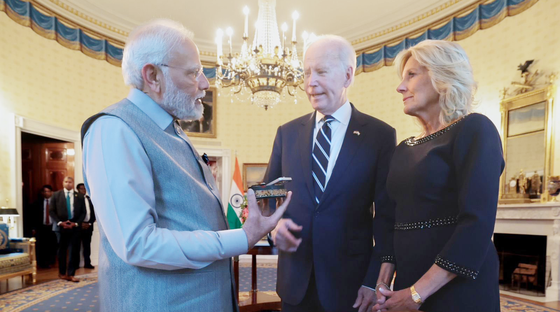 |
| US President Joe Biden and his wife (right) receive Indian Prime Minister Narendra Modi at the White House. |
Strengthening cooperation
This marks the first visit by the Indian Prime Minister to the United States since taking office in 2014. Therefore, Modi's visit is considered particularly important by both sides. According to US press sources, at a reception at the White House in the evening, the two leaders will discuss strengthening defense and technology cooperation, as well as expanding collaboration on global issues, including climate change.
According to observers, besides defense, cooperation on critical technologies is considered a leading driver of India-US cooperation, which has tightened in recent years. In May 2022, President Biden and Prime Minister Modi announced the India-US Initiative on Critical and Emerging Technologies (iCET), a framework linking technology cooperation to guide and promote collaboration between the two countries – primarily in advanced technology fields such as artificial intelligence (AI), semiconductor chips, and quantum computing. Over the past year, iCET has allowed for deeper and broader cooperation negotiations between US and Indian officials. Accordingly, the two sides have discussed strategic relationships and common challenges at a level that was “impossible” just a few years ago.
The U.S. National Security Council (NSC) and the Indian National Security Council Secretariat (NSCS) have devoted considerable time to establishing an action plan for iCET; this includes engaging with corporations investing in future technologies, numerous academic institutions focused on critical and emerging technologies, startups and micro, small, and medium-sized enterprises (MSMEs), advisory groups, and virtually every department and agency in the U.S. and India with significant involvement in the technology sector. Over the past four months, both sides have begun implementing concrete collaborations, further amplifying the impact of interactions between corporations and research institutions currently investing in critical and emerging technology sectors in both countries…
Challenge
Dr. Rajeswari Pillai Rajagopalan, Director of the Centre for Strategic, Technological and Security (CSST) at the Observer Research Foundation in New Delhi, India, emphasized that India-US cooperation on critical technologies has enormous potential, but also pointed out the major challenge for India: “balancing relationships with various partners and prioritizing strategic alliances.” To date, India maintains a policy of “multi-alignment.” Therefore, in cooperation with the US, India will find it difficult to view the US as an ally, and is concerned about current US sanctions, particularly due to trade with Russia. Meanwhile, on the US side, there appear to be no major factors affecting relations with India.
According to Rajagopalan, iCET's success in critical technologies depends primarily on its "effective deployment" and India's ability to navigate complex international relations, address internal issues, and simultaneously strengthen ties with the US.
Source

















![[Photo] Prime Minister Pham Minh Chinh attends the Conference on the Implementation of Tasks for 2026 of the Industry and Trade Sector](/_next/image?url=https%3A%2F%2Fvphoto.vietnam.vn%2Fthumb%2F1200x675%2Fvietnam%2Fresource%2FIMAGE%2F2025%2F12%2F19%2F1766159500458_ndo_br_shared31-jpg.webp&w=3840&q=75)


















































Comment (0)