

If Traditional Vietnamese Medicine (TCM) is viewed merely as a few supporting techniques or a fragmented repository of experience, it will be difficult to develop a commensurate mechanism. However, if correctly recognized as a branch of medicine with its own system of theory, practice methods, medicinal herbs, health preservation practices, culture, and professional ethics, Vietnamese TCM can become a significant resource for public health care in the new era.
To truly bring Traditional Chinese Medicine (TCM) back to the community, we must first answer a fundamental question: how do we perceive TCM?
If we view Traditional Vietnamese Medicine (TCM) merely as a few folk remedies, some acupuncture, massage, and acupressure techniques, or as an auxiliary specialty within the healthcare system, it will be difficult to achieve breakthroughs. However, if we look at its true nature, Vietnamese TCM is a complete medical field with its own theory, practice, medicinal herbs, diagnostic and treatment methods, disease prevention, health maintenance, training, research, culture, professional ethics, and unique set of values.
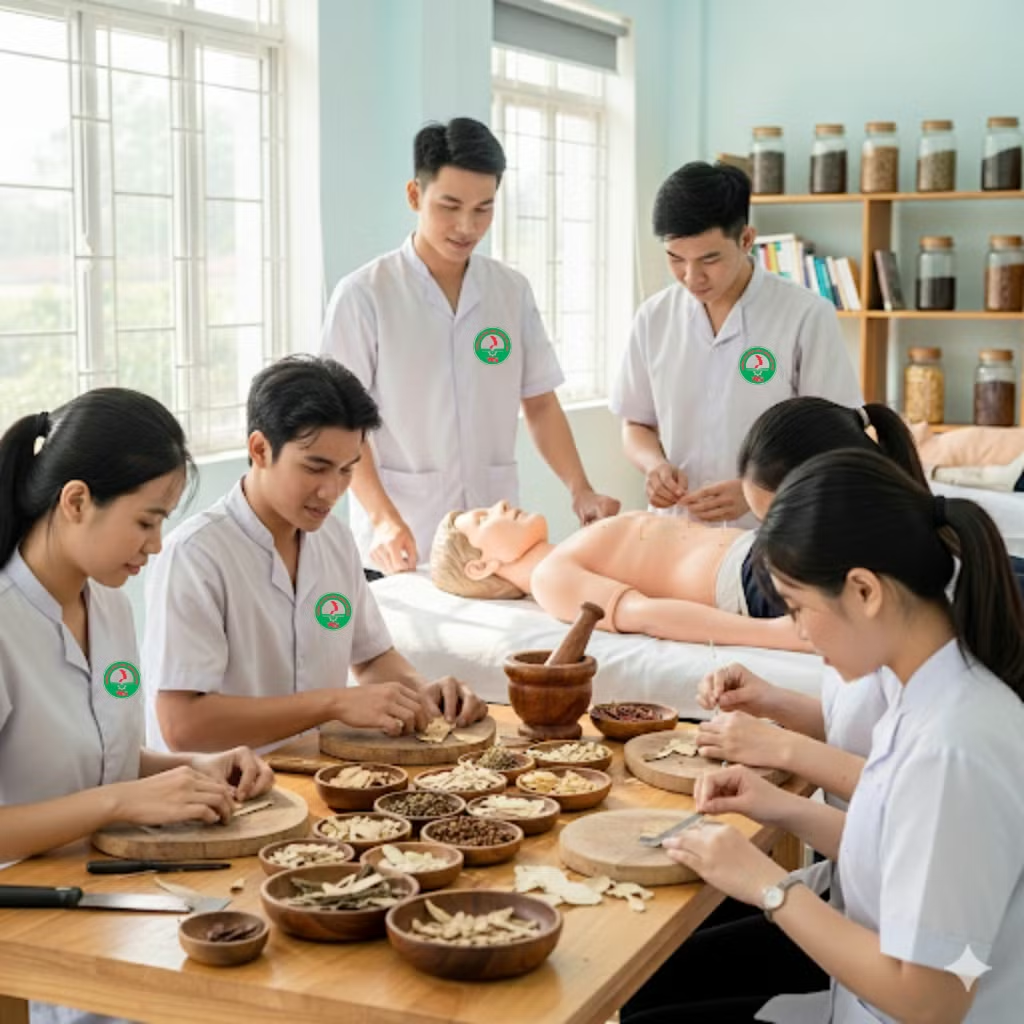
Recognizing the true characteristics of Traditional Chinese Medicine is therefore not a matter of designation. It's an institutional issue.
If the understanding is correct, the policy will be correct. If the policy is correct, the governance will be correct. If the governance is correct, resources will be unleashed. Conversely, if the understanding is wrong, Traditional Medicine may be managed with inappropriate standards, leading to hindered development, impoverishing the heritage, and preventing people from fully benefiting from the nation's wealth of knowledge.
Traditional Vietnamese medicine (TCM) is very different from medicine based on single-ingredient chemical drugs. A traditional prescription is not simply a mechanical addition of individual ingredients. In other words, the effectiveness of a prescription often lies in its systemic nature. When combined and heated, the ingredients interact to create a new complex that enhances efficacy, reduces toxicity, guides the medicine into the meridians, corrects imbalances, and restores balance. If only individual active ingredients are evaluated, the full value of the prescription and the resulting complex may not be appreciated. If only proof is required according to the model of chemical drugs, many valuable experiences, despite their long history of use and practical effectiveness, will not be able to pass the modern regulatory requirements.
This does not mean that Traditional Chinese Medicine (TCM) is separate from science . On the contrary, the more specialized it is, the more it needs appropriate science. For TCM, science is not necessarily just about finding a single molecule, but also about standardizing medicinal materials, researching compounds, testing safety, toxicity, heavy metals, microorganisms, chemical residues, standardizing manufacturing processes, monitoring adverse reactions, evaluating clinical efficacy, collecting real-world data, researching symptom improvement, quality of life, recovery potential, and treatment costs.
Traditional medicine needs science, but it must be science that correctly understands its target audience. The management of traditional medicine needs to be strict, but it must be management that understands its true nature. Specialization does not mean laxity. Specialization means smarter, more practical, more humane, and more effective management.
Currently, Traditional Chinese Medicine (TCM) faces many paradoxes such as a shortage of standardized medicinal materials, an incomplete mechanism for protecting the confidentiality of traditional remedies, limited support policies for long-established pharmacies, and a lack of interdisciplinary standards for health tourism . Furthermore, regulations regarding medicines, health supplements, herbal cosmetics, and healthcare services remain unclear. These obstacles necessitate a new institutional mindset, viewing TCM as a unique, interdisciplinary field deeply rooted in national culture.
First and foremost, it is necessary to clearly establish the position of Traditional Chinese Medicine (TCM) within the national healthcare system. TCM is not a supplement to modern medicine, nor is it a marginal service. It is an important component of Vietnam's healthcare system, especially in primary healthcare, disease prevention, chronic disease treatment, rehabilitation, health maintenance, elderly care, mental health, and improving quality of life.
Secondly, a sufficiently strong governing body is needed for Traditional Chinese Medicine (TCM). A sector with a history spanning thousands of years, linked to public health, medicinal herbs, culture, tourism, rural livelihoods, indigenous knowledge, and national soft power, cannot be managed merely as a small technical area. A competent institution is needed to advise on policies, develop laws, coordinate inter-sectoral efforts, develop data and standards, provide training, conduct research, and facilitate international integration.
Thirdly, it is necessary to develop a system of standards suitable to the specific characteristics of Traditional Chinese Medicine, including standards for: medicinal herbs, preparation, prescriptions, practice, medical examination and treatment facilities, healthcare services, healing tourism, and communication.
Fourth, it is necessary to build a national database on Vietnamese Traditional Medicine as a data repository on medicinal plants, remedies, renowned physicians, family-run pharmacies, medicinal herb villages, the experiences of 54 ethnic groups, growing regions, clinical research, products, services, adverse reactions, effective treatment models, and medical cultural heritage. Without digitizing the knowledge of Traditional Medicine, we may gradually lose this valuable knowledge while still being proud of it.
Fifth, and very importantly, there is a need for a mechanism to protect traditional remedies and indigenous knowledge. Many valuable remedies are held within families, clans, ethnic communities, and long-established pharmacies. If formulas are forced to be made public, the knowledge holders may lose their secrets. If they are not made public, they will be difficult to gain recognition. Therefore, a mechanism for confidential archiving, safety and efficacy assessment according to appropriate procedures, formula confidentiality, establishment of ownership rights, benefit sharing, and protection of knowledge from misappropriation is necessary.
Sixth, it is necessary to design a "standardization roadmap" mechanism for natural medicinal herbs, folk remedies, and indigenous experiences. We cannot immediately eliminate medicinal plants that have been used by communities for a long time simply because of a lack of documentation. However, we also cannot allow the market to be chaotic, lacking traceability and testing. The solution is to stratify management: a list of folk medicinal herbs by region, an appropriate traceability mechanism in the initial stage, mandatory safety testing for commercial products, and a gradual development of cultivation areas, documentation, standards, and a complete value chain.
Seventh, it is necessary to retrain the Traditional Chinese Medicine (TCM) workforce in an integrated manner. The new generation of TCM practitioners must be proficient in classical studies, understand modern practices, know how to use technology, conduct research, ensure patient safety, and collaborate with modern medicine. TCM cannot develop in the 21st century with a closed mindset. However, modernization cannot be achieved by losing its roots.
In short, Vietnamese Traditional Medicine must walk on two legs: science and cultural heritage. The "leg" of science makes Traditional Medicine safer, more transparent, more data-driven, more integrative, and more trustworthy in modern society. The "leg" of cultural heritage prevents Traditional Medicine from being reduced to a soulless commercial product; it preserves the ethics of the physician, Vietnamese identity, folk knowledge, the experiences of the 54 ethnic groups, traditional herbal medicine, a natural lifestyle, and a spirit of compassion.
Only when both "legs" are firm can Vietnamese Traditional Medicine enter the new era with dignity, confidence, and creativity.
The directive from General Secretary and President To Lam: Bringing Traditional Vietnamese Medicine back to the community therefore needs to be understood more deeply as restoring an entire medical system to its rightful place in national life. It's not just about bringing a few techniques to the grassroots level. It's not just about planting a few more medicinal herb gardens. It's not just about opening a few more health and wellness classes. Rather, it's about building a Vietnamese Traditional Medicine system that can care for the people from home to hospital, from disease prevention to rehabilitation, from medicinal herbs to health tourism, from indigenous knowledge to modern technology.
By recognizing its unique characteristics, we will no longer put Traditional Chinese Medicine (TCM) in a position where it has to prove itself with ill-fitting clothes. Instead, we will give TCM a suitable development framework: one with standards, laws, data, research, protection, a market, culture, and responsibility to the community.
That is the key to ensuring that Vietnamese Traditional Medicine is not only preserved but also revived. And when Traditional Medicine is revived properly, the first beneficiaries are the people.
Source: https://tienphong.vn/cong-nhan-dung-dac-thu-de-y-hoc-co-truyen-viet-nam-but-pha-post1846373.tpo





















































Comment (0)