

Through the adventures of fish and the effort to construct an entire aquatic worldview with aspirations for exploration and a new form of thinking and discourse.
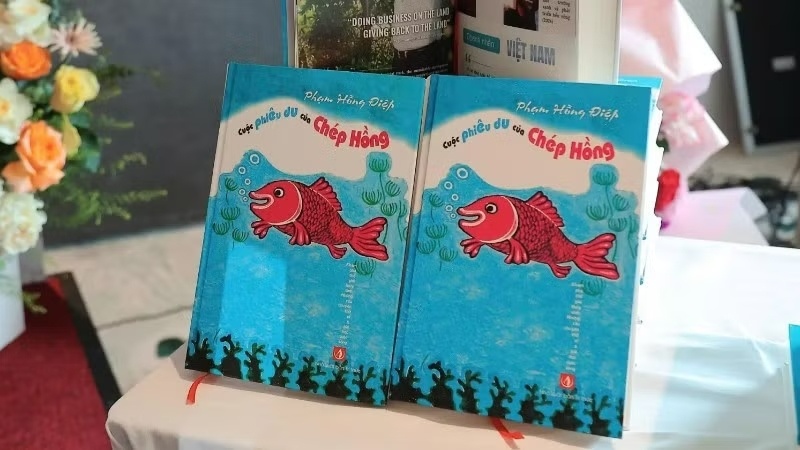 |
The children's book "The Adventures of the Pink Carp" is a meaningful gift for International Children's Day on June 1st. |
Literary critic Bui Viet Thang, in his introduction to *The Adventures of the Red Carp* , calls the book "a discourse on water." This is almost a crucial key to understanding the artistic whole of the work. In * The Adventures of the Red Carp* , water becomes the dynamic structure of the network of life. Every living thing must learn to flow, transform, and escape like water. From the Crocodile Pond to the floating ditch, from the rice paddies to the brackish water areas, from the mangrove forest to the swirling dragon transformation at the end of the work, the entire journey of the Red Carp is essentially a journey of learning the fluid nature of existence. Water is the living environment, synonymous with movement, adaptation, self-positioning, and constant self-restructuring.
In *The Adventures of the Red Carp* , water carries memories of shared living, cultural memories, and the unease of the increasingly conflicting relationship between humans and nature. Therefore, while the book is certainly written for children, it is also written for adults, especially as we live in an era of climate change, saltwater intrusion, pollution, and the growing rift between humanity and its own biosphere.
One of the issues frequently raised today is that children's literature often imposes an adult perspective, and children are merely recipients of truth, not truly experiencing life through their own innocent and honest eyes. The Adventures of the Red Carp consciously breaks away from this approach. The reality in the story is largely viewed from the "internal point of view" of the aquatic creatures. Fears, intuition, premonitions, survival experiences, changes in the aquatic environment… are all perceived by this very community. The book attempts to place humans in a position where they must "aquatize" their perspective. Humans are no longer the supreme subjects observing nature from afar, but merely one organism within the vast interconnected network of life.
From the outset, *Chép Hồng* (Red Carp) is placed in a setting that is anything but… fairytale-like. The Carp Pond, though vast, is still a place where fish compete for survival. The author doesn't just present the protagonist with a straight, flower-strewn path, a purely dreamy kingdom, but also places it in challenging situations, in the spirit of "fire tests gold, hardship tests strength." This is what gives the work its contemporary feel.
The book doesn't lull children into a world of absolute safety and goodness. On the contrary, the aquatic life here operates on a mechanism quite close to the gentle spirit of Darwinism: to survive, one must know how to regulate oneself; to thrive, one must learn to read environmental signals, and must know how to move, form alliances, and adapt.
The valuable lessons that Chép Hồng gradually learned after many journeys touched upon a philosophy of survival for the era. However, the work did not turn such a philosophy into rigid dogmas.
 |
Author Pham Hong Diep (left) at the book launch in Hanoi with writer Hoang Du. |
The knowledge gained in The Red Carp's Adventures is largely acquired through experience. Each body of water the Red Carp travels through corresponds to a different life lesson. The Croaker Lake is a space of primal survival competition; the floating ditch teaches the fish how to adapt to fluctuating currents; the brackish water opens up experiences of living in the intermingling of saltwater and freshwater; and the mangrove forest is a school of collective shelter. Within this structure of its adventures, the Red Carp is not "taught" in an imposed way, but learns through its interactions with life.
Here, the adult subject remains present as an underlying organizing force behind the adventures of the Red Carp. Many passages still have a rather concluding tone; many lessons are stated somewhat formally, and at times the senior characters, such as Uncle Catfish and Uncle Snakehead, still resemble sociological "mentors" more than natural beings.
However, perhaps this isn't necessarily a drawback of the work. Because, as mentioned, *The Adventures of the Pink Carp* doesn't aim to be purely children's literature. It also aspires to be a form of "philosophical fable," where the adventure story is used to convey reflections, questions, and dialogues about community, ecology, and future development.
Characters like Uncle Catfish and Uncle Barracuda not only act as guides but also serve as repositories of riverine memories, where survival experiences are passed down through generations. Therefore, the aquatic world in the work doesn't exist as a whimsical children's stage, but operates as a community with its own foundation, history, memory, and rules of existence.
The entire aquatic world depicted in the work is essentially a microcosm of society: there is competition, alliances, migration, the transmission of experience, and a life-or-death struggle against danger. Modern humans are becoming a source of intense trauma to the rich and harmonious natural ecosystem.
Beneath the adventures of the Red Carp lies a subtle, yet distinct, sense of ecological unease. The aquatic landscape in the work is both inclusive and perilous; every habitat is vulnerable to the changing world and the illusion of humanity's power to conquer and transform.
But if it only focused on the theme of survival, the book would easily become dry and cold. What keeps *The Adventures of the Red Carp* with the gentle feel of a fairy tale is the spirit of symbiosis that runs throughout the work. The Red Carp matures not through solitary individual strength, but through an awareness of resonance and teamwork (like a bird's nest with "dry straws tightly bound together, seemingly fragile at first glance but strong and durable"), of mutual support, especially supporting the weak, so that when they go far, they go together, and no one is left behind.
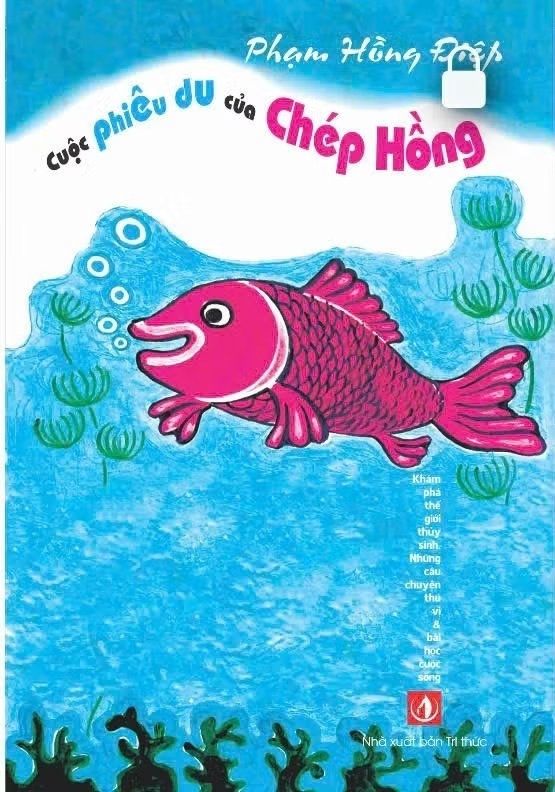 |
The children's book "The Adventures of the Pink Carp". |
On a broader level, this is also the very East Asian philosophy of "harmonizing with nature": the self does not separate itself from the collective; it does not seize power, but harmonizes with its surroundings.
Interestingly, while contemporary studies such as "hydrophysiology" are beginning to view water as a construct of identity and thought, Vietnam's rice-farming civilization had already lived by that model from a very early stage.
The work subtly hints at the characteristics of an "epic of water history" about Vietnam's rice-farming civilization. The entire setting of the work—Ca Cheo Lake, rice paddies, canals, brackish water areas, mangrove forests—strongly evokes the structure of alluvial civilization and riverine civilization.
The Red Carp doesn't just swim in water ("from gentle rice paddies to large rivers and then to the vast ocean"); it swims in Vietnamese cultural memory - a culture that researcher Tran Dinh Huou equates as "water culture": flexible, adaptable, and responsive.
In that sense, "The Adventures of the Red Carp" is an aquatic adventure, and at the same time a rather typical metaphor for the Vietnamese people's survival intelligence: not confronting all changes directly, but learning to flow through them like water. Adaptation in the work does not have a compromising connotation, but is a cultural capacity forged by the long history of river life.
The book, therefore, is no longer the journey of a single individual, but becomes the process of an entire community of living beings adapting and tolerant, ready to coexist and engage in dialogue with a "different world".
If "crossing the dragon gate" is a classic symbol of the aspiration to transform into a dragon, of the myth of personal ascension, then the "dream of crossing the dike" in *The Adventures of the Red Carp* carries a metaphor for a spirit of upward striving, of a contemporary era, not merely overcoming geographical limitations but a "leap forward" of a rice-farming civilization: breaking free from safe havens… to be ready to face the vast ocean and its turbulent waves, to know oneself and others, and to discover new horizons and possibilities.
This image is highly symbolic. It transforms the Red Carp from a naive, playful fish in a fairy tale into a symbol of a nation learning to venture out into the world in a new era, while still carrying the memories of its riverine civilization and the principles of communal living. Therefore, "breaking the dike" is essentially the inevitable result of a long history of accumulated survival experience and a yearning for foresight, silently prepared so that internal strength becomes the driving force for progress.
Life is fragile, yet boundless. Pham Hong Diep's "Red Carp" doesn't let the allure of novelty overshadow opportunities in the familiar and comforting present. After his travels across the seas, Red Carp understands: "It turns out the lake I live in holds so many fascinating things yet to be discovered." This simple statement carries a profound belief: travel is not opposed to staying; expansion does not negate deepening; liberation does not mean severing one's identity; encountering the ocean does not mean feeling insignificant.
Behind the story of Chép Hồng, a rather unique authorial image emerges: not the romanticized writer of nature, but rather a subject with a constructive and managerial mindset. Therefore, even when writing fables, Phạm Hồng Điệp views life as a dynamic, coexisting space: where all living things must learn to balance competition and cooperation, development and preservation, the aspiration to go far and the need to maintain their roots. It feels as though Phạm Hồng Điệp doesn't write about water as a descriptive object, but rather with the very mindset of water: soft yet resilient, dispersed yet interconnected. Thus, the fables here are both soft and structurally sound. Chép Hồng's journey reflects the mechanisms of economic, social, market, and even post-industrial life today.
Perhaps the most valuable aspect of the Red Carp's journey lies not in its dream of transforming into a dragon, but in learning the wisdom of water: knowing how to adapt without losing its essence; knowing how to change course while remaining connected. Perhaps the true meaning and message of "The Red Carp's Journey" lies there: not in teaching children how to win, but in teaching humanity how to live in harmony with the world.
Source: https://znews.vn/cuoc-phieu-du-cua-chep-hong-post1653427.html
![[Image] Close-up view of the interchange connecting the two expressways and Long Thanh Airport.](https://vphoto.vietnam.vn/thumb/1200x675/vietnam/resource/IMAGE/2026/05/25/1779703378210_ndo_br_z7863716673926-224453a31600126cce10622af6290afd-4549-jpg.webp)
![[Image] Hanoi's urban life under the challenge of a "scorching hot" environment](https://vphoto.vietnam.vn/thumb/1200x675/vietnam/resource/IMAGE/2026/05/25/1779706979265_nang-nong-t5-2026-minh-duy-7-4636-jpg.webp)
























































































Comment (0)